SHOWBIZ> Hot Pot Column

|
SHOWBIZ> Hot Pot Column
|
|
My troubles with making cents of Chinese currency
By Annette Fuller (China Daily)
Updated: 2009-10-13 11:28 In my home country of the United States, I swipe for the things that I buy. Debit and credit cards are standard in the US, and before coming here, I was a bonafide member of the cashless society.
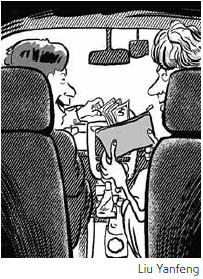
So here I am in Beijing, trying to get used to a thick wallet of cash, instead of a thin wallet with a couple of plastic cards. My wallet is not set up for cash. Back home, I bought a nice leather wallet that only has slots for credit cards, and no place for paper money, and certainly no compartment for coins. The smaller Chinese paper money was confusing to me at first. Why does the number "1" appear on two different pieces of paper money? Yes, one is printed on a bigger piece of paper, but still why isn't there a decimal point in front of the number on the smaller bills? When I first got here three months ago, in one of my first nervous excursions in a taxi by myself, I had to pay a fare of 15 yuan. I tried to give the taxi driver three of the small 5 bills. The driver unleashed a string of very polite but adamant refusals in Mandarin of my attempt to give him three 5-jiao notes instead of three 5-yuan notes. He finally motioned to my wallet, I turned it over to him, and he took the money out himself. I left the taxi, knowing that I surely had just done another stupid thing. As I fumbled around with the yuan currency during my first days here, more than once, a clerk at the cash register actually reached into my wallet and counted them out for me. I accepted these gestures, red-faced and embarrassed, but grateful. I have tried to download a money conversion program into my brain, but it only works about half the time. "How much would this cost in dollars?" is a perpetual question I ask myself. I find most items are much cheaper here. I found a nicely tailored part silk, part wool jacket for 90 yuan - which is less than $15. In the US, this would have easily cost $100. A package of chicken breast strips at the market costs about 3 yuan, which is less than 50 US cents. The same thing would have been $3 or $4 back home. I guess we have uppity chickens in the US. I have since opened a bank account here, and have a debit card that links to my Chinese money. But I also still use my American Visa card on occasion.
Using this card has been a hit-and-miss proposition. Some store clerks have swiped it about 10 times, looking confused, before handing it back to me with a Mandarin, "I'm sorry". Other stores have the capability of handling the international Visa cards, and the transaction goes without a hitch. In the US, I used a credit card for everything - even small purchases like a cheeseburger at a fast-food restaurant. On the credit card website, I track all my expenses and input them into my laptop's Microsoft Money program. This allows me to put every expenditure into a category, like "eating out" or "mobile phone", so I can keep track of what I am spending. But when I pay cash in China, I am just lost. I look in my wallet at the dwindling number of yuan, and mutter to myself: "What on earth did I buy?" The cash receipts (if I was even given one at all) are in Mandarin, which I don't understand. My short-term cash memory seems to be seriously impaired. By nightfall, I can't remember where I ate lunch, or what I bought at the Wu-Mart that morning. It's harder to scold yourself about spending too much cash when you can't remember where that cash went. |
主站蜘蛛池模板: 宁波市| 邢台市| 桐乡市| 长乐市| 曲麻莱县| 洪洞县| 嘉兴市| 油尖旺区| 合山市| 延吉市| 苍南县| 隆安县| 彝良县| 斗六市| 宁津县| 遂川县| 邢台县| 嘉义县| 安阳县| 肥乡县| 溧阳市| 永平县| 库伦旗| 泗水县| 隆昌县| 当雄县| 康定县| 肇庆市| 始兴县| 忻城县| 盐山县| 德兴市| 大城县| 七台河市| 昆山市| 白水县| 重庆市| 永修县| 仲巴县| 安多县| 荃湾区| 兴安盟| 丽水市| 乳山市| 原平市| 曲周县| 绿春县| 七台河市| 阜平县| 尼玛县| 抚松县| 长子县| 老河口市| 米脂县| 鄂尔多斯市| 阜平县| 平邑县| 炉霍县| 黔江区| 邵东县| 高唐县| 株洲县| 湖南省| 三门峡市| 耒阳市| 二连浩特市| 南雄市| 黑河市| 郁南县| 离岛区| 墨竹工卡县| 修文县| 民丰县| 章丘市| 陇南市| 神池县| 太仆寺旗| 公主岭市| 育儿| 太白县| 上杭县| 巴彦淖尔市|