Place to Go
The Ming Tombs (Shisanling)
(china.org.cn)
Updated: 2009-09-23 10:20
Although Beijing has been the capital of China for five dynasties, the only imperial mausoleums in the immediate vicinity of the city today are those of the Liao and Qing emperors are in the northeast China and in Hebei Province respectively. The tombs from the Jin Dynasty were destroyed at the end of the Ming Dynasty, and since the Mongol rulers of the Yuan Dynasty had no specific funeral rituals, there are no extant burial sites from this period.
The Ming tombs lie in a broad valley to the south of Tianshou (Longevity of Heaven) Mountain in Changping County, about 50 kilometers northwest of Beijing proper. To the southwest of this valley, a branch of the Yanshan Range suddenly to breaks off and forms a natural gateway to the 40-quare-kilometer basin in which the tombs were built. This gateway is "defended" on each side by the Dragon and Tiger hills, which are said to protect this sacred area from winds carrying evil influences. Thirteen out of the 16 Ming emperors are buried in this peaceful valley.
Visitors first pass by an elegant, five-arched white marble memorial archway. Built in 1540, this 29-meter-wide and 14-meter-high structure, with its delicate bas-relief carvings of lions, dragons and lotuses, is still in near-perfect condition. About one kilometer to the northeast of this archway stands the Great Red Gate (Dahongmen), the outermost gate of the entire mortuary complex.
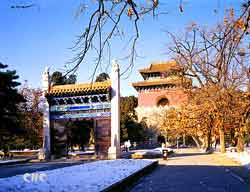
The Great Red Gate marks the beginning of the 7-kilometer-long Sacred Way (Shendao), which leads to the entrance of the Changling, the tomb of Emperor Yongle (reigned 1403-1424). Continuing on, one comes to a tall square stela pavilion, with four tall white stone ornamental columns (huabiao) set at each of its four corners, standing boldly in the center of the Sacred Way. The pavilion houses a huge stone tortoise by the famous Avenue of the Animals, where pairs of lions, elephants, camels. Horses and a number of mythological beasts line the road. There are 24 stone creatures in all. These beasts are followed in turn by a group of 12 stone human figures, which represent the funeral cortege of the deceased emperors. Carved in 1540, this group is made up of military, civil and meritorious officials. Immediately beyond these human figures are the Dragon and Phoenix Gate (Longfengmen), which are pierced with three archways.
Continuing north to the Changling, the Sacred Way passes over a river via two bridges of five and seven arches respectively. From here, all 13 tombs can be seen; the foothills and groves of trees dotted with golden yellow roofs stretch for 19 kilometers across this sacred valley.
Compared to the other 12 tombs the Changling is the largest and best preserved. Built on a south-facing slope, the Changling‘ s three courtyards are entirely surrounded by walls. The first courtyard extends from the massive three-arched entrance gate to the Gate of Eminent Favor (Long‘ enmen); on the east of this courtyard stands a pavilion, which contains a stone tablet, a stone camel and a stone dragon. Inside the second courtyard stands the Hall of Eminent Favor. The central portion of the stairway, which leads up to this great hall is carved with designs of sea beats and dragons. To the east and west of the hall stand two ritual stoves where bolts of silk and inscribed scrolls were set aflame as offerings to the emperor‘s ancestors. The dimensions of the Hall of Eminent Favor (67 x 29 meters) closely match the dimensions of the Hall of Supreme Harmony (Taihedian) in the Forbidden City, which makes it one of the largest wooden buildings in China. Four giant wooden columns and 28 smaller pillars support this structure, The four large columns are 14.3 meters high and 1.17 meters in diameter, and are extraordinary for the fact that they are each a single trunk of Phoebe nanmu.