Place to Go
The Palace Museum
(china.org.cn)
Updated: 2009-09-23 10:27
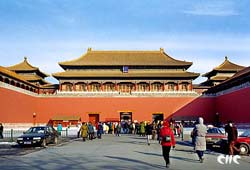
The Palace Museum, former home to the Ming and Qing emperors, is also known as the Forbidden City (Zijincheng).
There are four entrance gates: the Meridian Gate (Wumen) to the south, the Gate of Divine Prowess (Shenwumen) to the north, the Eastern Flowery Gate (Donghuamen) to the east and the Western Flowery Gate (Xihuamen) to the west. The largest and best preserved group of ancient buildings in China today, its more than 9,000 rooms cover some 150,000 square meters. A 10-meter-high wall and moat more than 52 meters wide run six kilometers around the perimeter.
A visit to the Palace Museum begins at the Meridian Gate (Wumen) in the south. Passage through the central opening was formerly restricted to the emperor whereas the two side openings served civil and military officials as well as imperial clansmen. An excursion to offer sacrifices at the Temple of Heaven or Altar of Earth was heralded at the gate by bells, which to the Imperial Ancestral Temple was announced by drums.
The Front Palace is reached through the Gate of Supreme Harmony (Taihemen). There a sea of flagstones covering more than 30,000 square meters is bounded on three sides by grand halls. Directly in front stands the Hall of Supreme Harmony (Taihedian). North of that, the Hall of Complete Harmony (Zhonghedian) and the Hall of Preserving Harmony (Baohedian). These "Three Great Halls"(Sandadian) dominate the Front Palace.
Only the most important ceremonies were held in the Hall of Supreme Harmony -- the enthronement of an emperor; celebration of the first day of the New Year, winter solstice; Spring Festival (from the first to the fifteenth of the first lunar month); the emperor‘s birthday, announcement of successful candidates in the imperial examinations and proclamation of imperial directives.
The imposing "Three Great Halls" are built up on broad terraces and decorated with carved pillars. The ornamental Dragon‘s head at the base of each pillar serves the practical purpose of water drainage. If you visit the palace on a rainy day you will witness the magnificent sight of 1,142 dragons on the three terraces simultaneously spurting rain water from their mouths.
Three flights of steps, the middle of which is decorated with slabs of exquisitely carved marble, connect the three terraces along the central Imperial Way. That to the north of the Hall of Preserving Harmony is the most spectacular of all. Large marble panels are framed with an order of flowers and ocean waves. In the center, a sea of curled clouds set off groups of nine (the imperial number) coiling dragons (the emperor‘ s personal symbol) rising from their midst. These stone carvings are considered to be some of the finest in China.
Construction of the Hall of Supreme Harmony was initiated in 1420 under Emperor Yongle of the Ming Dynasty. Emperor Kangxi of the Qing Dynasty rebuilt the extant structure in 1695. Thirty-five meters high, it is the tallest building in the entire palace complex. The golden lacquer ware throne, set between two golden pillars both decorated with dragons, sits directly at its heart. Above a mirrored sphere hangs from an umbrella-shaped niche filled with yet more golden dragons.
On veranda is a display of musical instruments: bronze bells and a set of jade musical stones. There are month organs, bamboo flutes, and a qin, a zither-like instrument without bridges. Whenever the emperor approached his throne, the bronze bells and the musical stones were sounded, creating in a wonderfully harmonious clatter that was known as shao music. Outside on the terrace, incense was burned in bronze tripods (ding) and cranes. Civil and military officials would kneel on the platform inside by rank. Though fragrant smoke no longer rises from the Hall of Supreme Harmony, everything remains as if the "Son of Heaven" had just departed.