Author of first book on 'One Belt, One Road' tells Europeans that initiative is open to all
Though many Europeans have shown lots of interest in China's recent economic and geopolitical initiatives, many are unclear as to what exactly they mean for Europe, according to the author of the first book focused on China's Belt and Road Initiative.
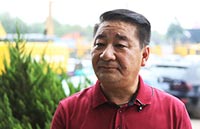
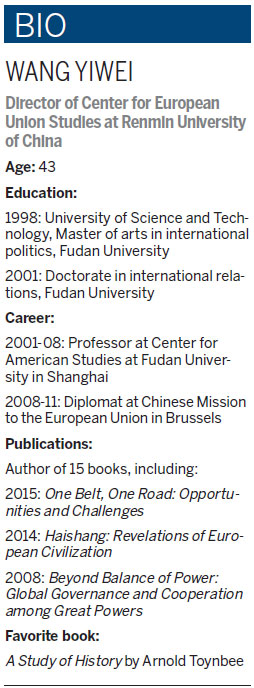
Wang Yiwei, 43, is a prolific writer and former Chinese diplomat in Brussels as well as an expert who can regularly be found brainstorming with Chinese ministries.
|
Wang Yiwei shows a sample of his new book given as a gift to the Madariaga College of Europe Foundation in Brussels. Liu Jia / For China Daily |
His new book, One Belt, One Road: Opportunities and Challenges, has pushed him to the center stage both at home and overseas.
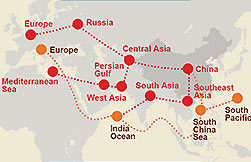
At a seminar organized by the Brussels-based think tank Madariaga at the College of Europe Foundation in April, he discussed reactions to the Belt and Road Initiative, which refers to the Silk Road Economic Belt and the 21st Century Maritime Silk Road initiatives, transport infrastructure projects linking Asia and Europe, launched by President Xi Jinping in 2013, which would use trade and investment to boost ties along ancient trade routes and elsewhere.
A related initiative is the China-led Asian Infrastructure Investment Bank, a multilateral development bank with 57 founding member nations from around the world.
Wang notes that some Brussels insiders had suspicion about China's geopolitical goals underlying strategic initiatives that would bring China and Europe much closer.
"Europeans have concerns on what is behind the plans. More or less, they suspect China of being another America," says Wang, referring to the Marshall Plan, the American initiative to aid Europe, in which the United States gave $13 billion (some $120 billion today) to help rebuild Europe after World War II.
The Soviet Union blocked Marshall Plan aid to Eastern Europe in part because it suspected US motives in rebuilding Western Europe, especially Germany, and criticized it as a tool for the US to impose its will on other nations.
"But China is not," Wang says of the comparison. "Neither the One Belt, One Road Initiative nor AIIB belongs only to China."
Wang's analysis in his book lays out why the initiative is new, innovative and different. "It is open and inclusive with no border," he says.
He also opposes tying it to a map. "Every country can be a part, including the United States."
Wang's book says the world will lift up China, and China will return the benefits to the world.
Through projects including a $40 billion (37 billion euros) Silk Road Fund, and the $100 billion AIIB now taking shape, he says China's role is to take the lead and convince the world it will work.
"China will also show the world how it can work by carrying out pilot projects."
According to studies by Bloomberg, the number of middle-class consumers in One Belt, One Road regions is estimated to hit 3 billion by 2050. And in the coming decade, the initiative could generate as much as $2.5 trillion in trade among 65 countries.
"It is similar to the philosophy of Chinese medicine. The mission of the initiative is to 'open joints', too, especially the key ones," he says.
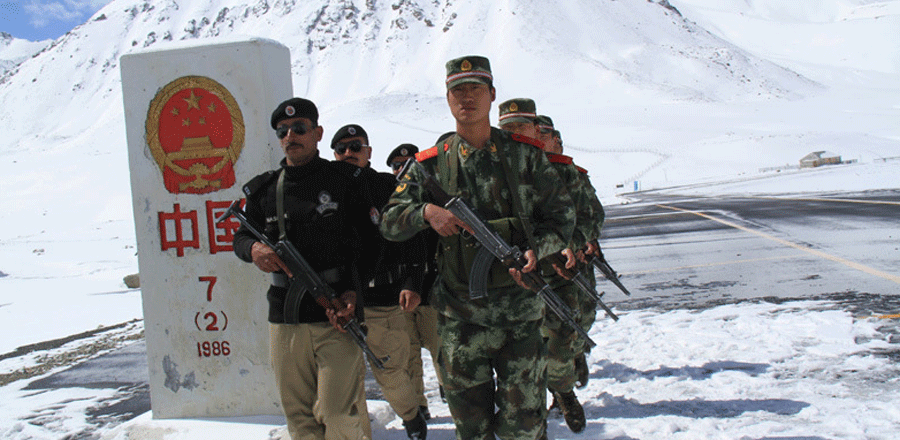
Pointing out recent agreements with Pakistan for energy and infrastructure projects worth $46 billion - a flagship project of One Belt, One Road - Wang says the initiative's aim is to boost economic growth and employment, especially in Eurasia.
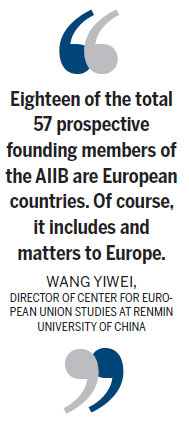
"Eighteen (including seventeen prospective founding members plus Hungary as ordinary member) of the total 57 member states of the AIIB are European countries. Of course, it includes and matters to Europe."
Wang says he thinks the European Union and China will discover a way to link the EU's investment plan with the initiative in the near future. He stresses that it would be beneficial for Europe to have a better, comprehensive understanding of the initiative beforehand.
He says European Commission President Jean-Claude Juncker's plan to inject 315 billion euros ($344 billion) into the EU economy over the next three years aims at stimulating growth and employment by leveraging the initial public investment.
"But there is still a funding gap in Europe. The initiative can bring new opportunities to Europe, including an inflow of foreign investment."
Wang says countries that were industrialized the earliest may be the most backward in infrastructure.
"In terms of infrastructure construction, China is able to provide technology, talent and management experience, too, besides capital, because of the country's recent industrialization."
Federica Mogherini, the EU high representative for foreign affairs and security policy and vice-president of the European Commission, says EU leaders would try to find synergy with the EU's infrastructure and connectivity policies in the coming EU-China Summit in June.
During a two-day visit to China in early May, Mogherini and Premier Li Keqiang discussed connections between the European Fund for Strategic Investment and the Belt and Road Initiative.
"I believe OBOR can spur an upgrade to the China-EU comprehensive strategic partnership," Wang says. "Juncker's investment plan is a European interconnection plan, and it needs to see beyond the European single market," he says, calling for a more open and ambitious European Union.
He says once linked by the initiative, the EU and China will enact a "five-way" connection in policy, trade, transportation, currency and people in greater Eurasia.
"Economic growth in Europe can be stimulated through two-way connections extending the EU single market into Eurasia.
"It will push forward China and Europe's four great partnerships - all-round collaboration in peace, growth, reform and civilization."
While there are potential difficulties and risks for Chinese companies as they expand beyond their national borders, Wang says he also sees great opportunities ahead.
"Not only will it benefit Europe, China's going-out strategy through the initiative will also push the country to further reform at home to be more competitive," Wang says.
"The AIIB will be lean, clean and green," Wang adds, quoting Jin Liqun, secretary-general of the bank. Wang says the principles of the AIIB will also work for implementation of the initiative.
When Wang was ready to write the latest of his 15 books, it didn't take him long. After a year of preparation, he started the book itself after a Silk Road seminar in the southern Chinese city of Quanzhou in February.
Thanks to plenty of firsthand knowledge collected in previous years, he was able to deliver the draft within only a few months.
"Apart from the original Chinese edition, there will be translated versions released soon in other languages, including English, French, Russian, Arabic and so on," says Wang.
For China Daily
(China Daily Africa Weekly 05/29/2015 page32)
Copyright 1995 - . All rights reserved. The content (including but not limited to text, photo, multimedia information, etc) published in this site belongs to China Daily Information Co (CDIC). Without written authorization from CDIC, such content shall not be republished or used in any form. Note: Browsers with 1024*768 or higher resolution are suggested for this site.
License for publishing multimedia online 0108263 Registration Number: 130349