PHOTO |
 China
World
Newsmaker
Slides
Weekly Photos
Share Your Photos
Special China
World
Newsmaker
Slides
Weekly Photos
Share Your Photos
Special
|
|
|
 |
|
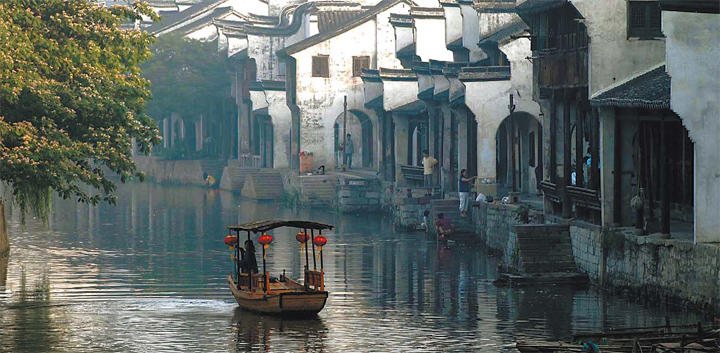
Streams flow through every old town in Zhejiang and Jiangsu provinces, determining the pulse of local life and making it look like a watercolor painted with a Chinese brush. [Photo/Song Jianhao] |
Raymond Zhou takes you on a tour of his typical 'south of the Yangtze' home-town of mulberry trees and paddy fields
While I was growing up, it never occurred to me that my hometown would someday be a source of endless fascination. One's hometown is something you take for granted until you set foot on a journey that will never take you home again - except for an occasional visit.
I grew up in a typical "Jiangnan" small town. "Jiangnan" means, literally, south of the Yangtze River, but in the purest sense of the word it refers to a swath of land in southern Jiangsu and northern Zhejiang provinces. It is bracketed by Suzhou and Hangzhou, the proverbial twin paradises on Earth.
The Grand Canal flows through it, forking into numerous branches and rivulets. Every town has at least one tributary. The one in Lianshi, my hometown, runs right off the canal, but nobody has bothered to give it a name. Instead, each section or bend is known by the bridge over it.
When I was a kid, dozens of boys would swim from one bridge pier to another. That may sound like fun. But if you knew the river also functioned as a kitchen sink and sewage for the town's 3,000 people, you might think twice before dipping your toes in the water.
By the time I was in high school, the river had turned so dirty few would go near it. In my memory, there was only one dredging effort. The last time I paddled in that river, I could wade through to the other side, but could not see inches from the surface.
Lianshi was essentially one street. I once timed it, walking from the west end to the east, where my high school sits. It took seven minutes. The street used to be paved with stone slabs, but much of it gave way to asphalt during my teenage years, along with most of the tile-roof houses.
I always envied those who lived on the riverside. They could fetch water with a pail right from their bedroom and keep the wooden floors so clean we could just lie on the floor to keep cool in the summer. And I was even more envious of those who lived on the boats; they could do their cooking on the stern. Little did I realize that these families were the poorest, somewhat like the gypsies of "Jiangnan", whose livelihood depended on the peripatetic and fast-vanishing trade of fishing.
Jiangnan is known for its prosperity, but only two crops are grown in this fertile land. One is shuidao, or rice. The summer harvest season used to be so hectic that townsfolk would help out the farmers. I helped with the planting and harvesting of rice while barely a teenager. The most terrible thing was having to deal with the leeches. Now, when I look back, this back-breaking work is something only an able-bodied youth can handle.
On dry land, we grew mostly mulberry trees. Mulberry fruits are small and crimson. Kids would go and pluck them. I don't remember people selling them; I guess there was little money in that. The really valuable part is the leaves, which are food for silk worms. Almost every two months, there would be a harvest and every household in rural areas would turn every conceivable space into a breeding ground for silk worms. I had to walk on a wooden plank to cross the living room.
Silk worms are voracious. A layer of leaves can disappear in minutes, leaving only the veins. The worms always seemed to make cocoons at night. When I woke up, they were gone; the adults would say they "have climbed up the mountain", referring to the "straw shaft" where worms eventually transform into cocoons. I would ask stupid questions, and the grown-ups would tell me a beautiful lie: "They flew away and turned into the clothes you wear."
It was not exactly a lie. It is ultimately turned into silk, which is the most enchanting fabric I know. It embodies the qualities of the place and the people - quietly refined and elegantly restrained. People from Jiangnan are not good at marketing or public speaking. They tend to be self-effacing and are endowed with a sense of modesty that goes against the current trend. But the place has produced a plethora of writers and entrepreneurs.
The colors in Jiangnan are subdued. Bright red is rarely seen except in a bridal gown. Jiangnan is like a watercolor painted with a Chinese brush. It does not mean to jump at you, nor does it aim to engulf you. It just brushes by like a breeze.
When I was little, the farthest place my mother envisioned I would reach was Shanghai. You see, Jiangnan people tend to eschew grand ambitions. But once outside it, I realized that living in Jiangnan was, in a sense, like living on a wooden boat.
It was comfortable but I would never truly inhabit it.