SPORTS> China

|
SPORTS> China
|
|
Infrastructure overhaul well ahead of schedule for Universiade 2011
By Zhan Ji (China Daily)
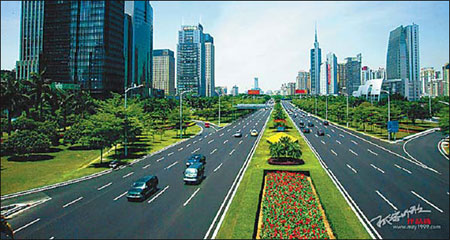
Updated: 2009-07-07 09:46 Faced with an inevitable mass influx of motor vehicles and would-be public transport passengers as the opening of the 2011 Universiade looms ever closer, Shenzhen has embarked on a fundamental overhaul of both its transport facilities and its highway infrastructure.
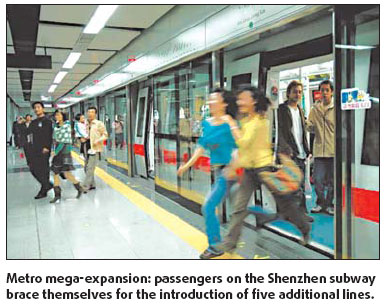
The five new metro lines will have a total combined length of 178.8 km and are set to come into operation well before the Universiade. Their collective capacity will see them handling up to 7 million passengers a day. This increased capacity marks a major upgrade for the city's metro network, which began operations in 2004 and currently only has 22.8 km of track in use.
"We are going all out to ensure that traffic in the city flows smoothly and efficiently throughout the duration of the games. We are committed to upgrading the traffic management to one that is comparable with any international city in the world."
According to 2008 statistics, the city already has a 5,273 km long road network, consisting of 319 km of expressways and 1,871 km of trunk roads. Huang said: "One of the three key channels to the sports center of the Universiade will even have 10 traffic lanes in both directions. This will be the first expressway of that width in China." The city is expected to handle an additional traffic burden of more than 16,000 athletes, referees and retinues, 10,000 media professionals, 3,000 sponsors, 3,000 officials and VIPs, as well as some 100,000 spectators daily during the 10-day event. Huang said: "This will definitely prove a major challenge to the traffic infrastructure, public traffic facilities and information processing capabilities of the public transport system. "This should prove to be the point when the ITS system comes into its own and makes a major contribution to our traffic handling facilities." Huang's optimism as to the role of the ITS system is shared by Zhang Siping, vice-mayor of Shenzhen: "We will increase our investment into the development of ITS and ensure that it is up and running well before the first athlete arrives in the city. "We are convinced the system will help the city alleviate the pressure of congestion, improve road safety and lower vehicle exhaust emissions. "The city's 30,000 passenger vehicles, including buses and taxis, will be continuously monitored and strategically deployed in line with our GPS and video surveillance system. All traffic information will also be conveniently accessible via mobile phones and the Internet." Liang Daoxing, vice-chairman of the executive board and director-general of the executive office of the Universiade Shenzhen 2011, believes the city's communications bureau could also improve the traffic service system in other ways. He said: "The traffic symbols and nameplates should be standardized in line with international practice. This should minimize the chance of overseas visitors losing their bearings in the city. "The city should learn from the experience of the Beijing Olympic Games and set up a team of high-quality traffic volunteers with the same mission." |