Brazil worried about stadium gentrification


 |
|
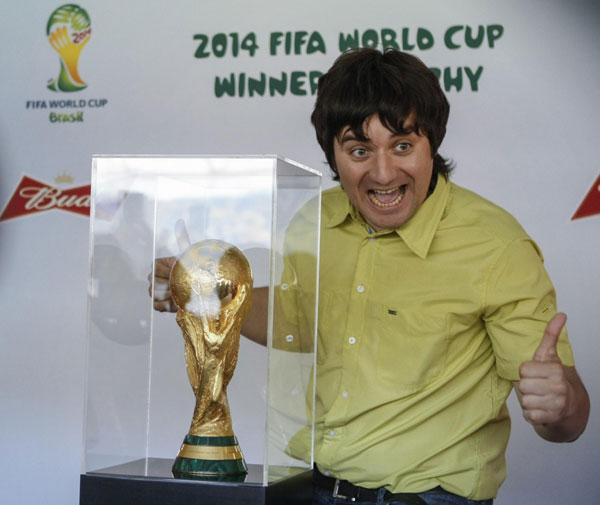
A man poses for a picture next to the 2014 World Cup soccer trophy during its presentation in Kiev April 18, 2013. The trophy is in Ukraine to promote the upcoming 2014 FIFA World Cup in Brazil, according to local media.[Photo/Agencies] |
The Brazilian government is worried ordinary fans could be priced out of the country's modernized stadiums in an unwanted legacy from hosting the 2014 World Cup.
Brazil is building two brand new stadiums and remodeling another 10 that will leave the country with a glut of all-seater, state-of-the-art arenas once next year's tournament is finished.
It will be a new experience for many Brazilian fans who for years have had to put up with dilapidated arenas, dubious catering and overflowing toilets.
The worry is that many of those who provided the throbbing atmosphere at top matches will no longer be able to afford to go to games as administrators look to gentrify the soccer-going public to increase income.
"To have socially exclusive stadiums as a result of the World Cup investments is not the legacy we want," deputy sports minister Luis Fernandes said.
"The government is very concerned with this issue and it has to be addressed very seriously. I think we could have a gentrification of the stadiums.
"Some stadium administrators are quite explicit in saying that, to be economically feasible, they would have to shift the type of attendance at games," he said.
"It would change from one where what predominates is the so-called D and E class, to one where there will be a heavy predominance of what they call class A and B spectators who will not only buy the tickets but will also consume in the stadium.
"But if you want to shift the social origin of the spectators so you can have people that can afford to buy other merchandise and food besides tickets, that could be a negative side effect."
Until recently, there has been almost nothing to buy inside Brazilian stadiums apart from rudimentary fast food and soft drinks. Supporters often prefer to buy counterfeit merchandise from unlicensed street vendors, known as camelos, in front of the stadium.
Central role
Nine of Brazil's 12 World Cup stadiums are owned by the governments of the respective states and will be handed over to private administrators who will hope to make money from selling merchandise inside.
"Football had and has a very central role in building national identity in Brazil," said Fernandes. "So we are very concerned with that aspect and will be dealing with it in terms of national and state legislation."
A similar phenomenon has already taken place in England, where stadiums have improved vastly over the past 20 years, but working-class fans have been priced out and replaced by middle-class ones.
However, while the shift in England, was built on the back of growing popularity for soccer, attendance at many Brazilian games is shrinking, with an average of 13,000 for last year's national championship first division.
Fans of Cruzeiro have already noticed the difference. Cheapest tickets for some of the team's matches have cost 60 Reais ($29.87) since the re-opening of Belo Horizonte's Mineirao stadium.
Meanwhile, cheapest tickets for the re-opened the Castelao stadium in Fortaleza cost 50 Reais for a double bill of matches in the local state championship, more than at many European first division clubs.
Fernandes pointed out soccer has such a strong influence in Brazil that memories of the 1950 tournament, which the country hosted but the team lost to Uruguay in the deciding match, were still dragged up.
"It has deep, historical roots," he said, explaining Brazilians suffered from what writer Nelson Rodrigues described as "the stray dog complex".
"Brazilians suffered an inferiority complex and when we lost that match against Uruguay, it reinforced that," he said. "We were the stray dogs and the others were the pedigrees.
"People felt condemned to be inferior. Football was the first area which inspired national pride ... where we thought Brazil can do it."