Comments
  Print
Print  Mail
Mail  Large Medium Small
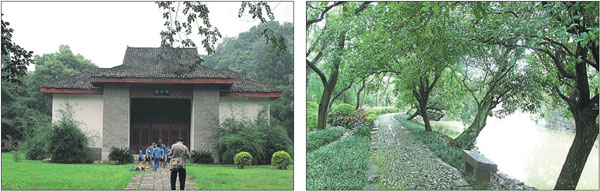
Yanshan Manor in Guilin, which once served as a shelter for scholars during World War II, remains a source of inspiration for philosophers, writers and artists.
The traditional manor, covering an area of 150,000 square meters, was built at the foot of Yanshan Mountain to its southwest by local official Tang Yue from 1869 to 1873 in the Qing Dynasty (1644-1911).
Following feng shui masters' suggestion, Tang constructed the manor along an open section of an underground stream, which flows into a deep pond in the north of the manor.
The stream is about 15 meters wide and 300 meters long. Its water is dark green and the water flow is stable throughout the year. Flourishing bamboos as well as osmanthus, maidenhair and banyan grow on the river banks, turning the manor into a sea of green, filling it with fragrance in blossom season.
|
Yanshan Manor, built during the 19th century, is popular among tourists and artists alike, with its unique architecture and landscape. Photos by Li Yang / China Daily |
A little hill on the east bank of the river provided Tang Yue with more options to plan his houses. He dug several small artificial ponds along the river and built at least five small gardens of different styles beside the ponds on both sides of the river.
It is said the delicate location of the Yanshan Mountain, which looks like a flying wild goose stretching its wings, and the stream, which is comparable to a dragon, can ensure constant prosperity for the manor's residents.
Tang was transferred to north China by the court a few years after the manor was built and died there in the late 1890s. His offspring sold the manor to the regional governor Cen Chunxuan in 1909.
The only legacy Cen left is a "dragon path" built with gravel along the stream, the hunched middle line of the path was marked with a row of neatly arranged gravel of similar sizes representing the backbone of a dragon. Cen believed walking on the path every day boded well for his promotion.
However, the Qing Dynasty was overthrown in 1911 and Cen left Guangxi with his family soon afterwards. Because of a lack of maintenance, most wooden buildings were destroyed by termites within a decade.
Cen gifted the deserted manor to the new provincial government hosted by local warlord Li Zongren in 1929, who rebuilt the manor without changing the layout designed by Tang Yue, replacing the old wooden buildings with solid brick buildings and small villas.
Guangxi Normal University was established in the manor in 1932 and merged into the Guangxi University in 1936, which was moved to the manor from neighboring Wuzhou city to dodge the invading Japanese.
With its open and free academic atmosphere, the university quickly attracted a large number of scholars, artists and writers on their way to Guilin from around China, such as philosophers Hu Shi and Liang Shuming, historian Chen Yinque, architects Liang Sicheng and Lin Huiyin, geologist Li Siguang, writers Ba Jin and Guo Moruo as well as painters Qi Baishi, Zhang Daqian and Xu Beihong.
Their short stay in Yanshan Manor, varying from one year to three years, came at the most difficult time in China's anti-Japanese war as well as their most productive periods.
They taught students and accomplished a large number of classic works during their stay in Yanshan Manor before moving to Yunnan together. Their perseverance in teaching and research during war inspired the whole nation and left a rich artistic and academic heritage.
The university moved to Guilin after the war. From the 1950s to the early 1980s, the manor was turned into a barracks. Thanks to military protection, most historical relics were not destroyed in the "cultural revolution" (1966-76).
Guangxi agricultural school was in charge of taking care of the manor until 2003 when businessman Peng Peng, with a doctorate in history, invested in it and opened it to the public as a tourist resort and a painting school for local painters.
Peng says: "Botanists regard the manor as a treasury of rare plants. Feng shui masters praised it as a treasure land. Architects marvel at its layout and buildings. Landscape painters find their home here."
Yang Min and Yang Huihong contributed to the story.
(China Daily 09/21/2013 page10)

 Guangzhou R&F, Chelsea open soccer school in S China
 Djokovic, Nadal, Murray shine on national duty
 Xinjiang scores on the national stage at last
 Brazil gets its kicks
 Guangdong defended men's basketball title at Games
 Li Na helps unveil wax figure in C China
 National Games: Pictures of the day
 National Games: Pictures of the day

Copyright 1995 - . All rights reserved. The content (including but not limited to text, photo, multimedia information, etc) published in this site belongs to China Daily Information Co (CDIC). Without written authorization from CDIC, such content shall not be republished or used in any form. Note: Browsers with 1024*768 or higher resolution are suggested for this site.
License for publishing multimedia online 0108263 Registration Number: 20100000002731