 |
|
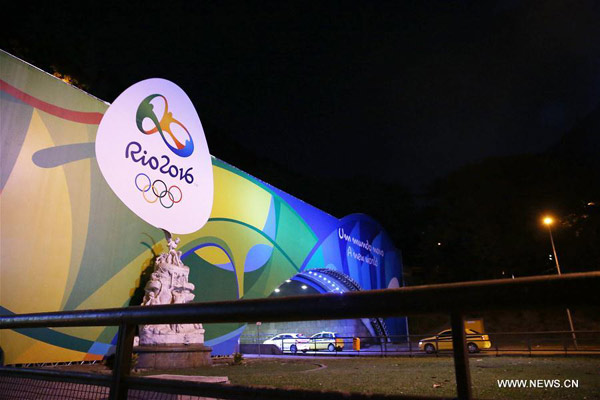
Photo taken on July 8, 2016 shows the "Tunel Novo" (the new tunnel), connecting Botafogo to Copacabana, decorated with Rio 2016 Games emblem and slogan in Rio de Janeiro, Brazil. [Photo/Xinhua] |
RIO DE JANEIRO - One of the main areas of concern for the International Olympic Committee (IOC) in choosing an Olympic host city is urban mobility, which will help visitors get around and become a legacy for residents.
Rio de Janeiro is thus undergoing a complete "revolution" with an overhaul of existing transportation options, as well as the construction of a new expressway and a new subway line.
Visitors and residents will be provided with a real range of options to get around the Olympic installations.
The majority of the Olympic and Paralympic events will happen in and around a number of major sites (Maracana, Engenhao, Copacabana, Barra de Tijuca, Deodoro), with individual events spread out across the city, while the Main Press Center, the International Broadcasting Center and the Olympic Village also need to be connected.
These areas are spread broadly across Rio de Janeiro and involve travelling long distances on winding roads, but all of them are integrated through a combination of different means of public transportation.
They will also all be linked by the Transolympic expressway, which opened on July 9, as well as the new subway line 4, which will open for business on August 1, just four days ahead of the Opening Ceremony on August 5.
When all these forms of public transport up and running, rapid bus lanes will be able to take visitors all the way from Barra de Tijuca across town to Deodoro on dedicated lanes.
Deodoro is also connected to Maracana by an existing railway line while a subway line links Maracana to Copacabana.
A combination of subway line 4 with the Transoeste bus lane will take people from Copacabana and Barra, while the Transcarioca bus lane will link Barra to Galeao, Rio's main international airport.
Galeao will be the main entry point for the over 600,000 visitors which are expected over the course of the Games. It has received an overhaul with a new expansion of 100,000 square meters, with 26 new gates, three of which can receive the largest passenger planes in the world.
Rio de Janeiro's creaking port area was also renovated in oder to reduce the flow of cars and buses in the center of the city and to allow tourists to visit Rio's museums, historical buildings and churches more easily.
A light rail, nicknamed VLT, has also opened to allow exploration of the city's port and surrounding areas, with 17 stops set to operate during the Games, from the Novo Rio bus terminal to the smaller Santos Dumont Airport.
Finally, visitors will also have access to an information and help network which will be present across all subway, railway and bus lines.

Copyright 1995 - . All rights reserved. The content (including but not limited to text, photo, multimedia information, etc) published in this site belongs to China Daily Information Co (CDIC). Without written authorization from CDIC, such content shall not be republished or used in any form. Note: Browsers with 1024*768 or higher resolution are suggested for this site.
License for publishing multimedia online 0108263 Registration Number: 130349