Electronic revolution in motion


 |
|
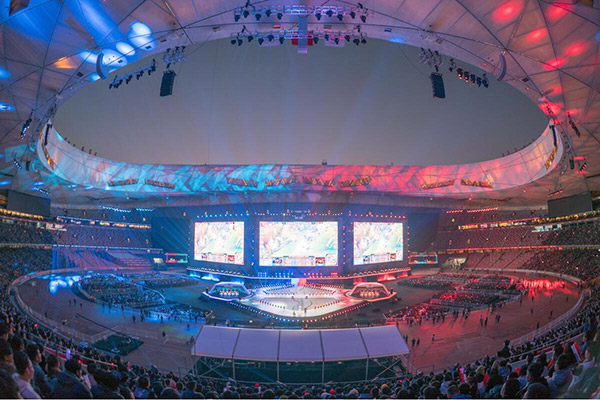
Around 40,000 gaming fans attended the 2017 League of Legends World Championship final between two South Korean teams at Beijing's Bird's Nest stadium on Nov 4. [Photo provided to China Daily] |
Lucrative competitive gaming sector taking China by storm
China is ushering in a golden era of e-sports, with industry revenue, prize money and viewership all skyrocketing to reshape the traditional sports entertainment landscape.
For those unfamiliar with the phenomenon, the ongoing playoff for the King Pro League's fall season provides a perfect snapshot of just how and why the gaming craze is sweeping the country.
The league, based on Tencent's role-play fantasy mobile game King of Glory, kicked off its eight-club playoff in late November, with arenas sold out for every matchup.
Hours before the Nov 26 clash between the defending champion QGhappy team and Shanghai-based club JC, a huge crowd queued outside the venue waiting for admittance.
Inside, fans were rewarded with an electric atmosphere and a slickly produced show, with jumbotrons, subwoofers and a high-tech lighting system creating an overall effect akin to a live NBA game.
Thanks to the popularity of King of Glory, which has attracted over 200 million registered users since its launch in 2015, the KPL has eclipsed some of its traditional sporting rivals in terms of viewership.
Its 2017 spring season was viewed over 2.68 billion times on streaming platforms, more than nine times the total viewership for the 2016 season of soccer's Chinese Super League.
Last month, Beijing's iconic Bird's Nest stadium witnessed hysteria levels not seen since the 2008 Olympics as 40,000 fans attended the final of the 2017 League of Legends World Championship, based on US developer Riot's hit multiplayer online battle arena game.
"The LPL's (League of Legends' professional competition) ascent to massive popularity, as evidenced by its online viewership of 2.7 billion for just the first half of this year, has heralded a new era for the sports entertainment business in China," said Mars Hou, a senior manager of Tencent Interactive Entertainment.
Years ago it would have been absurd to think that a videogame event could generate such interest levels and stir national pride, given the government's once-critical stance on gaming's influence on youth.
 |
|
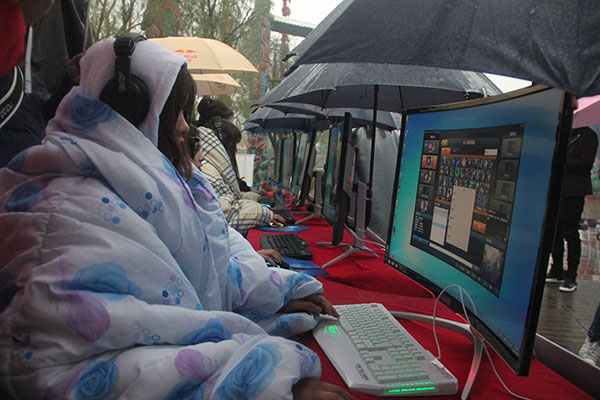
Students brave the cold and rain in Hangzhou during an online gaming competition in November last year. LIAN QUOQING/FOR CHINA DAILY |
"It's unimaginable that competitive video games could be developed into a serious business now with so many followers, with so much money at stake and with the government's approval," said Meng Yang, a retired League of Legends gamer who now works with Tencent's online development department.
According to the 2016 China Game Industry Report released by industry analyst Penguin Intelligence in June, the market value of China's e-sports sector reached 20 billion yuan (about $3 billion) generated by gamers' spending, copyright distribution, merchandizing and e-commerce.
Another industry consulting agency, iResearch, estimated that the figure will rise to nearly $7 billion by the end of this year, with the number of registered online gamers jumping to 220 million from 170 million last year.
To illustrate just how high the stakes are for competitors, the total prize purse for all e-sports tournaments in China last year was $51 million, according to market researcher Niko Partner. That's around 22 times the amount tennis star Li Na earned for winning the 2014 Australian Open.
Seal of approval
As China aims to develop an ambitious sports industry valued at 5 trillion yuan by 2025, the government and traditional sports bodies have embraced e-sports as a legitimate contributor to the sector.
During an October 2016 executive meeting of the State Council, China's cabinet, Premier Li Keqiang urged all relevant departments to work on preferential policies and to upgrade facilities to boost e-sports growth and consumption.
It was another significant pro-gaming step from the government after the General Administration of Sport of China recognized e-sports as the country's 99th athletic event in 2003 amid debates over whether it should be considered sport at all.
There is no debating the fact, though, that the traditional sporting world is taking notice of e-sports' rampant growth.
"E-sports has specific rules and time limits designed specifically for person-to-person intellectual competition, whereas playing online games is just a pastime for personal recreation," said Ding Dong, director of the information center at the GASC, the sport's governing body in China. "There is a clear distinction between the two."
The endorsements of top athletes are also adding to e-sports' kudos.
One of the keenest and most knowledgeable celebrities watching the action at the League of Legends World Championship was former short-track speed skater Wang Meng.
"The development of e-sports will go beyond a lot of people's imagination," said Wang, who won four gold medals at the 2006 and 2010 Winter Olympics, at the Bird's Nest.
"If you came here to experience the grand final, you will be overwhelmed by the passion of fans that is comparable to any other major sport."
In the past few years, government-funded e-sports towns have mushroomed across the country in lower-tier cities such as Kunshan, Jiangsu province, and Chengdu in Sichuan province, with the lucrative industry providing a big boost to local economies.
The government's push makes demographic sense, too. Tencent's Penguin report showed that 41 percent of e-sports fans live in second-tier cities, followed by 17 percent in third-tier centers.