|
|
 |
|
Latest News
On the Way Home
Festive China
Festival at Quake Zones
World Celebrations
Photo Gallery
Video
Slideshow
Year of Ox
Spring Festival Traditions
Festivals around China
You Nuo:
Housing prices choke spending  Chen Weihua:
Shanghai: All that glitters is not gold   Liu Shinan:
Holders should not pay for fake money  Brendan John Worrell:
The better angels of our nature  Preserving tradition in lean times
(China Daily)
Updated: 2009-01-19 16:40 He has almost stopped eating out since his annual income from a foreign-funded logistics company was cut by one-third last year amid the global financial crisis.
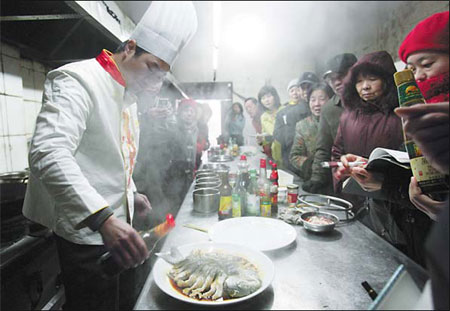
But Guangzhou resident Zeng Hongmin was not about to let his loved ones stay at home for what is arguably the most important meal of the year for Chinese at home and abroad. The white-collar worker tightened his belt and broke the news to his family - the seven of them would have their reunion dinner on the eve of the Lunar New Year at a restaurant, but only for 800 yuan ($117), less than a third of what they splurged on at the same hotel last year.
"I really hope to continue the family tradition and enjoy ourselves together," Zeng said. From individual families in cities and villages to small eateries and major restaurant chains preparing for a major dining season, Zeng is just one of the many Chinese nationwide finding ways to celebrate the start of the new year in these tough economic times. The reunion dinner on the eve of the Lunar New Year, which falls on Jan 25 this year, is a tradition dating back more than 2,000 years. The meal was also the most sumptuous one of the year for many Chinese, up until the country's economic boom started to be felt in modern times. Before the early 1990s when food rationing was discontinued, most Chinese gathered at home for the reunion dinner, with all members spending days on end around town to shop for raw ingredients. Many Chinese would be able to recall how the best cooks in their families would stay in the kitchen for hours preparing dishes that ran the gamut of local and regional dishes. But food production soon boomed along with the country's dramatic growth. Delicacies such as sea cucumber and yuanxiao sweet dumplings that were available only in markets during festivities three decades ago are now filling supermarket shelves year round. Chinese urbanites saddled with work have also been shying away from preparing home meals and opting instead for restaurants with exhaustive menus. Zeng Hongmin's family in Guangzhou has been eating reunion dinners in restaurants for the past 15 years, he said.
In the past few years, the catering industry has enjoyed booming business during the Spring Festival week, especially for its reunion dinner services. According to China's largest food website, www.21food.cn, in 2007, restaurants in 18 cities catered to some 600,000 tables, earning about 10 billion yuan in sales revenue. Last year, more than 160 restaurants in Shanghai served about 13,800 tables, charging an average of 1,699 yuan for each table, during the festive period, according to the Shanghai Economic Committee. Shanghai resident Sun Junhua has also reserved a table at a restaurant for her family of 12, spending about 3,000 yuan for the reunion dinner. Dining out during this time became routine for her family four years ago when they decided to avoid the hassle of cooking at home. "Eating out is worth the money, after all, it is a once-in-a-year occasion," Sun, 33, a senior manager in a foreign exhibition company, told China Daily. "In Shanghai, people celebrate many foreign festivals. But I think traditional Chinese festivals should be kept. In any case, Spring Festival is the most important of all Chinese festivals. It deserves to be a grand affair," she said. Still, the negative impact of the global economic slowdown has hurt diners and the restaurateurs alike, with many inevitably chosing to eat at home to save money. Shanghai housewife Wang Yuelian said she will cook this year's reunion dinner for her family of three to help cut down expenses. "I have to save money amid the economic slowdown," said Wang, whose family depends mostly on her husband's 5,000 yuan monthly salary in a State-owned company. Wang herself was laid off last October following the financial crisis and her 17-year-old daughter is still in high school. A recent survey conducted by Dianping.com, a popular restaurant review site, showed only 4 percent of the 1,800 respondents said they would choose expensive hotel restaurants to host their reunion dinners. Restaurants are beginning to feel the pinch. Many have reported huge drops in bookings by corporations and families. "We are not seeing as many reservations as in past years," said Zhang Jinfu, vice-secretary general of the China Hotel Association. Hotels and restaurants in Guangzhou and Shenzhen are reportedly hit harder than others in the country, with many offering special discounts to attract diners. The five-star Shangri-La Hotel in Guangzhou that used to charge a record 198,000 yuan for a 10-person family reunion dinner last year is now offering set meals valued at about 3,000 yuan each this year, local media reported.
 |
主站蜘蛛池模板: 天峨县| 洪洞县| 历史| 包头市| 克东县| 垣曲县| 浠水县| 南川市| 惠州市| 卢氏县| 西盟| 沾化县| 台中县| 贞丰县| 湖口县| 峨眉山市| 辽宁省| 吉木乃县| 达日县| 修文县| 赫章县| 仁化县| 鄂尔多斯市| 民丰县| 广宁县| 元氏县| 廉江市| 综艺| 宝应县| 合山市| 富裕县| 龙井市| 庆元县| 庆城县| 自治县| 陇南市| 湖南省| 永昌县| 惠州市| 民县| 日土县| 桐乡市| 古浪县| 繁昌县| 青阳县| 永春县| 赤壁市| 盐池县| 马公市| 陇南市| 板桥市| 凤庆县| 独山县| 盐津县| 乡宁县| 措勤县| 白城市| 乌兰县| 抚远县| 惠州市| 施秉县| 米泉市| 东乡县| 怀化市| 邛崃市| 兴安县| 九江市| 民和| 民丰县| 贵溪市| 廊坊市| 蓬莱市| 竹北市| 涟水县| 临邑县| 长子县| 军事| 浑源县| 尉犁县| 开阳县| 赣榆县| 孙吴县|