|
|
 |
|
Latest News
On the Way Home
Festive China
Festival at Quake Zones
World Celebrations
Photo Gallery
Video
Slideshow
Year of the Ox
Spring Festival Traditions
Festivals around China
Liu Shinan:
Going home: In pursuit of a better life  Hong Liang:
HK govt facilitator of economy  You Nuo:
Housing prices choke spending  Chen Weihua:
Shanghai: All that glitters is not gold   Sacred animal recalls Beijing's turbulent past
By Xiao Liu (China Daily)
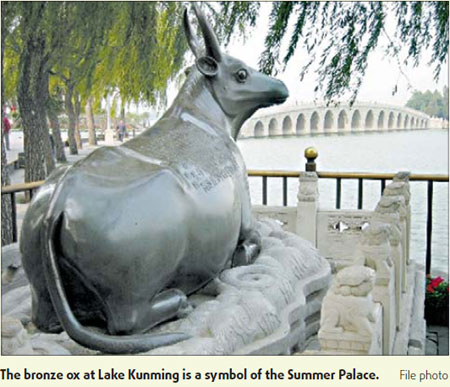
Updated: 2009-01-21 10:06 In Beijing's Summer Palace, a life-sized bronze ox lies on its belly on the eastern bank of Lake Kunming near the bridge with 17 arches. With both its ears pricked up, the elegant animal seems to be admiring the mountains and lake in the imperial garden.
As a symbol of the Summer Palace, the statue, known as the Golden Ox, has witnessed many memorable events. It was cast in 1755 on the order of Emperor Qianlong at the height of the Qing Dynasty (1644-1911). An inscription in the emperor's handwriting reads: "This sacred ox is made with gold to keep peace forever and bring good luck." In ancient China, people often called bronze "gold" but the nickname Golden Ox nearly brought it disaster. In 1900, when the Eight Allied Forces invaded Beijing, they looted most of the portable valuables in the Forbidden City and other imperial compounds before setting fire to the buildings. The prospect of getting a golden ox led the troops one dark night to the Summer Palace. Finding it impossible to move the ox even an inch, the soldiers decided to cut off its head instead. A soldier tried to deal the fatal blow with his bayonet but only left a slight mark on the animal's back, revealing bronze below the gilded surface. The disappointed looters left to seek other valuables. There are many explanations about why the bronze ox was placed by the lake. A popular story goes that the bronze ox was the Cowherd who married the Girl Weaver from the Western Heavens. They had two children and lived peacefully, until the Queen Mother of the Western Heavens separated them with the Milky Way. They reunite once every year on the night of Qixi (the 7th day of the 7th lunar month). Legends say the Milky Way is Lake Kunming and the Girl Weaver can be found at a scenic spot, called the Painting of Plowing and Weaving, opposite the ox across the lake. The site was burned down in 1860 by British and French troops, who also destroyed the imperial Yuanmingyuan and Qingyiyuan gardens. In 1888, Empress Dowager Cixi built the Summer Palace on the ruins of the Qingyiyuan. She built a wall on the western bank of the lake and kept the site of the fire outside the Summer Palace. Some people say she hated seeing the Cowherd find the Girl Weaver, in the same way that she tried to control Emperor Guangxu's marriage. During a Qixi festival, Cixi is said to have woken up after dreaming that the bronze ox leapt into the lake and swam toward the Girl Weaver. She immediately set out from the Forbidden City toward the Summer Palace to find the bronze ox still there. But she had the ox chained with a long, thick iron chain. The story goes on saying that the ox struggled so hard to get loose that it broke its tail. In 2004, the Painting of Plowing and Weaving was rebuilt at its original site. The legendary Cowherd and the Girl Weaver can now look at each other across the lake. There is another, more likely explanation. When China was plagued by rampant floods in ancient times, legendary leader Da Yu led people to fight the floods. He would cast a bronze ox and sink it into the river after diverting the floods. Chinese believe that oxen know water well and can control water demons. Later, people stopped putting statues of oxen on riverbanks. Two centuries ago, the Summer Palace was built on a network of rivers and lakes. In summer, heavy rain would easily lead to floods. The eastern dike of Kunming Lake is just 10 m higher than the Forbidden City, meaning that any serious flood could bring devastating results to the imperial palace. Every summer, special officials were dispatched to guard the bronze ox and check the water level. If the water got too near, the officials were under orders to immediately report to the Forbidden City, so measures could be taken in time. Still bearing the mark left by the bayonet, the bronze ox has been guarding the Summer Palace for 250 years. It is a national treasure testifying to a time when China was too weak to defend its own people.
 |
              |
主站蜘蛛池模板: 遂宁市| 定襄县| 乌恰县| 稻城县| 古交市| 嘉兴市| 成武县| 平塘县| 化隆| 保定市| 磴口县| 木里| 湖南省| 磐安县| 万盛区| 惠安县| 剑河县| 蒲城县| 萝北县| 海阳市| 正安县| 体育| 迁西县| 盐池县| 屏山县| 昭平县| 思南县| 五大连池市| 华池县| 清水县| 武隆县| 溧阳市| 青铜峡市| 金阳县| 兴城市| 靖西县| 拉萨市| 泰宁县| 得荣县| 延安市| 吉木乃县| 崇明县| 宜春市| 塔河县| 竹溪县| 福州市| 大洼县| 乌拉特中旗| 新安县| 平阴县| 乡宁县| 乌鲁木齐市| 塔城市| 遂溪县| 四子王旗| 页游| 庆云县| 西畴县| 明水县| 灵山县| 连云港市| 武安市| 涿鹿县| 分宜县| 舞阳县| 湖北省| 南岸区| 吴川市| 资源县| 南丰县| 林西县| 青龙| 宜州市| 宜章县| 思南县| 宁阳县| 民勤县| 古交市| 上饶县| 青州市| 丰原市| 贵溪市|