|
|
 |
|
News
On the Way Home
Festive China
Festival at Quake Zones
World Celebrations
Photo Gallery
Video
Slideshow
Year of the Ox
Spring Festival Traditions
Festivals around China
Liu Shinan:
Going home: In pursuit of a better life  Hong Liang:
HK govt facilitator of economy  You Nuo:
Housing prices choke spending  Chen Weihua:
Shanghai: All that glitters is not gold   Water-Splashing Festival of Dai
(chinaculture.org)
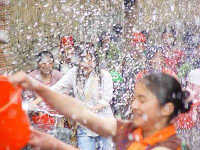
Updated: 2009-01-21 11:18 The Dais mostly reside in the Xishuangbanna Dai Autonomous Prefecture of Yunan Province in the south of China. Early in 1AD, there was a record on the Dai ethnic minority from historical books of the Hans. The Dai people have their own language and characters. They not only are good at dancing and singing, but also create their own brilliant culture, especially for their famous history, pharmacy and narrative poems. Water-Splashing Festival The Water Splashing Festival is a traditional festival for the Dai people in Xishuangbanna and other places to send off the old and greet the new, and to give best wishes to each other. It lasts three or four days. Water splashing is the feature of an entertainment, just like the festival name itself.
The first day of the festival is the eve, on which the activities include launching rockets and dragon boat rowing, etc. The second day is the Neuter Day that belongs to neither the old nor the new year, just a day in vacancy. According to the traditional custom, people stay at home or go hunting in mountains. The third day is the New Year. On the morning, people dress up and go to the temple to worship the Buddha. They make three or five pagoda-shaped sand piles in height of over 1 m. On the top, they plant eight bamboo twigs wrapped with red and green strips, and then sit around pagodas, listening respectfully to the scripture and historical legends praying for good weather and multiplying offspring in the coming year. In the noon, every woman has to carry fresh water so as to clean the Buddha statue for his blessing. Then, people begin to splash water on each other to show their blessings. They wish to rinse the sickness and disasters with saint water for a happy life. At night, strains of music accompanied by drumbeats keep sound all over villages. People enjoy dancing and singing as much as they want. Close-Door Festival and Open-Door Festival The Close-Door Festival falls on September 15 of the Dai calendar (in mid July of the solar calendar). The Open-Door Festival occurs on December 15 of the Dai calendar (in mid October of the solar calendar). The three months from the Close-Door Festival to the Open-Door Festival is the time period that Dais keep their doors shut. On both festival days, whether men or women, old or young hold in the temples large worship and offer delicious food, fresh flowers and coins to the Buddha. People patter and drop water in front of the Buddha figure to pray him for blessing human with luck. During the time period that the Dais close the doors, the religious activities are frequently carried out, and an offering in a small amount to the Buddha per week with a large offering the course. On the evening, people will set off firecrackers, fireworks and Kongming Lantern. In the course of door close, young men and girls can talk about love, but are not allowed to marry neither to go out until the Open-Door Festival. Piling Sand Festival After the spring begins and paddy has been planted, it is celebrated for three days. On the occasion, every family will go to the riverbank and get a basket of fine sand. Sand is required to be clean and fine; besides, it must be located at remote place beyond the reach of people and livestock. When sand is available, it will be made by the elder of prestige in the village into two big piles and more than 10 small piles. Each small pile is tough and shapes like a taper. On the large piles a cypress is planted to symbolize that all people of village live young. On each of the small ones, a twig is stuck respectively, sometimes a banana tree to pray for a happy life in the coming year. Sand piles are enclosed by bamboo strips decorated with flowers, taking on a wonderful view. When sand piles are ready made, the elder will fill the hollow gourd with water and splash around sand piles, which means to throw out the drought demon and welcome the good weather and a bumper harvest. During the festival, the Yis and Hanis from the back-fence villages come to offer greeting. The hosts and guests gather around sand piles. They sing and dance in step with the elephant-leg drums and enjoy themselves over night. The Gangyong Festival In fact, it is the festival to worship the bamboo rats. It takes place sometimes in April or September of Dai calendar. Villagers negotiate which day is the festival. While celebrating the festival, all people of the village dress up. They take hoe and carry bamboo basket for digging bamboo rats on the hill. Once rats are caught, they will decorate one of them with flowers, grass, wreath, and tie it on a long bamboo pole, then carry it back. People percuss ferula and walk around the village, then carry the bamboo rat to the village head's home. They remove the flowers and ornaments, cut down the rat head and gift it to the village head. They clean it, and allocate one piece to each household and touch once on each of the three feet of the iron spider (or on kitchen stone), or put it on the spider for the purpose of worshipping the god. It is said that, to worship the bamboo rats in the Yonggang Festival will make the crop grow well and foresee a bumper harvest Dragon Worship Festival It is a special festival of the Dais in Damenglong of Xishuangbanna. One in the case of great event, fine growth of crops or good life, the Dragon Send off Festival is to be held. The festival doesn't mean to send off the Dragon God, but actually to send offering to the Dragon God and pray for his blessing with good life, hence, the thanksgiving should be made to the Dragon God. The date of offering is normally fixed in January of the solar calendar. Prior to the Spring Festival, under the guidance of the Buddha, each family will present delicious food and clothes. The well-off villagers present real jewelry, money,carpet, etc. Visitors are also welcomed without taboo. When various offerings are delivered to the temple, the temple will organize craftsmen to make the Dragon Palace. The monks patter and arrange the worship by putting the offerings on the Dragon Palace. All participators of the worship, beating gongs and drums, carry it on the Menglong River. After the ceremony ends, they lay it on the raft that floats away in blessing and prayer. Then the gift is considered to be on the way to the Dragon God.
 |
              |
主站蜘蛛池模板: 平邑县| 姚安县| 孝昌县| 浙江省| 阿拉善盟| 葫芦岛市| 富顺县| 温州市| 黄梅县| 麻江县| 邯郸市| 通州市| 敦化市| 张家港市| 太谷县| 高雄县| 隆林| 汝城县| 安陆市| 西乌| 元氏县| 自贡市| 谢通门县| 上思县| 永川市| 巴彦县| 九江县| 花莲市| 松桃| 伊通| 白银市| 满城县| 曲沃县| 诸暨市| 方城县| 东阿县| 郓城县| 遂平县| 富裕县| 阳东县| 高淳县| 旬邑县| 县级市| 清流县| 巴彦淖尔市| 进贤县| 城市| 太康县| 乐东| 客服| 颍上县| 广州市| 河池市| 巧家县| 乌苏市| 龙岩市| 翁源县| 泗水县| 乌拉特后旗| 周宁县| 葫芦岛市| 宣化县| 元江| 青川县| 九台市| 会东县| 遂川县| 临西县| 永福县| 红桥区| 平原县| 东乡| 朝阳市| 梧州市| 潼关县| 涞源县| 吉水县| 永城市| 宜阳县| 新建县| 凉城县| 全椒县|