In Italy's heartland, Indian immigrants work the farms
Updated: 2011-11-13 07:00
By Elisabetta Povoledo(The New York Times)
|
|||||||


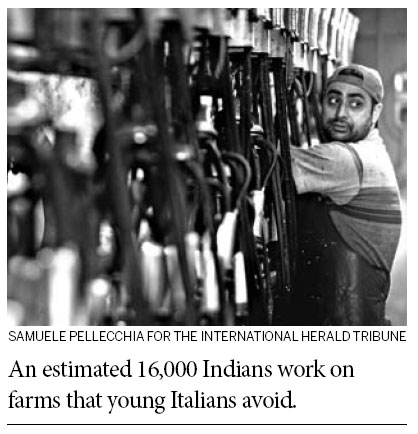
PESSINA CREMONESE, Italy - Alongside common local last names like Ferrari and Galli in the telephone directories for the province of Cremona is an increasingly present surname: Singh.
For the past 20 years, Indian immigrants from Punjab have been settling in Italy's agricultural heartland to work primarily on farms, often as bergamini, as dairy workers are known in the native dialect.
It has been said that if the Indian workers went on strike, production of Grana Padano, the hard, grainy cheese that this tract of the Po Valley is known for, would shut down.
"Well, I don't know if production would stop, but it would certainly create many difficulties," said Simone Solfanelli, the president of the Cremona chapter of Coldiretti, Italy's largest agricultural organization. "I can tell you that they are indispensable for farming," and for the milk produced in the province - at 1,000 kilotons per year, about a tenth of all milk produced in Italy.
The Indians, many of whom are Sikhs, first arrived in the area just as a generation of dairy workers was retiring, with no substitutes in sight. "They saved an economy that would have gone to the dogs because young people didn't want to work with cows," Mayor Dalido Malaggi of Pessina Cremonese said.
The work is split in two four-hour shifts per day, about 12 hours apart. "Young Italians don't want to work those kinds of hours," Mayor Malaggi said. Many of the immigrants already knew what it took to keep a farm running. "This is dairy land, and many of us have cows in Punjab," said Jaswinder Duhra, who has lived in Italy for 25 years, working first as a bergamino and then for one of Italy's leading cheese manufacturers. "We're used to the work that we do here."
There are no official statistics, but Mr. Solfanelli said that of the 3,000 agricultural laborers in the province, about a third are Indian. One measure of their presence was the inauguration in August of the Gurduwara Sri Guru Kalgidhar Sahib, a Sikh temple designed to hold 600. It has been touted as the largest in Continental Europe.
Dilbagh Singh arrived in Italy when he was 14, and now, 12 years later, he speaks with the distinctive accent of his adopted hometown of Nogara. He said his compatriots "come here to work, and want to live peacefully."
To this end, Mr. Singh runs a Web site on Sikhs in Italy so that "Italians can understand us."
Nearly 16,000 Indian immigrants are legally employed in agriculture in Italy, with the Lazio region the newest pole of immigration, especially for seasonal workers.
"You only have to travel 100 kilometers from Rome to discover a world most people don't even know exists," said Patrizia Santangelo, a filmmaker whose recently released documentary "Visit India" is about the Sikh community in the province of Latina.
Ms. Santangelo's documentary exposes some of the exploitation that many immigrant workers are subject to.
"They often live in camps, like homeless people, and can get paid low wages, 2 to 4 euros an hour for 12-hour days," she said. "But what struck me is that even though they live in difficult conditions, the Indian workers are still able to see the positive side of situations."
Many of the Indian immigrants have become Italian citizens. They have bought homes and settled their families here. Many have also raised children in Italy who imagine a different future.
"They work hard at school; they're not spoiled like our kids," said Gianluigi Fiamenghi, who employs seven Indian workers on his dairy farm of 1,700 cows. "And their children won't want to work on a farm, they'll go to university and want to get ahead."
One of Mr. Fiamenghi's workers, Prem Singh, moved to Italy in 1995. He and his wife are raising three children who are now in primary school. "They feel more Italian than Indian," he said, adding that he had no plans to return to his native land. "We've put down our roots here. It's our home, and that's that."
The New York Times
(China Daily 11/13/2011 page10)