China's rugby on a roll
Updated: 2012-03-04 07:53
By Tang Zhe(China Daily)
|
|||||||


|
Zhang Zhiqiang, one of the HSBC's Asian Rugby Ambassadors. Provied to China Daily |

Returning Olympic sport is gaining more popularity, but there is still a long way to go, Tang Zhe writes.
Despite China's significant role in international sports, it is still a comparative novice with only a few professionals and enthusiasts tackling the rugged sport of rugby for China. However, its return to the Olympic family has given it an opportunity to raise its profile in the country.
Rugby, which was last played at the Olympics in 1924, will return to the Summer Games in Rio de Janeiro in 2016. The event in four years time, will be a four-day seven-a-side tournament, instead of the traditional 15-a-side game, for 12 men's and women's teams.
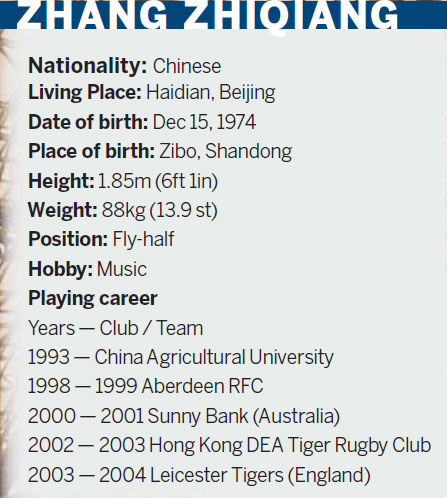
Zhang Zhiqiang is among the few who have witnessed rugby's progress in China. The 37-year-old fly-half started playing in 1993 and captained the national XV and Sevens for 11 years from 1998 to 2008. He also took up a coaching role with the squads in 2008.
"Many provinces have begun to build up rugby since it was included into the Olympics in 2009 and has also been added to the 2013 National Games," said Zhang, who has played in Hong Kong and also in Britain with the Leicester Tigers.
"Rugby is a new game, and the provinces have started organizing squads to have a chance of winning medals or finishing among the top eight at the National Games. This is why the sport is making rapid progress around the country," he said.
Up to now, 13 provinces have organized rugby teams. Together with school teams, there are more than 30 squads in Anhui province, while Shandong province has more than 20. Many provincial teams have started to go to rugby powerhouses like New Zealand and Fiji for training.
Zhang said, as a coach of the national team, he's glad to see the spreading influence of the sport because it will provide him with more choices in selecting players, but at the same time he pointed out Chinese rugby is still at an early stage and there are big discrepancies between different teams.
Among the 18-man national squad, which is preparing for the Cathay Pacific/HSBC Hong Kong Sevens (March 23-25), 12 players are from the Beijing team, which was built around former players from the China Agriculture University.
Without a domestic league, teams at the provincial level only have two tournaments to play each year, the national rugby sevens and the national championships.
"The gap between first-class players and the average ones is huge," said Zhang, who also took charge of the Beijing team after the Guangzhou Asian Games. "Our Beijing teams claimed both the men's and women's titles at last year's championships. The men's side even defeated Shangdong 52-0 in the final."
"We don't have a domestic league right now because rugby starts late in China and we need teams to play in a strong league; some people are prepared to put in and start a league that is expected to be up and running within two years," Zhang said.
Four years away from the 2016 Olympic Games, Zhang said Chinese rugby is still young and the sports authority hasn't set any goals for the team at the Olympics if it qualifies.
"Rugby in China is only 21 years old and is still a child compared with the history of other countries. Instead of a pyramid structure, which contributes to a sound foundation and ample talent reserves, we had only a few more than 10 players in the past, and only seven or eight of them were competitive," said Zhang, who believes Japan and Kazakhstan are China's biggest rivals in both the men's and women's sections for an Olympic berth in 2016.
"We haven't had any goals set by the authorities, and a lot of rugby enthusiasts around the world are astonished to see China improving so fast in Sevens," he said. "We defeated Italy in 2006, Canada in 2007 and overwhelmed world No 6 Scotland in 2008. The key is to keep gaining experience."
Though rugby has risen to a more important position after its re-entry to the Olympics, Zhang said, in the long run, its development should start with the children.
"The kids are good at learning new things. Also, their mentality and their body structure will develop to fit the requirements of the sport," said Zhang, who grew up in a martial arts family.
"Most Chinese players were track and field athletes before turning to rugby, and it's very hard to make changes at that time because the flexibility and structure of their body has already been shaped," he said.
"Instead, children in England play with the ball at a very early age and it gives them better flexibility and the ability to recover quickly. They are already equipped with outstanding skills in passing and receiving, as well as lots of game experience by the time they reach their teens."
Rugby's late start here has also made it hard for Chinese players to adapt to foreign coaches.
"Foreign coaches are used to starting with game strategies because foreign players already have the basic skills and are in good rugby shape. While Chinese players are inferior in both areas without that systematic basic training, therefore there is no use in them learning strategy straight away," Zhang said.
"Instead, Chinese coaches know more about the situation here and help the development of domestic players by just teaching the basics."
(China Daily 03/04/2012 page8)