Tea's slow start means better quality
Updated: 2012-04-01 08:07
By Ye Jun in Beijing(China Daily)
|
|||||||


|
Shop assistants of Wuyutai are happy with the sale of the first batches of Mingqian tea. Zou Hong / China Daily |
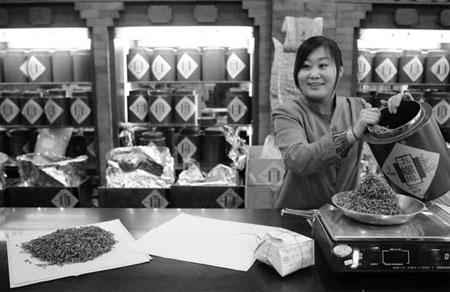
A cold winter has delayed the marketing of Mingqian tea, the prime of Chinese green teas. But that is not entirely a bad thing, because the quality is expected to be higher.
"A relatively long winter will help the tea shrubs to accumulate more nutrition, and curb sicknesses and worms, therefore improving quality," says Huang Li, publicity manager at Wuyutai, a major chain tea store in Beijing.
On March 21, the tea store received the first batch of 2.5 kilograms of biluochun (emerald spring spiral) green tea from Suzhou's Xishan, West Hill. The tea was priced at a record high 5,800 yuan ($922) per 500 grams, but sold out soon after it arrived.
Longjing (dragon well) and biluochun are top Chinese green teas, especially due to the fact that they are picked only in spring, from late March to early May.
The first batch of Hangzhou's prized Xihu Longjing, for example, contains mostly tender buds, and very tender "one bud with one leaf", the first of spring.
Gong Xiangtao, manager of Yupin'ge Teahouse in Beijing says professional tea brewers like herself call the longjing one-bud tea lianxin (heart of lotus seed), because of its shape. One bud with one leaf is called "flag spear". When the tea grows to one bud with two leaves in early summer, it is called "bird tongue".
Mingqian biluochun, on the other hand, contains only tiny, tender buds. Zhang Lanlan, member of the tea buying department at Wuyutai, says the first batch of biluochun sold at the tea store has more than 70,000 buds per 500 grams.
"To collect fresh leaves for that 2.5 kg of Mingqian biluochun, more than 40 workers spent two days picking at our base in Suzhou," says Zhang.
In the recent years, Wuyutai has been selling the first batches of longjing and biluochun at record prices. This year, the 2.5 kg of biluochun costs 5,800 yuan ($922) per 500 grams, 200 yuan more than last year.
Last year, the first batch of Xihu Longjing green tea was priced at 7,600 yuan ($1,208). The first batch of Xihu Longjing just arrived on March 30 at Wuyutai, priced at 8,200 yuan ($1,302) for 500 grams. The tea store said all 150 kg were sold out or booked out.
I was lucky enough to get a sip of the 5,800-yuan biluochun at the Beixinqiao branch of Wuyutai, which the tea store prepared for a media photo event. Even when the buds have extended fully after absorbing water, they measure less than one centimeter.
The dry tea is curly and has a lot of white downy fibers, a sign of good quality. When brewed, the tea recovers its shape on the shrub - neat, complete and tender buds in a lovely yellowish green. After drinking, the mouth is full of a flowery and fruity aroma that lingers long on the palate.
Wuyutai's Mingqian tea has recently made headlines in Chinese newspapers. The publicity certainly has worked. One middle-aged saleswoman was answering a phone call inquiring about the tea. She was telling the caller teas at this time cost more than 5,000 yuan or 7,000 yuan. "Call back in late April," she says to the phone.
That's when early summer tea will arrive at the tea store. By then customers will be able to buy longjing and biluochun teas at normal prices, such as 500 yuan ($80) per 500 grams.
March to April is the busiest time for tea collecting and trade in China. The biggest batch of Chinese green tea in the year will go on the market in April, lasting until end of May. The teas will be classified into different quality grades.
With its vast territory, China is very diversified in terms of tea production. Teas are produced as early as in late December in Hainan. February sees the marketing of new teas in Yunnan. In middle and late March, Sichuan starts to produce spring teas. The teas can be processed into green, black, or pu'er teas, depending on the process. Spring production is deemed the best for any of these varietals.
At the counters of Wuyutai, there are not just teas from Suzhou and Hangzhou, but also from Hainan, Yunnan and Sichuan. In fact, the concept Mingqian tea has been changing, as more Chinese tea-producing regions realized its market potential.
"Traditionally Mingqian tea refers to teas only in Zhejiang and Jiangsu, but now the concept is becoming wider to include green teas from other parts of the country," says Wu Xiduan, secretary-general with China Tea Marketing Association.
Some other famous green teas are Anhui Huangshan's maofeng, Yellow Mountain hairy mountain peak; bamboo leaf green tea from E'mei Mountain of Sichuan; Duyun maojian, furry tip from Guizhou's Duyun; and Yunnan's pu'er, which is made from sun-dried Yunnan green tea.
Zhang Lanlan says customers of Wuyutai are offered Mingqian tea at a reservation basis.
"Some drink themselves, some buy to give it as a gift," she says. "More and more Chinese people are looking for good teas, as people get a higher income, and because of its health benefits."
But Jiang Hong, a Beijing based tea drinker, says Mingqian teas are too expensive.
"It is not necessary to spend so much money on it, because the price is too high for that kind of taste," he says. "With five or six thousand yuan I can buy a rather good dahongpao (bright red gown), a north Fujian oolong."
Green teas are considered best to consume in the year of production. The quality will deteriorate fast if not consumed within a year. They do not have an aging potential, like pu'er or heavily baked oolong.
Nonetheless, Jiang likes the idea of trying the freshest produce of the season, for "a feel of spring".
"The tenderer the tea is, the more refreshing and gratifying it can be," he says. "Teas with a large percentage of buds have a specially uplifting aroma."
While Wuyutai just got its first batch of Xihu Longjing, Beijing's famous Lao She Teahouse got the first batch of this year's Mingqian longjing Xinchang of Hangzhou on March 10. The variety, called Dafo (big Buddha) Longjing, is a different varietal from Xihu Longjing traditionally picked early because of its microenvironment. It costs 2,800 yuan ($445) per 500 grams. Yu Jing, manager with Lao She, says the teahouse has already asked for restocking several times.
Gong Xiangtao just received the first batch of 5 kg of longjing from her tea farmer friend at Meijiawu of Hangzhou, and shared it with her closest friends in Beijing. The tea is priced at 6,000 yuan ($953) per 500 grams in her teahouse. She is set for an annual tour to Hangzhou and Suzhou's tea producing regions right after April 4.
"I heard teas are becoming very expensive this year. But my teahouse needs it," she says. She said she would get more teas at a lower price level.
yejun@chinadaily.com.cn
(China Daily 04/01/2012 page4)