A mystery from Earth's red-hot inner core
Updated: 2012-06-10 08:02
By Natalie Angier(The New York Times)
|
|||||||


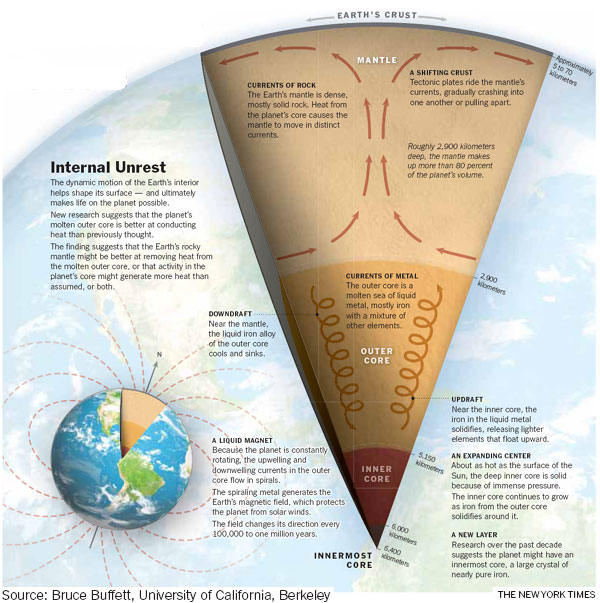
Geologists have long known that Earth's core, some 2,900 kilometers beneath our feet, is a dense, chemically laden ball of iron roughly the size of Mars. Pressures there bear down with the weight of 3.5 million atmospheres, and temperatures reach 5,538 degrees Celsius - as hot as the surface of the Sun. It's a place where iron is a fluid and a solid, and it spirals like liquid confetti.
The heat of Earth's inner core helps animate the tectonic plates above it, to build up mountains and gouge out seabeds. At the same time, the jostling of core iron generates Earth's magnetic field, which blocks dangerous cosmic radiation.
But reporting recently in the journal Nature, Dario Alfe of University College London and his colleagues presented evidence that iron in the outer layers of the core is wasting heat through conduction at two to three times the rate of previous estimates.
The theoretical consequences are far-reaching. The scientists say something else must account for the missing thermal energy in their calculations. They offer these possibilities:
The core holds more radioactive material, like potassium or thorium, than anyone had suspected, and its decay is giving off heat.
The iron of the innermost core is solidifying at a startlingly fast clip and releasing the latent heat of crystallization in the process.
The chemical interactions among the iron alloys of the core and the rocky silicates of the mantle are much fiercer and more energetic than previously believed.
"People are excited" by the report, Dr. Alfe said. "They see there might be a new mechanism going on."
Researchers elsewhere have discovered a host of other anomalies and surprises. They've found indications that the inner core is rotating slightly faster than the rest of the planet.
Miaki Ishii and her colleagues at Harvard University have proposed that within the inner core is a layer they call the innermost core: a structure some 604 kilometers in diameter that may be almost pure iron.
Most of what is known about the core comes from studying seismic waves generated by earthquakes. As John Vidale of the University of Washington explained, most earthquakes originate in the upper 48 kilometers of the globe, and no seismic source has been detected below 805 kilometers. But the quakes' energy waves radiate across the planet, detectably passing through the core.
Dr. Ishii and other researchers have also combed through seismic data from the underground testing of nuclear weapons carried out in the 20th century. The Russian explosions in particular, she said, "are a remarkably telling data set," adding that with bombs, unlike earthquakes, the precise epicenter is known.
"Oh, the things we could learn, if only we had unlimited resources," Dr. Ishii said.
The core does leave faint but readable marks on the surface, by way of the magnetic field that loops out from the vast chthonic geodynamo of swirling iron permeating the planet and reaching thousands of kilometers into space. Magnetic particles trapped in neat alignment in rocks reveal that the field, and presumably the core structures that generate it, has been around for well over 3 billion of Earth's 4.5 billion years.
Every 100,000 to a million years or more, the north-south orientation of the magnetosphere reverses, an event often preceded by an overall weakening of the field.
Earth assumed its basic layered effect as it gravitationally formed from the young solar system, with the heaviest ingredients, like iron and nickel, migrating toward the center and lighter, rocky material bobbing above.
Distinct boundaries distinguish the layers - between the elastic rock of the mantle and the iron liquid of the outer core, and between the liquid outer core and the solid inner core.
The core accounts for one-sixth of the Earth's volume and one-third of its mass, the great bulk of iron maintained in liquid form by the core's heat. Only in the inner core does the iron solidify.
As the hot Earth orbits through frigid space, the core gradually sheds some of its stored heat.
The heat can be conducted straight outward, the way heat travels along a frying pan, or convected out in plumes, the way hot air rises in the atmosphere.
Conduction is a wasted form of energy transfer - heat moves, but the Earth does not. Convection is potentially industrious. Its currents ripple through the mantle and shuffle around the tectonic plates, and convection stokes the geodynamo that yields the switching field.
In their report in Nature, Dr. Alfe and his colleagues used powerful computers and basic considerations of atomic behavior to calculate the properties of iron and iron alloys under the presumed conditions of the core. They concluded that the core was losing two to three times as much heat to conduction as previously believed, which would leave too little thermal energy to account for the convective forces that power the Earth's geodynamo. Hence the need to consider possible sources of additional heat, like stores of radioactive potassium or thorium, or a fast-crystallizing inner core.
Bruce Buffett, a geologist at the University of California, Berkeley, suggests water on the surface may also help Earth balance its thermal budget - by slightly weakening the rocky plates and making them more readily churned and recycled in a vigorous, sustainable convective stew.
The New York Times
(China Daily 06/10/2012 page11)