In caves along Danube, the first musical notes
Updated: 2012-06-17 07:46
By John Noble Wilford(
The New York Times
)
|
|||||||


|
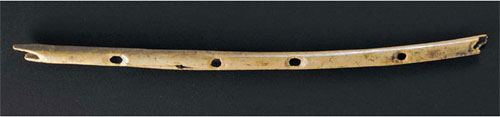
Scientists say flutes made of bird bone and mammoth ivory that were discovered in Germany are 42,000 years old. H. Jensen / University of Tubingen |
In hillside caves of southwestern Germany, archaeologists in recent years have uncovered the beginnings of music and art by early modern humans migrating into Europe from Africa.
New dating evidence shows that these oldest known musical instruments in the world, flutes made of bird bone and mammoth ivory, are even older than first thought.
Scientists led by Thomas Higham of the University of Oxford in England reported last month that improved radiocarbon tests determined that animal bones found with the flutes were 42,000 to 43,000 years old. This is close to the time when the first anatomically modern humans were spreading into Central Europe, presumably along the Danube River valley.
Earlier tests had yielded dates of 35,000 years ago for artifacts at several caves where flutes and also ivory statuettes of voluptuous women have been found near Ulm, Germany, and the headwaters of the Danube. The best preserved bone flute, with five finger holes, was collected at Hohle Fels Cave.
The new analysis was based on material from the nearby Geissenklosterle Cave.
Some scholars were slow to accept the first reports of the 35,000-year flute chronology in assessing the timing and setting of cultural changes arising from the arrival of modern humans, who would then replace the native Neanderthals 30,000 years ago. Radiocarbon ages older than 30,000 years can be unreliable.
The new findings, published in The Journal of Human Evolution, "are consistent with a wide range of innovations coming from the Upper Danube," Nicholas J. Conard, an archaeologist at Tubingen University in Germany, said in an e-mail. Dr. Conard, one of the authors of the report, was the excavator of the artifacts at several of the caves.
After several discoveries of pieces of flutes, samples of figurative art and distinctive personal decoration in the caves, Dr. Conard said the new dates supported the hypothesis that the Danube was "a key corridor for the movement of humans and technological innovations into Central Europe between 40,000 and 45,000 years ago."
In Dr. Higham's research, the animal bones being dated were buried in the same ground layers as the flutes in Geissenklosterle Cave. They were treated against contamination by advanced "ultrafiltration."
The bone results, the researchers wrote, "strongly imply that the previous dates were affected by insufficient decontamination of the bone collagen prior to dating."
If the new dates are correct, scientists said, modern humans first moved through the Upper Danube region, making music, before an extremely cold phase of the ice age, about 39,000 years ago. In a chronology that was based on younger dates for the flutes, it was supposed that modern humans had waited for better weather before heading through the Danube.
The New York Times
(China Daily 06/17/2012 page11)