In Mexico, distrusting tap water
Updated: 2012-07-29 07:12
By Elisabeth Malkin(The New York Times)
|
|||||||


|
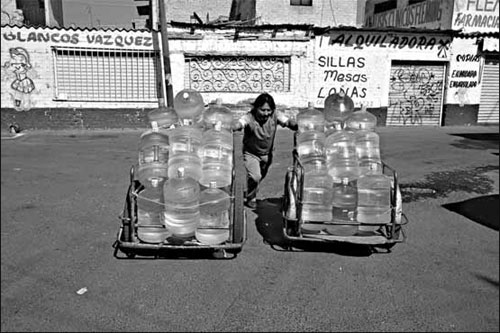
Mexico is the world's largest per capita consumer of bottled water. Maximiliano Santiago makes a profit of about $15 a day selling 19-liter jugs of water. Janet Jarman for The New York Times |
MEXICO CITY - David Montero drives three hours every week from his apartment in Iztapalapa, a district on the eastern edge of this city, to the village where he was born to fill five 19-liter jugs with clean water to mix with the juices he sells from a roadside stand.
Back at home, his wife, Cecilia Silva Reyes, buys as many as eight 19-liter jugs of water a week for drinking and cooking. As for the tap water supplied to their housing complex, "it's yellow," Mr. Montero scoffed. "It has been like that forever."
In Iztapalapa and in many communities across Mexico, distrust of tap water is a constant, even when politicians sometimes guzzle some in public to make a point.
A study released last year by the Inter-American Development Bank found that Mexicans used about 480 liters of bottled water per person a year, more than any country surveyed.
"People are using this water for cooking, for bathing their babies," said Federico Basanes, division chief for water and sanitation at the development bank.
There is a similar trend in countries like China, Indonesia and Thailand, his group found, as rising incomes give residents the ability to buy bottled water.
Mr. Basanes said the study raises the question of whether governments are paying enough attention to water quality as they try to bring tap water to all their citizens. He noted that the countries of Latin America and the Caribbean region have invested a total of about $2.8 billion a year on improved water and sanitation since 1990. "Is there a perception problem?" he asked.
Families sometimes spend as much as 10 percent of their incomes on water, double what the bank estimates they should.
Then there is the concern of whether the bottled water is really any better.
"We've never had any complaints," said Maximiliano Santiago, who owns a water purification business in Iztapalapa.
He buys and purifies well water that is trucked in from outside of Mexico City rather than using the Iztapalapa tap water - "it would damage the filters," he said. He said he calls a biologist from time to time to check the quality.
Mr. Santiago works seven days a week for a profit of about $15 a day. He stacks 40 19-liter jugs on two three-wheeled cargo bicycles and pushes them through the neighborhood shouting "aguaaaa" along the way.
It is a business model that is emerging in megacities across the developing world. Rich people pay a premium for branded jugs that can be refilled from companies like PepsiCo and Coca-Cola. In working-class neighborhoods, local entrepreneurs fill the demand.
In Mexico City, the authorities have been trying to improve water quality in places like the long-neglected district of Iztapalapa. The city has spent about $70 million on water purification plants over the past six years, Ramon Aguirre, the director of the city's municipal water authority, said.
He blamed advertising by the large bottlers for the lack of confidence in the city's water. There is "money behind the sale of drinking water," he said. Mr. Aguirre also speculated that water gets contaminated once it reaches people's homes, in their underground or rooftop storage tanks.
"I know the water," he said. "What I don't know is the level of maintenance in buildings' cisterns and water tanks."
Jesus Rebollo, a community activist in Iztapalapa, agreed that there has been an improvement over the past few years, but said most people do not believe it.
"After having seen yellow water, brown water, people just don't want to take the risk," he said. "It has stuck, the problem of the lack of confidence."
Even Mr. Rebollo is not certain of how effective the investment has been, suggesting that purified water from the new plants gets contaminated in the city's aging water mains. "Once it gets into the pipes, you lose all the effort that was put into it," he said.
Rocio Perez Gonzalez, one of Mr. Santiago's customers, ran the water from her tap in her kitchen, where she was preparing lunch. Crystalline water gushed out.
"It's clean now, but years ago it came out dirty. It looked like chocolate," she said. "So I got used to using the refill jug. Everybody here got used to buying water. We have had that habit for 15 years."
The New York Times