In Korea, drunkards test police
Updated: 2012-08-05 08:02
By Choe Sang-Hun(The New York Times)
|
|||||||


|
Many South Koreans enjoy heavy drinking after work. In Seoul, abuse of officers by drunken citizens is tolerated. An officer dragged a drunken man. Jean Chung for the International Herald Tribune |
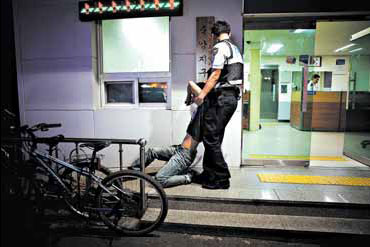
SEOUL, South Korea - The drunken man banged the door of his cell in the police station with his knee. He ripped the padding off the walls, throwing shreds and spouting curses at the police officers outside the bars, who ignored him as if such rampages were part of their nightly routine.
Such scenes are common in South Korea. They say much about that society's acceptance of heavy drinking and about the peculiar relationship between citizens and their police.
Almost every night in almost every police station lockup in Seoul, drunken men - and sometimes women - can be found abusing officers verbally and even physically, as a widely tolerated way of banishing anger. They usually are allowed to sleep it off and go home, their punishment no more than a small fine.
"They consider the police station a place to let off steam," a police superintendent, Park Dan-won, said. "They consider us pushovers."
Now the Seoul Metropolitan Police Agency has decided that it has had enough.
In May, banners went up around the city announcing a crackdown on drunken violence. It is intended to reassert police authority in a country that remembers, resentfully, when the police served as henchmen for Japanese colonial masters and military dictators.
In Seoul last year, nearly 77 percent of those charged with obstruction of justice - like abusing public servants - were drunk at the time. But in only 15 percent of such cases did the police seek to hold the offender for any length of time, and they succeeded in only half of those cases because of judges' and prosecutors' traditional leniency toward drunken offenses.
"We hesitate to use force against unruly drunken citizens because then we're likely to face charges of police brutality," said Cho Tai-il, senior police inspector in the Guro district of Seoul.
Since the police campaign began, the police have arrested nearly 230 serial offenders - individuals who had been investigated an average of 26 times, but arrested only occasionally, over various drunken offenses.
Many South Koreans, who work some of the longest hours in the world, believe that one of the quickest ways of building friendship and office camaraderie is to get drunk together. "He who drinks more works better" is a common saying here, and the working person's drink of choice is often "the bomb," a shot glass of soju, the local grain liquor, added to a glass of beer.
|
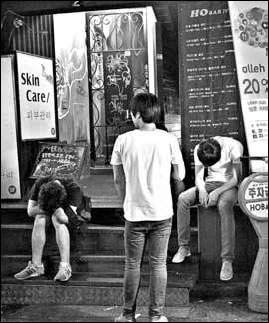
Young people with hangovers in Seoul, where police are cracking down on drunken violence. Jean Chung for The International Herald Tribune |
According to the World Health Organization, South Koreans rank No. 13 in alcohol consumption over all but No. 1 in hard liquor consumption. A Korean Alcohol Research Foundation survey in 2010 found that about 44 percent of college students said they had experienced blackouts from excessive drinking.
It is also cheap to get drunk in South Korea. A 360-milliliter bottle of soju costs about 1,200 won, about $1, at ubiquitous all-night stores.
On weekend nights, it is easy to find besotted men, some in suits and ties, vomiting or sprawled in the subways or on the street. (Some take off their shoes and glasses and sleep using their briefcase or a curb for a pillow.)
Choi Jeong-wook, an assistant police inspector in the Yeongdeungpo district of Seoul, said 80 percent of the work at his station involved dealing with drunks.
During Japan's colonial rule, from 1910 to 1945, Koreans resented the police for working with the Japanese authorities. After Korea's liberation, many officers ran the national police force, which suppressed pro-democracy demonstrations.
After the country's democratization in the late 1980s, the relationship between citizens and the police flipped. Fear of officers was replaced with an attitude of "citizens are your boss."
"We're not asking people to fear us," Inspector Choi said. "We're just asking them not to abuse us."
The New York Times
(China Daily 08/05/2012 page9)