Using apps and iPads, doctors redefine medicine
Updated: 2012-10-21 08:01
By Katie Hafner(The New York Times)
|
|||||||


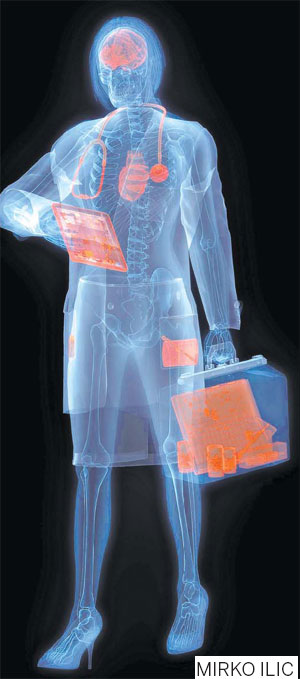
SAN FRANCISCO - The proliferation of gadgets, apps and Web-based information has given doctors a black bag of new tools, but also created something of a generational divide.
Older doctors admire, even envy, their young colleagues' ease with new technology. But they worry that the human connections that lie at the core of medical practice are at risk of being lost.
"Just adding an app won't necessarily make people better doctors or more caring clinicians," said Dr. Paul C. Tang, chief innovation and technology officer at Palo Alto Medical Foundation in California. "What we need to learn is how to use technology to be better, more humane professionals."
At the University of California, San Francisco Medical Center, Dr. Alvin Rajkomar is among the new crop of device-happy physicians. He stores every clinical nugget he finds on an application called Evernote, an electronic filing cabinet. "I use Evernote as a second brain," he said. "I now have a small textbook of personalized, auto-indexed clinical pearls that I carry with me at all times on my iPhone."
Along with MedCalc, the clinical calculator, Dr. Rajkomar's phone has ePocrates, an app for looking up drug dosages and interactions; and Qx Calculate, which he uses to create risk profiles for his patients. His favorite technology is his electronic stethoscope, which amplifies heart sounds while canceling out ambient noise.
Not that he is indiscriminate in his use of technology. When he decided the electronic health record was taking too long to load on his iPad, he went back to taking notes by hand, on paper. But he is experimenting with writing by hand on a Samsung mini-tablet.
He is aware of the pitfalls of computerized records, particularly the "if the problem is X, then do Y" templates, which encourage a cut-and-paste approach to daily progress notes. While efficient, they can give rise to robotic bookkeeping without regard to how the patient is faring.
Tablet computers that are linked to electronic health records are making their way into the hands of medical trainees around the United States. All internal-medicine residents at the University of Chicago and Johns Hopkins University in Baltimore, Maryland, are given iPads; entering medical students at Stanford University in California are given vouchers they can use to buy one.
A University of Chicago study this year in Archives of Internal Medicine found that residents with iPads were able to enter orders in a more timely manner, and a majority of residents perceived that the iPads improved their work efficiency. At the University of California, San Francisco Medical Center, some physicians use iPads, and many use one of the hospital's computers on wheels.
At an outpatient clinic seven kilometers west of the hospital is Dr. Paul A. Heineken, a primary care physician.
Dr. Heineken is a revered figure among trainees at the San Francisco V.A. Medical Center, where he makes a point of requiring something old-fashioned.
"I tell them that their first reflex should be to look at the patient, not the computer," Dr. Heineken said. And he tells trainees to return to each patient's bedside at day's end. "I say, 'Don't go to a computer; go back to the room, sit down and listen to them. And don't look like you're in a hurry.'"
One reason for this, Dr. Heineken said, is to adjust treatment recommendations based on the patient's own priorities. "Any difficult clinical decision is made easier after discussing it with the patient," he said.
Dr. Heineken fills his teaching days with similar lessons, which can mean struggling upstream against a current of technology. Through his career, he has seen the advent of CT scans, ultrasounds, M.R.I.'s and countless new lab tests. He has watched peers turn their backs on patients while struggling with a new computer system, or rush patients through their appointments while forgetting the most fundamental tools - their eyes and ears.
Dr. Rajkomar heeds Dr. Heineken's advice by making sure to keep his gaze fixed on his patients while he is typing. As the conversation with the patient goes, so goes Dr. Rajkomar's interaction with the computer. Lab results? On the screen in a flash. A list of past and current medications and dosages? Voila!
But Dr. Rajkomar also knows when the computer needs to be set aside. During a visit, when a patient confided that his wife was taking his pain medication, Dr. Rajkomar excused himself and walked down the hall to consult with the pharmacist about a plan to keep that from happening.
Dr. Rajkomar knows he has a great deal to learn about being a physician, especially patients' social and psychological complexities.
"One patient fired me," he said, smiling as he added, "Dr. Heineken gets those patients."
The New York Times
(China Daily 10/21/2012 page11)