Web classes, but without profits
Updated: 2013-01-27 08:25
By Tamar Lewin(The New York Times)
|
|||||||


|
The online company Coursera has seen enrollment pass the two million mark. An employee in the company kitchen. Ramin Rahimian for The New York Times |

MOUNTAIN VIEW, California - In August, four months after Daphne Koller and Andrew Ng started the online education company Coursera, its free college courses had drawn a million users, a faster launching than either Facebook or Twitter.
The co-founders, computer science professors at Stanford University near here, watched with amazement as enrollment passed two million in December, with 70,000 new students a week signing up for over 200 courses, including Human-Computer Interaction, Songwriting and Gamification, taught by faculty members at the company's partners, 33 elite universities.
In less than a year, Coursera has attracted $22 million in venture capital and has created so much buzz that some universities sound a bit defensive about not doing the same.
Universities across the United States are increasing their online offerings, hoping to attract students around the world. New ventures like Udemy help professors put their courses online. Harvard University and the Massachusetts Institute of Technology have each provided $30 million to create edX. Another Stanford spinoff, Udacity, has attracted more than a million students to its massive open online courses, or MOOCs, along with $15 million in financing.
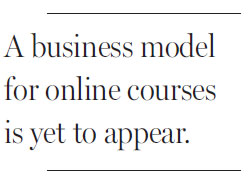
All of this could well add up to the future of higher education - if anyone can figure out how to make money.
Coursera has emerged as the current leader, striving to support its business by creating revenue streams through licensing, certification fees and recruitment data provided to employers, among other efforts. But there is no guarantee that it will keep its position in the exploding education technology marketplace.
"No one's got the model that's going to work yet," said James Grimmelmann, a New York Law School professor who specializes in computer and Internet law. "I expect all the current ventures to fail, because the expectations are too high. People think something will catch on like wildfire. But more likely, it's maybe a decade later that somebody figures out how to do it and make money."
Ms. Koller and Mr. Ng proclaim a desire to keep courses freely available to poor students worldwide. Education, they have said repeatedly, should be a right, not a privilege. And even their venture backers say profits can wait.
"Monetization is not the most important objective for this business at this point," said Scott Sandell, a Coursera financier who is a general partner at New Enterprise Associates. "What is important is that Coursera is rapidly accumulating a body of high-quality content that could be very attractive to universities that want to license it for their own use."
But with the first trickles of revenue now coming in, Coursera's university partners expect to see some revenue sooner.
"We'll make money when Coursera makes money," said Peter Lange, the provost of Duke University in North Carolina, one of Coursera's partners. "I don't think it will be too long down the road. We don't want to make the mistake the newspaper industry did, of giving our product away free online for too long."
Right now, the most promising source of revenue for Coursera is the payment of licensing fees from other educational institutions that want to use the Coursera classes, either as a ready-made course or as video lectures students can watch before going to class to work with a faculty member.
Ms. Koller is planning to charge $20, or maybe $50, for certificates of completion. And her company, like Udacity, has begun to charge corporate employers, including Facebook and Twitter, for access to high-performing students.
Under Coursera's contracts, the company gets most of the revenue; the universities keep 6 percent to 15 percent of the revenue, and 20 percent of gross profits. Other possibilities include charging a subscription fee, after a class is over, to continue the discussion forum as a Web community, or perhaps offering follow-up courses, again for a fee. And advertising sponsorships remain a possibility.
Some Coursera partners say they are in no hurry to cash in.
"Part of what Coursera's gotten right is that it makes more sense to build your user base first and then figure out later how to monetize it, than to worry too much at the beginning about how to monetize it," said Edward Rock, a law professor serving as the University of Pennsylvania's senior adviser on open course initiatives.
The Coursera co-founders have become oracles of higher education, spreading their message of massive open online courses at the World Economic Forum in Abu Dhabi, the Web Summit in Dublin and the Aspen Ideas Festival in Colorado.
They describe how free online courses can open access to higher education to anyone with an Internet connection; liberate professors from repeating the same tired lectures semester after semester; and generate data, because the computers capture every answer right or wrong, that can provide new understanding of how students learn best.
But Ms. Koller is unsure about the future. "A year ago, I could not have imagined that we would be where we are now," she said. "Who knows where we'll be in five more years?"
The New York Times
(China Daily 01/27/2013 page9)