In the lab, a $325,000 burger
Updated: 2013-06-02 08:01
By Henry Fountain(The New York Times)
|
|||||||


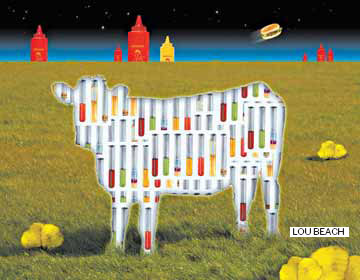
MAASTRICHT, the Netherlands - As a gastronomic delicacy, the 140-gram hamburger that Mark Post has created here surely will not turn any heads. But Dr. Post is hoping that it will change some minds.
The hamburger, assembled from tiny bits of beef muscle tissue grown in a laboratory and to be cooked and eaten at an event in London, perhaps in a few weeks, is meant to show the world - including potential sources of research funds - that so-called in vitro meat, or cultured meat, is a reality.
"Let's make a proof of concept, and change the discussion from 'this is never going to work' to, 'well, we actually showed that it works, but now we need to get funding and work on it,'" Dr. Post said in an interview last fall in his office at Maastricht University.
Down the hall, in a lab with incubators filled with clear plastic containers holding a pinkish liquid, a technician was tending to the delicate task of growing the tens of billions of cells needed to make the burger, starting with a particular type of cell removed from cow necks obtained at a slaughterhouse.
The idea of creating meat in a laboratory - actual animal tissue, not a substitute made from soybeans or other protein sources - has been around for decades. The arguments in favor of it are many, covering both animal welfare and environmental issues.
A 2011 study in the journal Environmental Science and Technology showed that full-scale production of cultured meat could greatly reduce water, land and energy use, and emissions of methane and other greenhouse gases, compared with conventional raising and slaughtering of cattle or other livestock. Those environmental arguments will only gain strength, advocates say, as worldwide demand for meat increases with the rise of middle-class populations in China and elsewhere.
Dr. Post has made strides in developing cultured meat through the use of stem cells - precursor cells that can turn into others that are specific to muscle, for example - and techniques adapted from medical research for growing tissues and organs.
Growing meat in the laboratory has proved difficult and devilishly expensive. Dr. Post, who knows as much about the subject as anybody, has repeatedly postponed the hamburger cook-off, which was originally expected to take place in November.
His burger consists of about 20,000 thin strips of cultured muscle tissue. Dr. Post, who has conducted some informal taste tests, said that even without any fat, the tissue "tastes reasonably good." For the London event he plans to add only salt and pepper.
The meat is produced with materials - including fetal calf serum, used as a medium in which to grow the cells - that eventually would have to be replaced by similar materials of non-animal origin. And the burger was created at phenomenal cost - 250,000 euros, or about $325,000, provided by a donor who so far has remained anonymous.
Dr. Post uses a type of stem cell called a myosatellite cell, found in a certain part of muscle tissue. The cells are removed from the cow neck and put in containers with the growth medium. The researchers have learned how best to get the cells to grow and divide, doubling repeatedly over about three weeks.
"But we need billions," said Anon van Essen, a technician in Dr. Post's lab.
The cells are then poured onto gel in a plastic dish. The nutrients in the growth medium are greatly reduced, essentially starving the cells, which forces them to differentiate into muscle cells. "We use the cell's natural tendency to differentiate," Dr. Post said. "We don't do any magic."
Over time the differentiated cells merge to form primitive muscle fibers, called myotubes. "And then they just start to put on protein," Dr. Post said.
The result is a strip of tissue that looks like a short pink rice noodle, Dr. Post said.
The strips have to be thin because cells need to be close to a supply of nutrients to stay alive. One approach to making thicker tissues - to make a cultured steak rather than a hamburger, for instance - would require developing a network of channels, the equivalent of blood vessels, to carry nutrients to each cell.
Other researchers are studying different kinds of stem cells that, unlike myosatellite cells, can reproduce indefinitely, ensuring a "livestock-autonomous" supply of cells to make cultured meat.
But Dr. Post said, "If we can reduce the global herd a millionfold, then I'm happy. I don't need to reduce it a billionfold."
He added: "I feel strongly that this could have a major impact on society in general. And that's a big motivator."
The New York Times
(China Daily 06/02/2013 page9)