What to others is waste, Norway wants for energy
Updated: 2013-06-16 07:41
By John Tagliabue(The New York Times)
|
|||||||


|
Half of Oslo and most of its schools are heated by garbage burned at waste-to-energy incinerators. Brian Cliff Olguin for The New York Times |
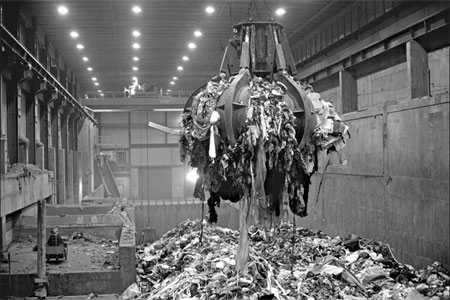
OSLO - This is a city that imports garbage. Some comes from England, some from Ireland. Some is from neighboring Sweden. It even has designs on the American market.
"I'd like to take some from the United States," said Pal Mikkelsen, in his office at a huge plant on the edge of town that turns garbage into heat and electricity. "Sea transport is cheap."
Oslo, where roughly half the city and most of its schools are heated by burning garbage - household trash, industrial waste, even toxic and dangerous waste from hospitals and drug arrests - has a problem: It has run out of garbage to burn.
The problem is not unique to Oslo. Across Northern Europe, where the practice of burning garbage to generate heat and electricity has exploded in recent decades, demand for trash far outstrips supply.
The fastidious population of Northern Europe produces only about 136 million metric tons of waste a year, far too little to supply incinerating plants that can handle more than 635 million metric tons. "And the Swedes continue to build" more plants, "as do Austria and Germany," said Mr. Mikkelsen, 50, a mechanical engineer who for the last year has been the managing director of Oslo's waste- to-energy agency.
By ship and by truck, countless tons of garbage make their way from regions that have an excess to others that have the capacity to burn it and produce energy.
"There's a European waste market - it's a commodity," said Hege Rooth Olbergsveen, the senior adviser to Oslo's waste recovery program. "It's a growing market."
Most people approve of the idea. "Yes, absolutely," said Terje Worren, 36, a software consultant. "It utilizes waste in a good way."
The English like it, too. The Yorkshire-based company that handles garbage collection in the north of England now ships as much as 907 metric tons a month of garbage to countries in Northern Europe, including Norway, according to Donna Cox, a Leeds city spokeswoman. A British tax on landfill makes it cheaper to send it to places like Oslo.
For some, it might seem bizarre that Oslo would resort to importing garbage to produce energy. Norway ranks among the world's 10 largest exporters of oil and gas, and has abundant coal reserves and a network of more than 1,100 hydroelectric plants in its water-rich mountains.
Yet Mr. Mikkelsen said garbage burning was "a game of renewable energy, to reduce the use of fossil fuels."
But Lars Haltbrekken, the chairman of Norway's oldest environmental group, an affiliate of the Friends of the Earth, said that from an environmental point of view, the waste-to-energy trend presented a big problem, causing pressure to produce more waste.
In a hierarchy of environmental goals, Mr. Haltbrekken said, producing less garbage should take first place, while generating energy from garbage should be at the bottom. "The problem is that our lowest priority conflicts with our highest one," he said.
In Oslo, households separate their garbage, putting food waste in green plastic bags, plastics in blue bags and glass elsewhere. The bags are handed out for free at groceries and other stores.
The larger of Mr. Mikkelsen's two waste-to-energy plants uses computerized sensors to separate the color-coded garbage bags. The separation of organic garbage, like food waste, has begun enabling Oslo to produce biogas, which is now powering some buses in downtown Oslo.
Other areas of Europe are producing abundant amounts of garbage, including southern Italy, where cities like Naples paid towns in Germany and the Netherlands to accept garbage, helping to defuse a Neapolitan garbage crisis. Yet though Oslo considered the Italian garbage, it preferred to stick with what it said was the cleaner and safer English waste.
Mr. Mikkelsen said: "It's a sensitive question."
The New York Times
(China Daily 06/16/2013 page10)