Mutated gene sparks drug race Gina Kolata
Updated: 2013-07-21 08:24
(The New York Times)
|
|||||||


|
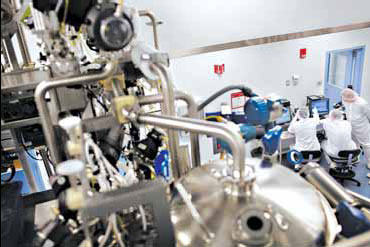
Amgen, one of three companies pursuing a drug that may lower cholesterol dramatically, has set up a factory to produce it. Christopher Capozziello for The New York Times |
She was a 32-year-old aerobics instructor from a Texas suburb - healthy, college educated, with two young children. Nothing out of the ordinary, except one thing. Her cholesterol was astoundingly low. Her low-density lipoprotein, or LDL, the form that promotes heart disease, was 14, a level unheard-of in healthy adults, whose normal level is over 100.
The reason was a rare gene mutation she had inherited from both her mother and her father. Only one other person, a young, healthy Zimbabwean woman whose LDL cholesterol was 15, has ever been found with the same mutation.
The discovery has set off one of the greatest medical chases ever. It is a fevered race among three pharmaceutical companies - Amgen and Pfizer, two American companies, and Sanofi, which is French - to test and win approval for a drug that mimics the effects of the mutation, drives LDL levels to new lows and prevents heart attacks. All three companies have drugs in clinical trials and report that their results, so far, are exciting.
"This is our top priority," said Dr. Andrew Plump of Sanofi. "Nothing else we are doing has the same public health impact."
Dr. Gary H. Gibbons, the director of the United States National Heart, Lung, and Blood Institute, estimates that even if the drugs were expensive and injected, as many as two million Americans might be candidates. If the drugs could be made affordable and in pill form - two very big ifs - they might be used by one in four adults.
Heart disease remains the leading killer of Americans, causing nearly 600,000 deaths a year. Statins, the cholesterol-lowering drugs that went on the market in 1987, were a huge breakthrough, but were far from a panacea.
The companies and many heart researchers hope they are closing in on a breakthrough, cheered by success with preliminary studies. But Dr. Gibbons cautioned that critical large-scale studies that would tell whether the drugs actually prevent heart attacks are only starting. "That will show if they are a game changer," he said.
So far, people with stubbornly high cholesterol levels who are taking the drugs in preliminary studies have seen their LDL levels plunging from levels well over 100 to 50, 40, or even lower.
Dr. Barry Gumbiner, who is directing Pfizer's studies, said the company had to decide whether to set a floor for patients' LDL levels. Pfizer is interrupting treatment when LDL levels reach 25 or lower. The people seemed fine, but the company got nervous.
"There is not a lot of experience treating people to LDL levels this low," Dr. Gumbiner said.
There is another concern: cost. Each company's drug is a biologic, made in living cells at an enormous expense, like some new cancer drugs that are already straining the medical system.
Insurers generally pay for drugs approved by the United States Food and Drug Administration, and the number who might benefit from these cholesterol drugs dwarfs those who are helped by the biologic cancer drugs.
And, if the drugs come into use, researchers are asking, can cholesterol go too low?
The data point to increasing benefits with lower and lower LDL levels, said Dr. Daniel J. Rader, a cholesterol researcher at the University of Pennsylvania and a consultant for Sanofi.
Several years back, Jonathan C. Cohen and Dr. Helen H. Hobbs of the University of Texas Southwestern Medical Center in Dallas had an idea. If a mutation in a gene called PCSK9 slows the body's ability to get rid of cholesterol and leads to high LDL levels, perhaps there were defects that did the opposite - led to very low levels of LDL and protected against heart disease.
They found data from a United States study showing that some people with a single mutated PCSK9 gene that no longer functioned had somewhat lower LDL levels than normal.
Scientists began to search for people who had a mutated gene from both parents. Dr. Cohen and Dr. Hobbs found one such couple and tested their daughter in 2006. She was the aerobics instructor.
Around the same time, South African researchers began their own search and found a healthy woman at a clinic in Zimbabwe.
Those two young women showed that people could be healthy and thrive with very low LDL cholesterol levels, and seem almost immune to heart disease.
The companies want to be ready with large quantities of their versions of the drug if they are approved.
As their factories were starting to produce the drugs, the companies began recruiting patients with high LDL levels to receive the experimental substance.
David Mayse, 60, who lives in South Point, Ohio, was 49 when he had his first heart attack. Cholesterol-lowering drugs were not helping. Then Mr. Mayse had another heart attack and bypass surgery. A cardiologist who called his cholesterol levels "outrageous" asked Mr. Mayse if he would enter a clinical trial.
"I was willing to try anything at that point," Mr. Mayse said.
Mr. Mayse enrolled in a study for Amgen's experimental drug. His LDL fell to 42, from a high of 160.
The New York Times
(China Daily 07/21/2013 page9)