Unorthodox film's killers all too real
Updated: 2013-07-21 08:26
By Larry Rohter(The New York Times)
|
|||||||



In "The Act of Killing," Joshua Oppenheimer's startling new documentary about mass murder and impunity in Indonesia, a death squad leader named Anwar Congo demonstrates how he strangled hundreds of people with wire. It was quicker and less messy than beating them to death, he explains before breaking into a dance routine, performing the cha cha cha for the camera.
"The Act of Killing," which has played in numerous festivals in the last year, is crammed with such unsettlingly bizarre moments. Killers joke and brag about their deeds, which earns them applause on an Indonesian TV talk show, praise from the government in power today and condemnation from the human rights groups that want to see them brought to justice.
But Mr. Oppenheimer's film, which counts Werner Herzog and Errol Morris as its executive producers and was made by a largely Indonesian crew, is also stirring controversy because of its unorthodox form. Re-enactments are always a source of disagreement in the documentary world, but Mr. Oppenheimer has taken that longstanding debate to a new level by encouraging the perpetrators of human rights abuses to restage their crimes, on film and for a global audience.
"Here are human beings, like us, boasting about atrocities that should be unimaginable," Mr. Oppenheimer, 38, said. "And the question is: Why are they doing this? For whom are they doing this? What does it mean to them? How do they want to be seen? How do they see themselves? And this method was a way of answering those questions."
The events addressed are little known in the West: the slaughter of as many as a million people in Indonesia following the military's seizure of power there in 1965. The victims were labeled Communists but included labor leaders, ethnic Chinese and intellectuals, with paramilitary groups carrying out the killings at the behest of the Indonesian Army and with the support of the United States and its allies, who worried that Indonesia, like Vietnam, would fall into Communist hands.
Mr. Oppenheimer focuses on Medan, a large city in northern Sumatra. There a group of so-called "movie gangsters" did much of the killing, inspired in part by the films they loved.
Mr. Congo tells of seeing an Elvis Presley movie, then skipping across the street, "still in the mood of the film," to the roof of the building where he would strangle his victims. "It was like we were killing happily."
Mr. Oppenheimer said the decision to stage the re-enactments emerged after his interviews with some 40 death squad members. They had a natural theatricality, he said, which led him to offer to film their re-enactments of their deeds. The killers did not get a salary but were paid a "modest per diem," he said.
"Within minutes of meeting me, they would tell me horrible stories, often boastfully, and would say, 'How about if we go to the place where I killed people, and I will show you how I did it?'" he recalled. "And then they would often lament afterwards, 'Oh I should have brought a machete along to use as a prop,' or 'I should have brought friends along who could play victims, it would have been more cool that way.'"
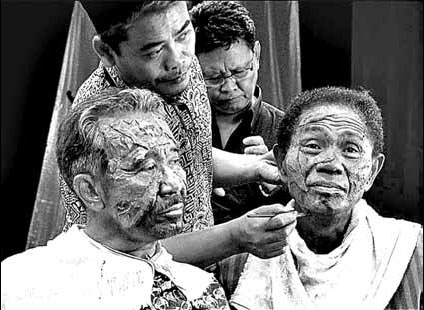
The death squad members molded their performances to fit their favorite film genres. One scene was staged as a western, with Mr. Congo and his comically portly sidekick wearing cowboy hats, while others were done as film noir or horror.
"You watch this, and you know that in a way, it's real," said Mr. Herzog. "And yet you cannot believe that reality can take forms as crazy and weird as that."
In Berlin, one audience member suggested that what Mr. Oppenheimer had done was "like having SS officers re-enact the Holocaust," to which he said he replied that "it isn't, because the Nazis are no longer in power," whereas the Indonesian death squad members still serve and enjoy the protection of the state.
Some question whether the film is a documentary. Mr. Oppenheimer offers a nuanced view. He distinguishes between the observational style of the film's first half and what comes after it pivots to the re-enactments.
"I think it almost stops being a documentary altogether," he said. "It becomes a kind of hallucinatory aria, a kind of fever dream." At that point, he added, the film "transcends documentary."
The New York Times
|
In "The Act of Killing," re-enactments of murders committed in 1965 were set in the killers' favorite film genres. Drafthouse Films |
(China Daily 07/21/2013 page12)