Pleas for quiet, but city still roars
Updated: 2013-07-28 08:28
By Emily S. Rueb(The New York Times)
|
|||||||


|
New Yorkers for years have tried to curb the city's roar: a decibel machine in 1929, a "Stop the Noise" sign in 1941, top right, and an offending jackhammer, 1961. William J. McGarry |
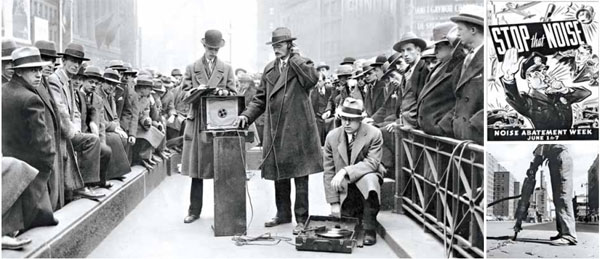
New Yorkers have complained about noise for as long as anyone will listen.
To silence the city, or at least quiet it down, the police have yanked hand organs and loud radios. Traffic lights replaced whistle-blowing police officers. Horses and subway cars were outfitted with rubber soles. Jet planes were rerouted and clanging garbage trucks redesigned. Yet the racket has thundered on.
Henry J. Stern, who created quiet zones in the 1980s when he was the parks commissioner, summed up the struggle this way: "It's a city, not a cemetery."
Mr. Stern dealt with grievances from those who produced noise and those exposed to it, including a case that shot up to the United States Supreme Court and pitted Rock Against Racism, a group that put on concerts in Central Park, and the police commissioner. "A noisemaker's First Amendment right stops when a listener's Eighth Amendment right is impaired," he said. (The Eighth Amendment of the U.S. Constitution prohibits cruel and unusual punishments.)
And so it has gone for more than a century. Campaigns with aggressive slogans like Operation Soundtrap and The War on Noise came and went, vanquished by a lack of resolve, tight budgets and more pressing problems. Untold thousands of fines were handed out.
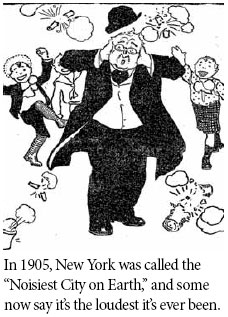
Today, many believe the city is the loudest it has ever been. Sound systems are deliberately cranked up to full volume in restaurants, gyms and stores - with the goal of creating a frenzied environment in which people want to spend money. And outside, construction, hovering helicopters and idling trucks have drowned out the few successes the city has had.
But public outrage was perhaps louder in the early 1900s, when Julia Barnett Rice, a physician and socialite, organized the Society for the Suppression of Unnecessary Noise.
Dr. Rice lobbied Congress to pass one of the earliest antinoise laws, one that prohibited "unnecessary" steamboat whistling that could "murder sleep
and therefore man." She posted signs around hospitals, churches and schools.
Dr. Rice's effort faded, but science came up with new ways to quantify the din. In the 1920s, a group of acoustical experts used the decibel, named after Alexander Graham Bell, to figure out just how loud the city was.
Men with rounded glasses and porkpie hats from the Noise Abatement Commission created a roving laboratory on the back of a flatbed truck. In "City Noise," an exquisitely detailed report of their findings published in 1930, they concluded that New York was so loud that a Bengal tiger could "roar or snarl indefinitely" without attracting attention.
There was tremendous optimism that a scientist's gauge could solve the problem, said Emily Thompson, a historian at Princeton University.
"Measuring was easy," she said. "Control was harder."
In 1936, the city passed its first comprehensive noise code. There was a $1 fine for the first offense.
In the 1970s, car alarms, truck back-up beepers, the component car stereo and roaring jet planes rattled the city. Noise was now considered a pollutant.
In 1972, the city's noise code was overhauled. Horn-honking "when there is no imminent danger" became a criminal offense. The Sanitation Department redesigned its garbage trucks to operate at a noise level no louder than a vacuum cleaner.
In 1973, inspectors staked out busy intersections. One outraged driver who was given a ticket near the Lincoln Tunnel shouted, "Didn't you see that guy cut me off?"
But plans to enforce and educate the public about the code faded after a wave of budget cuts in the 1980s. In 1998, Mayor Rudolph W. Giuliani began a Civility Campaign, in which he said he was determined to stop annoying behavior, like littering and blaring car alarms, before it started. The police began mapping complaints about loud music along with major crimes, and in 2000 issued 4,866 noise summonses.
When he took office, Mayor Michael R. Bloomberg vowed that frequently dismissed noise infractions would be enforced. In January 2002, he announced plans for a 311 Citizen Service Center.
When the code took effect two years later, few noticed or cared. Except when the noise police arrived. The driver of an ice-cream truck , when given a $30 fine, said he would lose business if he did not play the jingle.
This year, the Transportation Department began removing "Do Not Honk" signs to declutter lampposts. But antinoise activists said it acknowledged defeat.
Arline L. Bronzaft, a psychologist who helped erect the signs 27 years ago, said, "I wish we could regulate good manners."
The New York Times
(China Daily 07/28/2013 page9)