Progress in struggle to retire lab chimps
Updated: 2013-07-28 08:29
By James Gorman(The New York Times)
|
|||||||


|
Research agencies have decided to cut back on the use of chimpanzees in research. A sanctuary in Seattle. Photographs by Leah Nash for The New York Times |
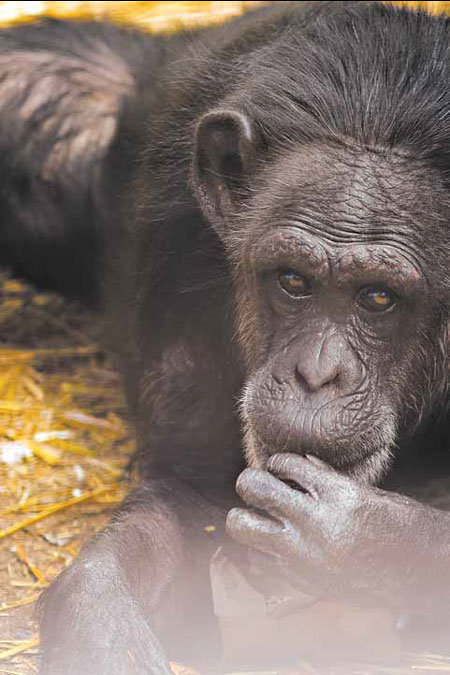

Jane Goodall says it was a "Damascus moment" that turned her from the groundbreaking studies of chimpanzees in the wild that revealed their complex social and emotional lives, to a life of nomadic global activism on their behalf.
That moment, at a conference on chimps nearly 27 years ago, led her to begin a campaign to protect chimps, wild and captive, and inspired numerous animal welfare activists who took up the cause.
Last month, activists had two major victories when two United States agencies took steps that together may come close to halting research on chimps.
On June 26, Dr. Francis S. Collins, the director of the National Institutes of Health in Maryland, announced that more than 300 of the 360 chimpanzees owned by the N.I.H. would be retired to sanctuaries over the next few years.
That followed a proposal two weeks earlier by the United States Fish and Wildlife Service to list all chimpanzees as endangered.
The plan would raise barriers for experimenting on chimps even higher, by requiring a permit for almost all medical research on the animals unless it involved only observation or tests that are part of normal veterinary visits. Permits would be granted only if the research was judged to be for the benefit of chimpanzees.
Dr. Goodall wrote about her longtime studies of chimpanzees in the book, "The Chimpanzees of Gombe: Patterns of Behavior."
"I always felt that I didn't have the credentials to stand up to some of these white-coated lab people," she said, speaking recently from her home in Tanzania. But after her book was published, she said, "I had more self-confidence."
Over the past few years, as animal welfare groups have mounted a strong but pragmatic campaign against invasive experiments like subjecting chimps to vaccines and treatments for human diseases, Dr. Goodall has had the occasional conversation with arguably the ultimate white-coated lab person in Dr. Collins.
"I was impressed from the very beginning," Dr. Goodall said of Dr. Collins. "He agreed something should be done and went ahead and did it."
Dr. Collins, who invited her to speak to the N.I.H. staff, said, "I found her to be remarkably realistic and practical, but also idealistic in terms of her views."
The path to the recent decisions began in June 2010, when the N.I.H. started to move 186 chimps, held in semiretirement in Alamogordo, New Mexico, back into the research stream. They were to go to the Texas Biomedical Research Institute.
"That's what triggered all of this," said Sarah Baeckler Davis of the North American Primate Sanctuary Alliance. "That's when we all yelled and screamed about the move."
Laura Bonar of Animal Protection of New Mexico said the N.I.H. move was so egregious that "the public was outraged."
The animals had been used in research by the Coulston Foundation, at the Alamogordo facility, which closed after many allegations of mistreatment of the chimps. Save the Chimps brought some of the Coulston animals to Florida, where the group has the largest North American chimpanzee sanctuary. Others were still being held at the facility but were not used in research.
Well-known politicians called for a high-level review of the need for chimpanzees in research. Other animal welfare groups rallied to the cause.
The N.I.H. relented, and Dr. Collins asked the Institute of Medicine to perform the study. The report, released in December 2011, concluded that almost no research on chimpanzees was necessary.
Chimpanzees, the report said, should be used only in cases necessary for human health, and even then, the animals should be housed in social groups, with plenty of space and enrichment.
Dr. Collins last month accepted the committee's report.
"Much of chimpanzee research could no longer be justified because we had other ways to get the same answers," Dr. Collins said. "Then you factor into that that chimpanzees are special creatures," he added.
The animal welfare movement will not stop at chimpanzees.
Dr. Goodall said, "Once you admit that we're not the only beings with personalities, minds, capable of thought and emotions, it raises ethical issues about the ways we use and abuse so many other sentient, sapient beings."
The New York Times
(China Daily 07/28/2013 page11)