Ahoy, Hanoi!
Updated: 2013-07-28 08:31
By Hilton Yip(China Daily)
|
|||||||


|
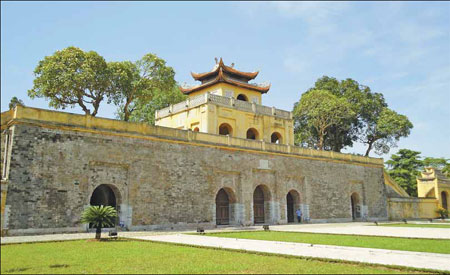
The South Gate of the Imperial Citadel is the former palace of Vietnam’s emperors. It’s a UNESCO World Heritage Site. Photos by Hilton Yip / for China Daily |
|
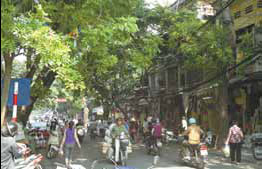
Hanoi's Old Quarter, a maze of streets packed with restaurants, cafes, hotels and shops, is busy, noisy and scenic. |
|
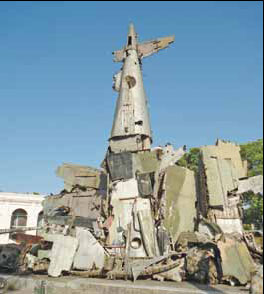
This wreckage heap at the Military History Museum comes from planes that were shot down during the war. |
Vietnam's capital is full of history, and youthful vigor. Hilton Yip explores the city.
As I prepared to cross the road, nervously eyeing the incoming rush of motorbikes and cars, I couldn't help think that what I'd thought of Hanoi was wrong. From what I'd read online, I was expecting the capital to be laidback and stodgy. Instead, I found a city that was both historic and bustling. Hanoi has more than 1,000 years of history, serving most of that time as Vietnam's capital. It boasts historic sites, attractive French-built colonial-era buildings, and scenic lakes. Vietnam's revered leader Ho Chi Minh has several major sites dedicated to him. Hanoi is a busy city. The most noticeable evidence of this is the traffic, most of which is the motorized two-wheel kind, which creates a loud cacophony of honking and rumbling at all times of the day.
I lived in Taipei where motorscooters and motorcycles make up a big part of traffic as well, but Hanoi has Taipei beat both in numbers and decibel levels.
Hanoi is often compared to Ho Chi Minh City in the south.
"Hanoi is more traditional and historic while Ho Chi Minh City is more dynamic, perhaps similar to Beijing and Shanghai," says Minh Trang, a university student and my guide for my first day.
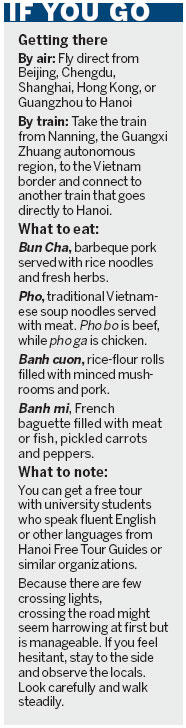
Trang is a member of Hanoi Free Tour Guides, whose student guides offer free tours in several languages. This history and tradition can be found in many places, especially the Old Quarter, the core of the city.
The Old Quarter is a maze of streets packed with restaurants, cafes, hotels and shops, selling all kinds of wares displayed in the open, making it great for strolling and sightseeing.
You can see vendors carrying heavy loads balanced on poles on the streets, while throngs of people sit outside restaurants on sidewalks on small chairs enjoying food and drink.
On Friday, Saturday and Sunday nights, an entire street is closed to vehicular traffic, and a busy outdoor night market runs the whole length up to the Dong Xuan indoor market.
To the south of the quarter is the small but famed Hoan Kiem Lake. At night, the lakeshore is filled with locals, tourists and vendors, enjoying the views and atmosphere.
The Turtle Tower stands on an islet in the lake's center, while the Jade Mountain Temple on the east shore can be visited in the daytime.
The lake bears one of Vietnam's most famous legends - that of a turtle emerging from the lake to take the sword of the Emperor Le Loi who was on a boat.
Hence the name Hoan Kiem, which means "return of the sword". The emperor reasoned the turtle was reclaiming the sword - reminiscent of King Arthur's Excalibur - which was said to have special powers and origins.
The French legacy is clearly evident in European-style buildings, painted in distinctive yellow ochre colors and used as government buildings, stores or tourism.
Many of these building are in the French Quarter, southeast of Hoan Kiem Lake. Hanoi's Opera House is a fine example, as are the nearby National Museum of Vietnamese History and the Revolutionary Museum.
A little further to the west of the Old Quarter are the Military History Museum and the Ho Chi Minh mausoleum. Here, Ho Chi Minh, or "Uncle Ho" as he is respectfully called by locals, can be seen in person.
The mausoleum is located at Bo Dinh Square, where Ho declared Vietnam's independence from France in 1945. Nearby are the Presidential Palace, the Ho Chi Minh Museum, the Ho Chi Minh stilt house (where Ho lived, rather than reside in the palace) and the One-Pillar Pagoda - a small temple built atop a pillar in the middle of a pond.
"Ho Chi Minh was our leader in two wars (against France and the US), and you can go there to understand why he is much loved and respected. It's not just a touristy place but a place that many Vietnamese visit," Trang says.
The Military History Museum features exhibits from ancient wars to the 20th-century conflicts against France and the US. The star attractions are the Vietnam War-era tanks and aircraft outside.
Next to the museum is the Imperial Citadel, a UN World Heritage Site, the palace of Vietnam's emperors before the 19th century. Damaged by past wars, the existing structures are just a small part of the original citadel, though more remains are being excavated.
The best known among Hanoi's temples is the Temple of Literature. Built in 1070, this temple is used to worship Confucius and served as a university - the Imperial Academy, to be precise - until 1802. It played vital roles in religion and education.
The temple is in a large rectangular compound with pleasant gardens, a series of courtyards and the main worship halls at the rear. There are many Chinese inscriptions on the temple's gates, gardens and steles that bear past scholars' names.
The most famous American who was shot down in Hanoi is John McCain, the former senator and presidential candidate.
McCain was held in the Hoa Lo prison, called the "Hanoi Hilton" by Americans. The prison is now a museum, and John McCain's flight suit is on display. The prison was built in the late 20th century by the French to jail Vietnamese independence advocates, and the bleak conditions are fully preserved.
Going back to the beginning, I did cross the road easily. As Trang showed me, what looked foolhardy is actually very manageable.
No mad dash or slow crawl is required. Just look carefully, step onto the road and walk steadily ahead. Vehicles will adjust their speed accordingly, and you'll make it across safely.
I would say that's how I felt about Hanoi - you'll be pleasantly surprised.
Contact the writer at sundayed@chinadaily.com.cn.
(China Daily 07/28/2013 page16)