Scientists debate the riddle of monogamy
Updated: 2013-08-18 07:51
By Carl Zimmer(The New York Times)
|
|||||||


"Monogamy is a problem," said Dieter Lukas of the University of Cambridge.
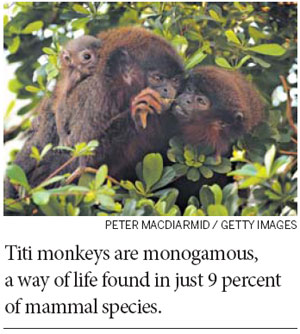
In 9 percent of all mammal species, males and females will share a common territory for more than one breeding season, and in some cases bond for life. This is a problem - a scientific one - because male mammals could theoretically have more offspring by giving up on monogamy and mating with lots of females.
In a new study, Dr. Lukas and his colleague Tim Clutton-Brock suggest that monogamy evolves when females spread out, making it hard for a male to travel around and fend off competing males.
Kit Opie of University College London and his colleagues published a similar study on primates, which are especially monogamous - males and females bond in over a quarter of primate species. The London scientists came to a different conclusion: that the threat of infanticide leads males to stick with only one female, protecting her from other males.
What does this say about men and women?
"The human mating system is extremely flexible," Bernard Chapais of the University of Montreal wrote in a recent review in Evolutionary Anthropology. Only 17 percent of human cultures are strictly monogamous. The vast majority of human societies embrace a mix of marriage types, with some people practicing monogamy and others polygamy.
There are even some societies where a woman may marry several men. And some men and women have secret relationships that last for years while they're married to other people, a kind of dual monogamy. Same-sex marriages acknowledge commitments that in many cases existed long before they won legal recognition.
Each species faces its own special challenges - the climate where it lives, or the food it depends on, or the predators that stalk it - and certain conditions may favor monogamy despite its drawbacks. One source of clues to the origin of human mating lies in our closest relatives, chimpanzees and bonobos. They live in large groups where the females mate with lots of males when they're ovulating. Male chimpanzees will fight with each other for the chance to mate, and they've evolved to produce extra sperm to increase their chances that they get to father a female's young.
Our own ancestors split off from the ancestors of chimpanzees about seven million years ago. Fossils may offer us some clues to how our mating systems evolved after that parting of ways. The hormone levels that course through monogamous primates are different from those of other species, possibly because the males aren't in constant battle for females.
That difference in hormones influences how primates grow in some remarkable ways. For example, the ratio of their finger lengths is different.
In 2011, Emma Nelson of the University of Liverpool and her colleagues looked at the finger bones of ancient hominid fossils. From what they found, they concluded that hominids 4.4 million years ago mated with many females. By about 3.5 million years ago, however, the finger-length ratio indicated that hominids had shifted more toward monogamy.
Our lineage never evolved to be strictly monogamous. But even in polygamous relationships, individual men and women formed long-term bonds - a far cry from the arrangement in chimpanzees.
While the two new studies disagree about the force driving the evolution of monogamy, they do agree on something important. "Once monogamy has evolved, then male care is far more likely," Dr. Opie said.
Once a monogamous primate father starts to stick around, he has the opportunity to raise the odds that his offspring will survive. He can carry them, groom their fur and protect them from attacks.
In our own lineage, however, fathers went further. They had evolved the ability to hunt and scavenge meat, and they were supplying some of that food to their children. "They may have gone beyond what is normal for monogamous primates," said Dr. Opie.
The extra supply of protein and calories that human children started to receive is widely considered a watershed moment in our evolution. It could explain why we have brains far bigger than other mammals.
Brains are hungry organs, demanding 20 times more calories than a similar piece of muscle. Only with a steady supply of energy-rich meat, Dr. Opie suggests, were we able to evolve big brains - and all the mental capacities that come with it.
Because of monogamy, Dr. Opie said, "This could be how humans were able to push through a ceiling in terms of brain size."
The New York Times
(China Daily 08/18/2013 page11)