Immigrants' love of running
Updated: 2013-11-03 08:11
By Lindsay Crouse(The New York Times)
|
|||||||


On a recent foggy Sunday in New York's Central Park, runners lingered near the finish line of a half-marathon, recounting their efforts in Spanish. They had finished the 21-kilometer course before many entrants reached the halfway point.
Julio Sauce, a 41-year-old New Yorker from Ecuador, clutched a glass plaque he had earned for finishing first in his age group. Mr. Sauce said he was tired - but not just from the race.
From 2:30 p.m. Saturday to 12:30 a.m. Sunday, Mr. Sauce had worked as a cook at 44 & X Hells Kitchen, a Midtown restaurant. After the train ride home to Coney Island, he had only three hours of sleep before returning to Manhattan for the early race. Undeterred, he pronounced himself ready for his next big event: the New York City Marathon on November 3.
"Living here is hard work," he said. "But we are used to hard work. Marathons are just more of it."
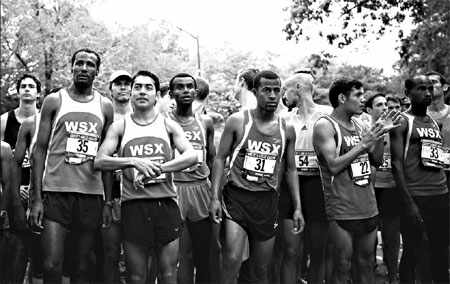
Mr. Sauce belongs to West Side Runners, one of New York City's oldest and fastest running teams. It is also the city's most diverse: nearly all of its 300 members were born outside the United States. Runners from places as far away as Colombia and Gambia, Japan and Brazil, all regularly toe the starting line at weekend road races in matching red-and-white WSX singlets.
The team's Ethiopian runners are world-class. But most are working class, part of New York's Latino community.
They are busboys, dishwashers, construction workers. They are on their feet at enervating jobs all day and often all night. Many do not have health insurance. Most find it difficult to afford the fees New York Road Runners charges for its races, especially the marathon, which costs at least $227. For Mr. Sauce, that is half a week's paycheck.
Bill Staab, the president of West Side Runners, said: "They work unbelievably hard at their jobs, but few of these guys have major successes financially. Whereas success in running is available to everyone."
Hispanic immigrants were drawn to West Side Runners through word of mouth. The Colombian government sent three runners to the New York City Marathon in 1980. After they became top athletes for the newly founded West Side Runners, other local Colombians joined in scores. Then came Ecuadoreans and Mexicans, often migrating from soccer. The club had found its backbone. In the United States, competitive distance running has long been a sport of the relatively affluent and the white.
"Back then, other teams would laugh at us because we were mostly Latino," Mr. Staab said, referring to the 1980s. "There was stigma."
The team's fast white runners were snatched up by sponsored competitors, Mr. Staab said, while the comparably talented Latinos were left behind.
Then something changed.
"We began to beat them," Mr. Staab said. "We became one of the best running teams in New York City."
As the volunteer head of his team, Mr. Staab is part administrator, part benefactor and occasional innkeeper. He helps arrange athletic visas. He pays race entry fees for many members who cannot afford them. He has gone to court with runners caught in the mix-ups that plague people in unfamiliar places with unfamiliar rules and unfamiliar languages. Mr. Staab usually has several Ethiopian runners staying at his two-bedroom apartment on the Upper West Side for weeks or months at a time.
"It's not a big place," he said wryly. "But they're thin; they fit just fine."
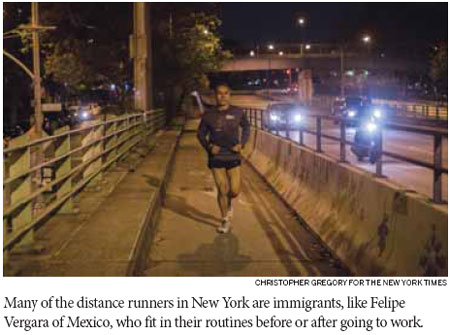
Felipe Vergara, 49, starts his first of two daily workouts at 4:30 a.m., running 12 to 16 kilometers in Prospect Park in Brooklyn. Then he heads to his job as a plumber at 7 a.m.
"As long as I'm at work on time, they don't ask questions," Mr. Vergara said of his bosses.
He runs 16 kilometers in the evening, often with his teammate Angel Confesor.
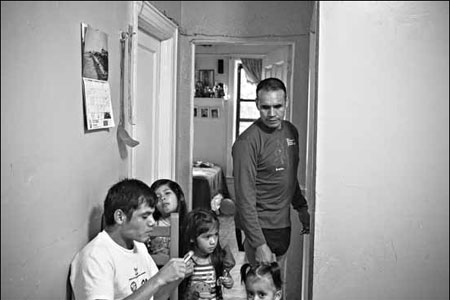
They have been roommates for eight years in Brooklyn. Mr. Vergara supports his four children, who live in Mexico.
Not all runners have been able to cope with the pressures that can complicate an immigrant's experience here. One of the team's fastest runners, who was supporting five sisters and his mother in Colombia, committed suicide in 1990.
Mr. Staab said that some of his faster runners had moved to Mexico, where they have a better chance of winning prize money. For Mr. Sauce, the sport offers something to pass on to his children.
"Sometimes when I wake up after getting home late, I say I'm tired," said Mr. Sauce, who has run 11 New York City Marathons. "But I always get up. It's an example. Now, my son tells me, 'When I grow up, I want to win the New York Marathon.' I guess it's sort of an American dream."
The New York Times
|
Members of the West Side Runners in Central Park. Felipe Vergara, below on right, in his apartment, which he shares with fellow runner Angel Confesor. Photographs by Christopher Gregory for The New York Times |
(China Daily 11/03/2013 page9)