Italian innovation
Updated: 2014-02-16 08:36
By Ye Jun(China Daily)
|
|||||||


Chef Samuel Zucca brings flavors of his homeland to Beijing diners with a few twists. Ye Jun grabs a soup bowl and listens.
Italian restaurant Daccapo's recently arrived chef de cuisine Samuel Zucca has quite a few tricks up his sleeves. Diners can expect some dishes not quite like what they find at other Italian restaurants in Beijing.
His Italian vegetable soup, for example, has as many as 15 kinds of vegetables. Although it has so many ingredients, the soup does not look disorderly. In fact, the great number of colors gives it a beautiful contrast, as well as a good taste.
The secret is to prepare these vegetables with different textures in a timely sequence - hard ones first, and soft ones later.
"Potato, carrot, beans and celery go in first, broccoli and cauliflower in the middle, zucchini and spinach go in last," he says.
Moreover, when the soup is prepared, the chef refrigerates it for one night, to intensify flavor.
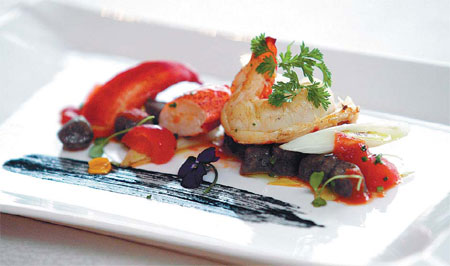
Another example is his black-olive gnocchi - not often seen in the Chinese capital. The dark pasta has the strong taste of black olives, which combine well with flour. The idea of the gnocchi comes from the classic version, which usually uses potato, pumpkin, spinach or ricotta cheese.
Chef Zucca is from Grado, a small island in the Friuli region of northeast Italy in the Adriatic Sea. The place produces a lot of seafood, good wine and San Daniele ham, which the chef says is better and more expensive than Parma ham.
Now 39, he started cooking at the age of 13, and he has worked in a professional kitchen for more than 20 years. His entire family works in hospitality. His father is also a chef.
This is his first time in China, after working in many five-star hotels and restaurants in Europe and Asia. He worked in many different countries, including the United States, England, Australia, Germany, Vietnam, Thailand and South Korea.
"Changing places to work every two or three years helps me get motivated," he says. "Each place has a different culture and good memories."
Working in the kitchen is all about experience, according to the chef. Therefore he needs to show his team in the kitchen how to prepare dishes, even though he has already given them a recipe. Ingredients here are different from, for example, South Korea. Therefore, one has to make adjustments. Only in pastry preparation is it OK to simply follow a recipe.
"My philosophy is a very classic Italian plate, but the preparation is different," he says. In other words, he presents traditional recipes in a modern way.
His focus is not just on taste and quality, but also health.
"I like to use red chili, which is good for the heart," says the chef, who also prefers to season dishes with white pepper instead of black.
Zucca uses purple-colored tuna, which he finds to be fresher tasting than light-colored flesh. He also follows the seasons in pursuit of ingredients.
His winter menu is available until March. "It has some heavy food with more calories, following Italian tradition, but with a focus on balance," he says.
Highlights on the menu include a roast pork belly with chanterelle and baby vegetables, seared scallops, pumpkin-stuffed agnolotti, and veal tenderloin medallions.
The pork belly is roasted at 62 C for 48 hours to be really tender.
But the chef has more. He is planning to serve chicken-liver-with-pumpkin soup, as he knows Chinese people would like it. He is also eager to cook veal cheek with the sous vide method, vacuum-sealed cooking for long hours in a controlled, low-temperature water bath, so that it comes to the plate as tender as butter.
Zucca uses many imported meats and fishes - sea bass from Chile, scallops from Canada and carpaccio from Australia.
All of his dishes, even the meats, come with many side dishes of vegetables and flower garnishes to give diners something both beautiful and healthy.
"People eat not just to fill the stomach but also to enjoy," he says.
Contact the writer at yejun@chinadaily.com.cn.
|
Black-olive gnocchi with fresh lobster highlights the winter menu. Provided to China Daily |
|
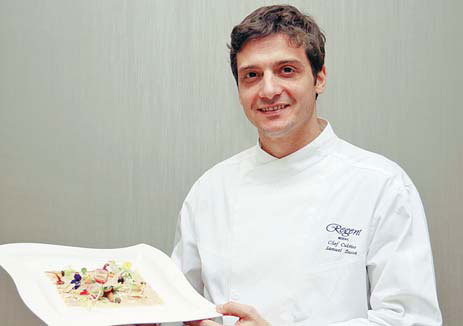
Samuel Zucca adds a fresh touch to traditional Italian cuisine. Ye Jun / China Daily |
(China Daily 02/16/2014 page7)