World
Cancun climate deal holds out hope
By Connie Hedegaard (China Daily)
Updated: 2010-12-22 08:06
 |
Large Medium Small |
Although Christmas and a cold winter are upon us, there is good reason to reflect on global warming and the recent climate change conference in Cancun, Mexico. It may seem unreal in Europe now when our teeth are chattering, but 2010 was actually one of the hottest years on record.
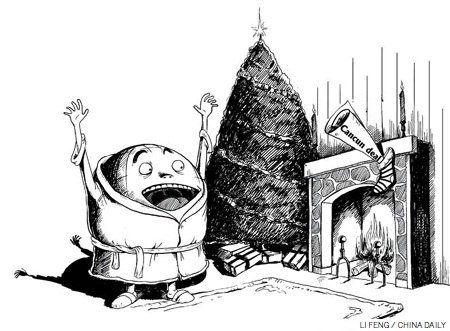
Weather-related catastrophes, from fires in Moscow to floods in Pakistan and Venezuela are a forewarning of things to come, unless we deal with the challenge of climate change. That's why the package of decisions that came out of the conference in Cancun may well be this year's most important Christmas present.
What is in the package? Quite a bit. And Europe can be proud of having contributed significantly to the content.
The key points of the agreement concluded in Cancun are based on the results we achieved in Copenhagen last year, including the 2 C target and the pledges that countries made in the run-up to Copenhagen. It comprises the commitment of developed nations to provide finance for developing countries - $30 billion in the short term (2010-2012) and $100 billion annually by 2020. And it includes the rules for transparency - how countries measure and report their emissions. The last point may sound a bit technical, but in fact it is very political, as the rules are key to ensuring that countries deliver on their promises.
We also need the rules to be able to assess the impact of climate projects in developing countries that are financed with European taxpayers' money. In Cancun, all countries - except for Bolivia - agreed to what was agreed in Copenhagen.
But Cancun also took new steps. Besides tightened rules on transparency, the agreement contains detailed decisions for improved cooperation on technology between North and South, an agreement on climate adaptation in developing countries and a mechanism to reverse deforestation in the Tropics. These are substantial decisions that will lead to concrete action, and decisions with a clear European fingerprint.
For example, Andreas Carlgren, Swedish environment minister, and his counterpart from Grenada were appointed to fine-tune the wording of the agreement's overarching shared vision. Along with Algeria, Spanish State Secretary Teresa Ribera forged the compromise on adaptation. In cooperation with Brazil, Chris Huhne, British secretary of state for energy and climate change, was asked to handle the delicate issue of the future of the Kyoto Protocol and find out how to anchor the reduction pledges from Copenhagen in the new agreement. And the newly appointed environment minister of France led the consultations on technology.
In other words, Europe played a key role in the political stage of the negotiations. We have strived to push things forward at the technical level with a steady stream of analyses, text input and suggestions, and in relation to the strategy.
You don't have to take my word for that. Mexican Foreign Minister Patricia Espinosa explicitly said at a meeting with the European Union (EU) on the last day of negotiations that without the constructive work of Europe it would have been impossible to bring the process back on track. A key reason why Europe has been able to make its mark on the agreement and help strengthen its ambition is that in Cancun, we managed to collaborate constructively and communicate in a clear and coordinated manner.
It has long been said that Europe must speak with one voice, but there cannot be only one voice. Rather, we should decide on the messages together and then communicate them clearly and consistently to the outside world. That's what we did in Cancun. And that's what we should be doing in the future to ensure that Europe's word has an influence worthy of the world's largest economy.
Cancun did not solve everything. The reduction commitments are not enough to keep the temperature increase below 2 degrees. There are other outstanding issues, too, such as the legal form of the agreement and how to provide the long-term finance. But Cancun proved that the multilateral process could deliver results. Without an agreement the UN process would have been in imminent danger.
Politicians and the public may have lost faith in the process and discarded it - with nothing to put in its place. Now we have a deal. But there is still much work ahead of us. Both internationally, where we must still deal with the outstanding issues, and domestically where we now have to deliver on what has been decided. In Europe we are already working on it.
Next year we present a road map for how we can create an intelligent, innovative low-carbon economy by 2050. We do this for the environment, but we also do it for the sake of competitiveness and energy security. In a world with ever more people and fewer fossil energy resources, it goes without saying that the winners will be the ones who are independent of oscillating oil prices, and who can provide energy efficient and innovative solutions.
If there is a task that the EU should take time to address, it is the task of getting energy security, economic growth and climate conservation to work in unison. The very core of our community is to take on the challenges together, with which EU member states cannot deal on their own. That's why it was so encouraging that the EU acted in a constructive and coordinated way in Cancun, and that's why the agreement in Cancun is a victory. Not only for the skillful Mexican presidency and for the multilateral process, but certainly also for Europe.
The author is European commissioner for climate action.