Economy
Labor market is imbalanced
By Zhang Zhouxiang (China Daily)
Updated: 2011-02-24 07:38
 |
Large Medium Small |
Many Chinese cities have made it a practice to hold two separate recruitment fairs simultaneously - one for college graduates, the other for migrant workers. But the dividing line between graduates and migrant workers is no longer as clear as before. At a recent recruitment fair for migrant workers in Rizhao, Shandong province, more than 50 percent of the applicants were graduates. Similar cases have been reported from many other cities.
With jobs getting scarcer, an increasing number of graduates have taken up jobs that don't require a college diploma. Earlier, such jobs used to be taken up only by migrant workers. The latest survey of the All-China Federation of Trade Unions (ACFTU) shows that about 20.4 percent of the migrant workers have a college diploma. The percentage is even higher, 25.3, among the younger group.
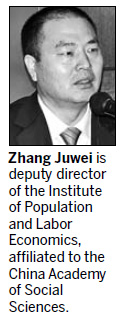
This trend reflects the imbalance between demand and supply in the country's labor market and will continue for some time, says Zhang Juwei, a professor at and deputy director of the Institute of Population and Labor Economics, affiliated to the China Academy of Social Sciences.
"The largest group of graduates who have taken up jobs that don't require a college diploma has become blue-collar workers," says Zhang, who has been studying the labor problems in the country for a long time. "Many other graduates have entered simple service sectors like security and housekeeping."
Disproportionate availability of jobs across industries is the prime cause of the trend, he says. The number of students graduating from colleges multiplied from 3.3 million in 2005 to 5.59 million in 2008. The graduates generally are employed in service sectors and work at office.
Though there are no data on the precise nature of jobs that migrant workers with college diplomas do, the ACFTU survey shows 81.7 percent of the second-generation migrant workers work in the second industry such as manufacturing and 18 percent in the third or services industry. This indicates young migrant workers constitute the main labor force in the second industry, and according to some reports, more graduates are entering the construction sector, which is part of the second industry.
Zhang says the country's relatively backward economic structure and inferior position in the world industrial chain is the cause of this imbalance. China's economic growth has relied heavily on the second industry, which accounts for about half of the total economic output, while the third industry accounts for only about 40 percent, much lower than in most developed countries.
Besides, China is still downstream in the global industrial chain, which deprives it of creating many jobs. "Many job opportunities such as designing, research and development, and marketing appeal to and need people with higher qualifications but they are not properly or adequately distributed in China, for many products made here are designed abroad."
Take iPhone for instance. While foreign designers and researchers work out how to add value to the product and attract more consumers, Chinese workers only assemble and package them. That's why college graduates may have fewer opportunities in China than abroad. Having compared Chinese and foreign college graduates, Zhang found that less than 3 percent of the country's graduates are likely to start their own business compared with 20 percent in developed countries. That dries up many job opportunities, because if one person starts a business, he/she could provide employment to several others.
It is inevitable that more college graduates will become blue-collar workers in the future, which will enhance the average educational level of workers. "The entry threshold in many professions is rising. Many manufacturing enterprises already want applicants to have a college diploma." This phenomenon is not uncommon in developed countries.
Developed countries don't have the concept of migrant workers. Instead, college graduates are divided into two categories: fully employed or partly employed. Partly employed graduates often have unstable jobs without good pay or perks, something that is common to Chinese migrant workers.
About 80 percent of American college graduates who responded to a survey said the most important thing for them was to work, even it was part-time. In Japan, one out of every six graduate is unemployed, and many part-time workers have to do full-time jobs.
The situation in China is no different. "The imbalance between demand and supply in the labor market is serious, though the accelerated upgrade of the manufacturing industry and development of the third industry will boost the need for personnel with higher qualifications and skills."
Zhang, however, says that even if college graduates find a job in relatively high-end services like designing and marketing, they should not expect higher starting salaries than migrant workers, because their contribution to the economy is not much different in the beginning. College graduates' average starting pay is less than 1,500 yuan ($227) a month and migrant workers' is about 1,200 yuan, though the latest data from the National Bureau of Statistics show the average salary of migrant workers is slightly higher than that of fresh graduates and according to the ACFTU survey, the average young migrant worker earns about 1,747 yuan a month.
Will that prevent many people from pursuing higher education, which is also a form of investment? Zhang does not think so. "Fresh college graduates might share the same starting salary and even do the same job that migrant workers do, but their career will vary greatly in the future."
In the coming years, jobs will require continuous learning of more skills, he says. And the greatest advantage higher education offers is the art of learning and mastering new technologies. "After all, the future belongs to those with knowledge."
(China Daily 02/24/2011 page9)
| 分享按鈕 |