Red-hot Shaoshan
|
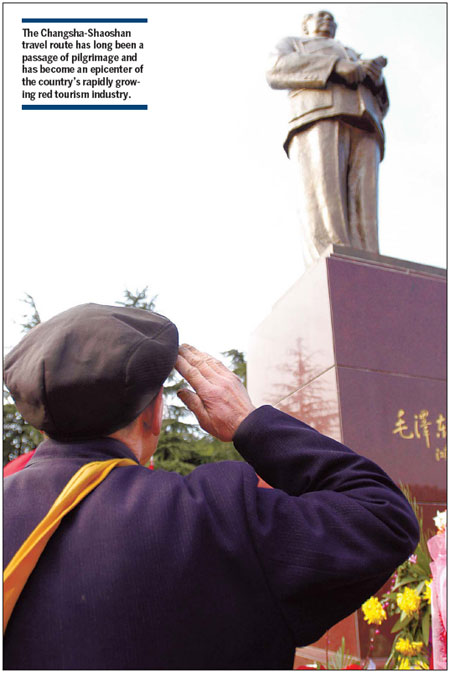
A veteran salutes the statue of Mao Zedong in Shaoshan, the birthplace of New China's founding father. Zhang Jingming / Asia News Photo |
|
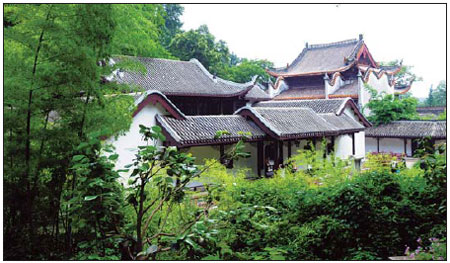
The 1,000-year-old Yuelu Academy is where Mao went to high school. Qing Hua / China Photo Press |
|
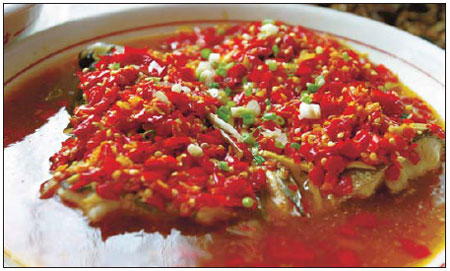
Hunan dishes are known for their liberal use of chili peppers. Wu Yan / for China Daily |
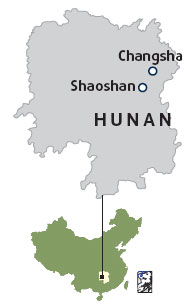
Chairman Mao Zedong's birthplace in Hunan is as much about revolutionary zeal as about crimson foods with a spicy zest. Erik Nilsson reports.
It's the chili pepper's searing spiciness and crimson color that make it the totem of the Hunan spirit. Most natives espouse a philosophy of you are what you eat; in this case, they say, that means fiery and red. So locally venerated and associated with revolutionary vim is the chili, that statues of these fire fruits crown several government buildings in the provincial capital, Changsha.
A firebrand revolutionary ethos has long been a hallmark of this swath of the country's heartland, which has nurtured a legion of red heroes - among them, Peng Dehuai, Liu Shaoqi and Zhu Rongji.
And Shaoshan is also the birthplace of that son of Hunan who became the father of New China, Chairman Mao Zedong, whose zeal for spicy fare and revolution are legendary.
Consequently, the Changsha-Shaoshan travel route has long been a passage of pilgrimage and has become an epicenter of the country's rapidly growing red tourism industry, while also luring foodies with a penchant for pungent nosh.
Spicy offerings are today served in local restaurants contrived to conjure red nostalgia, places such as Xiang Cun Chai Fang (Hunan Village Firewood House) and Mao's Family Restaurant, where portraits of Mao watch over diners savoring his favorite foods.
And the Changsha-Shaoshan circuit is arguably the best locale for sampling what later - because of his celebrated adoration of it - became known as Mao's red braised pork.
Mao likely developed his preference for pork during his childhood in Shaoshan, about 100 km south of Changsha. Pig farming remains the hamlet's largest industry after Mao-based tourism. Pork production accounted for 15 percent of the village economy, while tourism occupied the other 85 percent in 2007, village chief Mao Yushi told China Daily that year.
Travelers of the Changsha-Shaoshan route can not only taste Mao's favorite foods but also see where his mother prepared his childhood meals - the home cooking that fostered his palate - in the kitchen of the 13-room mud-brick farmhouse in which he was born.
The adobe structure's fantastic feng shui comes from its location between the heel of a forested mount and a shimmering lotus pond.
Inside, mostly original farming and cooking implements hang among several pieces of the family's furniture.
Mao's childhood home is the red giant in the constellation of sites commemorating Mao scattered throughout Shaoshan and, consequently, has the most gravitational pull for tourists.
Dishui Cave is where Mao spent 11 days in 1966 poring over the writings of iconoclast Lu Xun (1881-1936) and pondering the onset of the "cultural revolution" (1966-1976).
The Mao Zedong Exhibition Hall, opened in 2008, features 1,008 historical displays, such as his official car and wax-figure depictions of farmers greeting him upon his return at the dawn of the "cultural revolution".
Other sites include the Mao Ancestral Hall, the Steles Forest of Mao's Poems and Mao Zedong Square.
Departing from Shaoshan as the 16-year-old Mao did, travelers can follow his path to the 1,000-year-old Yuelu Academy, where the foremost founder of the People's Republic went to high school.
This place of learning - one of the top four institutions for classical studies in the arc of Chinese history - is wedged between scenic Mount Yuelu, which the late leader enjoyed climbing, and Xiangjiang River, in which he enjoyed swimming.
Dabbed across the Xiangjiang's dancing surface is a 5-km-long streak of land called Orange Isle. This was Mao's place of escape and contemplation during his formative school years.
The island's monumental influence in sculpting the late leader's early life has, in turn, shaped Orange Isle after his death - most dramatically, with the 2009 completion of a 3,500-square-meter stone statue of Mao based on a 1925 photograph.
It's the world's biggest Mao statue, rising from the world's largest inland river island.
The 32-meter-high, 83-meter-long, 42-meter-wide rock visage of New China's founding father appears as the Chinese version of Mount Rushmore.
Visitors to the island can, literally, step into Mao's heart to get a better understanding of his writings and life by passing through the doors in his statue's chest and into an exhibition center showcasing his works and belongings.
And it should be no surprise that two motifs pervade the displays here, as they do in the hearts of most Hunanese - red revolution and chili peppers.
(China Daily 01/20/2011 page19)