'Red tourism' raises hopes
|
Tourists watch a performance at Huogongdian, an eating and entertainment district in Changsha, capital of Hunan province, on Feb 4. According to official figures, both the number of tourists to visit Hunan and the amount of tourism revenue collected in Hunan during the Spring Festival have increased by 30 percent over the previous year. Photos by Duan Yan / China Daily and Long Hongtao / Xinhua |

|
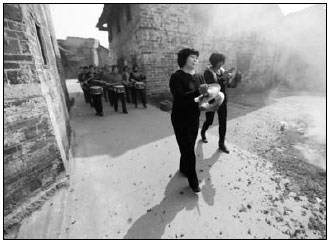
Residents of Baishidu village on Feb 5 welcome tourists attracted by "red tourism". |
YIZHANG, Hunan - Baishidu village used to be quiet and secluded during the Chinese lunar new year.
This Spring Festival, though, the old revolutionary base in Yizhang county of Central China's Hunan province came to life, its villagers beating drums and dancing along to revolutionary songs to welcome tourists from neighboring provinces.
The change, in part, is the result of "red tourism", a name given to the industry that has sprung up around sites associated with the Chinese Communist Revolution. Baishidu residents have recently recognized that such tourism presents a new means of reviving their hometown and protecting their old courtyards and beautiful views of mountain scenery.
The village gained fame from a visit by four leaders who founded the New China in 1949.
Along the way of the famous Long March undertaken by the Red Army in 1934, Chairman Mao Zedong and premier Zhou Enlai arrived at the village and stayed for three days, before moving on to break through the blockades of the Kuomintangarmy.
And Zhu De and Chen Yi, two military leaders of the Communist Party of China who led a large uprising in 1928, also had a brief stay in the village.
"My mom used to tell me the stories of how the Red Army soldiers limped to the villagers' houses and were offered food and accommodations," Kuang Chaode, a 54-year-old local resident, said with a sense of pride.
"They chose our house because there are many doors," he said. "If the enemy arrived, the Red Army soldiers could evacuate through all of those doors."
Yet, even with such a rich history, the village has not escaped the forces of modernization. As is often the case in rural places, many young residents of Baishidu village have migrated to big cities to seek jobs.
As a result, some of the old houses where they had lived now stand abandoned while others have been replaced by modern concrete buildings.
In the hopes of bringing in more revenue from tourism, villagers chipped in to make improvements, repairing houses that had once lodged top Party leaders, building roads and erecting signs to guide visitors.
The villagers are not alone in their attempts to make money from red tourism, said He Lifen, a Yizhangpublicityofficial.
In 2010, Yizhang county government invested 310 million yuan ($47 million) to renovate and improve the infrastructure of major historical sites.
China's giant network of high-speed railroads has also proved a benefit.
"Now it only takes two hours for tourists from Guangdong province to come here," said Kuang Pingyi, a 55-year-old photographer at Yizhang's Baishidu village, who is a volunteer guide for red tourism. Guangdong is a major source of tourists to Hunan.
As a result, more than 2.1 million people visited the county last year, up 72 percent from 2009.
The total revenue from tourism reached 1.4 billion yuan for the county, a rise of 77 percent from the previous year.
Throughout the country, red tourism programs have transformed mountain villages into attractions for domestic tourists who are interested in the country's revolutionary history.
According to Shao Qiwei, chief of the National Tourism Administration, the red tourism industry has expanded rapidly in the past six years. By the end of 2010, the total number of tourists attracted by revolutionary themes was around 1.3 billion, and the combined revenue produced was 400 billion yuan.
In Yizhang, red tourism has just started, according to He, the publicity official for the county. "There are lots of things that need to be done in the future."
Kuang Pingyi and his neighbors have been writing reports in search of more support from the local government. Among other requests, they called on the government to establish new bus stops.
"We also need to clean up the polluted river," Kuang said. "We can't do this without the government's support."
China Daily
(China Daily 02/12/2011 page4)