Jade-colored pots
|
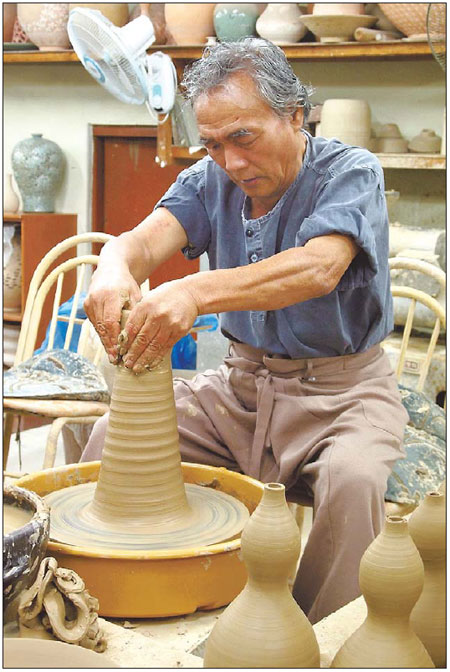
Master potter Kim Bok-han has been listed as one of South Korea's national treasures, and his work is prized by museum curators around the world. Provided to China Daily |
|
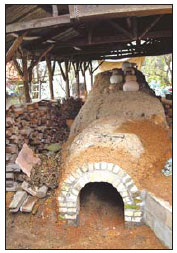
Firewood provides the steady high heat needed in the kiln. Provided to China Daily |
Korean celadon, a beautiful translucent green, is treasured by collectors in and out of the country. Pauline D. Loh visits a kiln in Icheon to see how this traditional ceramic is made.
The sky was gray and overcast. A cold front from Mongolia had descended, blanketing the Korean Peninsula in a misty veil. As we crossed the Hangang River that divides Seoul in two, the metal-colored waterway faded in and out of the thin fog. About an hour later, the expressways are behind us, and as we entered the country roads, we started seeing fields of rice, their heads heavy with fat golden grains. Persimmon trees marked the remaining kilometers, their fruits nodding on bare branches like little orange lanterns.
We were on our way to Icheon, a potters' village where the best celadon in South Korea is made.
On the bus, we were given a crash course on Korean celadon by our guide, Ginny. The green celadon first came to Korea from China in the ninth century and its beautiful kingfisher-blue glaze made it popular with the imperial and aristocratic households - so much so that local potters were encouraged to duplicate the style and make their own collections.
After a decade of experimenting, celadon became an art form that became distinctly Korean as master potters applied their own techniques. During the Koryo Dynasty (918-1392), Korean celadon reached its peak.
These days, celadon potters are congregated in two villages, one of which is Icheon where we were heading.
Our bus soon backed into a tiny courtyard with traditional buildings on both sides and the ubiquitous persimmon tree in the center. At the far side, we could see a brick kiln covered by a thatched roof. This is the kiln of Kim Bok-han, a master potter who has already been listed as a national treasure. His works are collected by museums worldwide, including the New York Metropolitan.
The master potter himself was sitting under the persimmon tree, feeding a baby chicken hardly out of its down coat. When he saw our party, he rose and led the way to his workshop, taking his place behind the potter's wheel.
For the next five minutes, Master Kim slapped a ball of clay on his wheel and, with a few deft movements worthy of a minimalist dancer, shaped a pot-bellied vase that was so thin it was a wonder it held up.
Behind him, racks of drying vases sat on the wall, waiting for the next process, the carving of the clouds, cranes, bats and other auspicious symbols. A contrasting white clay will be inlaid later.
After the vase hardens, it is sanded, after which more details are etched on the vase - such as the curves of clouds, the feathers, beaks and eyes of the crane, the pine needles on gnarled trunks and the ears and wings of bats. Black clay will be used as inlay this time.
The pot is then fired for the first time. When it comes out, the famous green crackle glaze is added and the vase fired a final time.
The long and complicated molding, drying and firing process claims many casualties and few vases survive the whole procedure, having been eliminated for little imperfections. Even for the masters, only a few vases will eventually find their way to the showrooms, where the vases sell for a commensurate value.
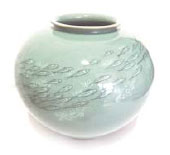
The vase I bought for my husband's collection is an elegant, buxom vase featuring an unusual subject. A school of tiny anchovies swirled around the vase, almost as if in a fish bowl. The simplicity and the clarity of the glaze were what made the vase unusual - a testament to the craftsmanship of the celadon masters.
It is also testimony that China, with its rich treasure trove of culture, shares a lot more than geographical boundaries with its neighbors.
(China Daily 02/27/2011 page16)