Romance of the revolution
 |
|
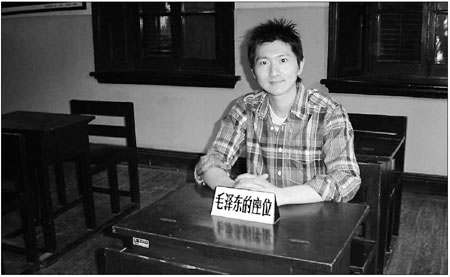
Zhu Hui sits where Chairman Mao once sat at the Hunan First Teachers' School during his trip to Changsha, Hunan province. Photos Provided to China Daily |
Touched by Edgar Snow's celebrated 1937 book, a young entrepreneur spends 70,000 yuan over four months visiting places associated with the Red Army. Xu Lin reports.
American journalist Edgar Snow's popular 1937 book, Red Star over China, has inspired tens of thousands of readers, with its descriptions of the Red Army's Long March and interviews with Communist Party of China (CPC) stalwarts. One of those fans is 31-year-old Zhu Hui, who became interested in the CPC's history after reading it in 2003.
"It's so lively," Zhu says.
Since 2009, Zhu has spent four months and some 70,000 yuan ($10,830) touring nearly 1,000 "red" scenic spots - so called for its association with the communist revolution - in Beijing, Shanghai, Chongqing, as well as cities in nine provinces.
"I was eager to visit these historic places after reading about them. I want to see how different they are from what was described in the book," he says.
Zhu, who is from Xiushui county, Jiangxi province, came to Beijng in 2003, and opened a small advertising company two years later.
He has a collection of some 300 books, including those about Mao and the Long March, memoirs of Red Army generals, books by experts on China from home and abroad, and experts on the history of the CPC.
He particularly cherishes the story of Pulitzer Prize-winning US journalist Harrison Evans Salisbury.
In 1984, Salisbury and his wife, who were then 76 and 70, spent 74 days traveling the Long March route and interviewing about 100 veterans. Despite being on a pacemaker and suffering a heart attack, "he completed the tour and wrote a book about the Long March", Zhu says.
 |
|
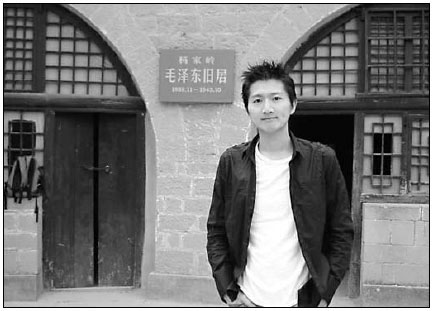
Zhu Hui at the cave where Chairman Mao once lived in Yan'an. |
"I'm young and passionate, so why can't I do it? Besides, my schedule is very flexible as I work for myself."
He undertook his first red trip in October 2009. He stayed in Yan'an, Shaanxi province, a renowned base of the Party before the founding of New China, for about a week.
"I never expected Yan'an to be such a modern city. But living conditions in the 30s were actually much worse than that described in the books I read," he says.
The cave that Mao once lived in was so stifling he could hardly breathe there after a while, he says.
To make sure he covered all the places in a province associated with the revolution, he planned the routes well in advance.
"Most red sightseeing places are remote memorial halls and ruins, so few people find them accessible. Sometimes, I was the sole visitor," he says.
Zhu recalls how difficult it was to locate the Catholic church where the Red Army held a conference before securing the strategic Luding Bridge across the Dadu River in Sichuan province, that took the communists further to Yan'an.
All the leads that he got from the locals turned out to be wrong. He located it after searching for hours, only to find the door locked. A sympathetic girl working in a nearby store finally helped him track down the doorkeeper to get the keys.
"He had locked it as no one had stopped by in over a week. I have had many similar experiences," Zhu says.
He adds that he always reads up extensively on the places he visits and spends considerable time once he is there.
"I may stay for several hours in one old house, and imagine who sat there and what he said. It's so exciting to be on the scene," he says.
He's also thrilled when he is able to verify the accuracy of a historical detail.
He recounts his trip to Dawei, Sichuan province, where the Red Army joined forces with another group of the army after climbing the snow mountains in 1935. According to what he had read, they held an evening party on the ground in front of a Lama temple. But Zhu did not find it there.
"I thought it was the wrong place, until the villagers assured me there was once open ground there. I felt so glad," he says.
In Chengnanzhuang village, Hebei province, he met 86-year-old Zhang Jixin, who saw Chairman Mao when Mao lived in the village for nine days in 1948.
"I was so excited to talk to someone who had experienced that history, and could tell me more about it," Zhu says.
It is also recorded that Chairman Mao's guard asked the farmers not to use a stone roller to crush grain, so as to not disturb Mao's rest. Mao became angry on hearing of it and told his guard to back off. Zhang was also able to confirm this story to Zhu.
"I'm not indulging in a personality cult. I'm just interested in Mao's personal experience, how he became a great leader, " he says.
Zhu never spends time visiting picturesque places near his red destinations.
"It's a waste of time," he says.
"Several decades ago, a group of people sacrificed themselves to build a new China. We should remember them.
"They deserve it."