World walker
 |
|
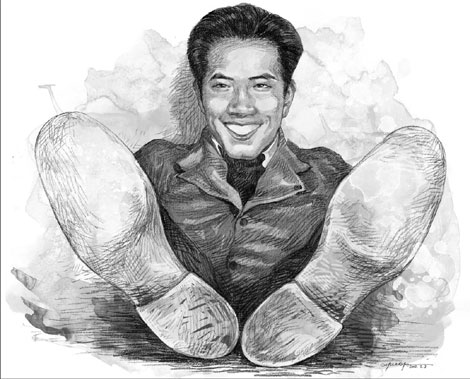
Replica of photo published in the New York Times by Li Min / China Daily |
 |
|
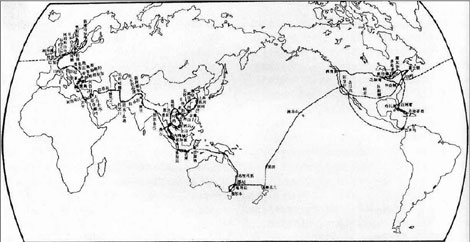
A historical world map in Chinese shows the itinerary of Pan Deming's travels. Provided to China Daily |
 |
|
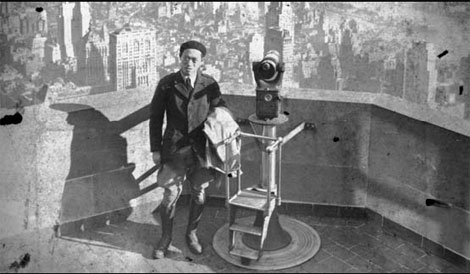
Pan Deming stands at the top of New York's Empire State Building. Provided to China Daily |
A Chinese sojourner who walked and biked the globe 81 years ago has left a legacy for future generations. Wu Ping reports.
Young Chinese associate world travel with self-discovery, romantic encounters and bourgeois sentiment.
But 81 years ago, 22-year-old Pan Deming - aka Poon Tuck-ming - embarked on a journey that was even more enthralling than Jules Verne's Around the World in 80 Days.
He became the first person ever to travel the entire world by bicycle and foot.
Pan Su never met his grandfather but has been proud of his exploits since childhood.
"I was just familiar with his stories because my family constantly talked about my grandfather," Pan Su says.
Pan Deming didn't just encounter amazing places but also met legendary people on his seven-year sojourn. They include literary giant Rabindranath Tagore, Indian independence leader Mahatma Gandhi and then US president Franklin Roosevelt.
Pan set out from Shanghai on June 28, 1930. He returned in 1937 with 1,200 signatures from world leaders and international organizations, and 571 postmarks from more than 40 countries.
Pan Deming was born to a tailor who made clothes for foreigners in Huzhou, Zhejiang province, in 1908. This enabled him to learn English from age 4.
He often wondered why blue-eyed people were so much richer than his compatriots.
When he was about 8 years old, he climbed a mountain outside the city. When he reached the top, he marveled at how big the unknown world was.
But an old monk's words were an even stronger influence on his curiosity about the world.
"If you stand higher, you can see farther, but you will never see through the whole world, no matter how hard you try," the monk said.
Pan and his family moved to Shanghai when he was 16. There, he studied business for two years.
He later opened a Western restaurant in Nanjing, Jiangsu province. More contact with foreigners made him even more determined to see the world.
He read a report in the Shun Pao newspaper about a seven-member China Touring Expedition party that would begin a journey around the globe.
The team's mission, the report said, was to awaken decadent and hedonistic Chinese youths, and show the world what the Chinese nation truly was.
The 22-year-old immediately closed the restaurant and joined the group. The three women and five men set off.
But reality gradually overwhelmed them.
Members quit, one-by-one, because of physical or psychological strains.
In Saigon (now Ho Chi Minh), Vietnam, the group completely unraveled because of conflicting opinions between Pan Deming and the other two.
Pan continued alone. He bought a bicycle and a notebook for eminent figures to sign.
Pan wrote on the first page: "I will take the world as my school, and nature, people and events as my textbooks. I will study by hearing with my own ears and seeing with my own eyes. I'll take the wind, snow, rain, frost, scorching desert, burning sun, morning stars and lonely moon as my scholarship."
The full record of his day-to-day experiences has been lost. But a basic outline emerges from the photos, signatures, visas and tickets sports editor Ji Yide retrieved from waste piles in a Shanghai police station in 1979.
Pan passed away in 1976. But Ji compiled his stories in 21 articles in China Sports Daily and later in a book.
Pan had intimate and unexpected wildlife encounters.
One night, he tied himself to a tree in the Indian jungle and fell asleep. He awoke the next morning to a tiger's gaze.
He beat a gong given to him by a local villager before he'd entered the jungle. The big cat retreated.
Pan was also chased by wasps in Egypt, wrestled a python in Turkey, saw seals repose on the ice near Norway, was struck by a kangaroo in Australia and was nearly trapped in a cave by wild elephants in Myanmar.
But Pan most cherished his human encounters.
He met the great Indian poet Tagore, who gave him a painting and wished him a smooth journey in Chinese on April 22, 1931.
This meaningful meeting was recorded in a photo. The respected Indian National Congress leaders Gandhi and Jawaharlal Nehru also appreciated Pan's grand tour and met him.
The founder of the Republic of Turkey, Kemal Ataturk, received Pan in the presidential palace - a dilapidated temple - and introduced the reforms taking place in the country. Pan was shocked Kemal removed the requirements for women to wear veils. He spent two months exploring Turkey.
It was during the Great Depression that Pan visited the United States. Roosevelt gave him a gold medal in 1934. Roosevelt joked he would join Pan to climb Mount Whitney - the US' highest summit - if he weren't in a wheelchair.
Pan's reception in Germany was different. The Nazi regime had refused him entry until Adolf Hitler wanted to meet him.
On Sept 26, 1933, a limo pulled up to Pan's hotel.
Pan knew the moment had come but couldn't imagine what was waiting for him. When propaganda minister Joseph Goebbels introduced Pan to Hitler, the Fuhrer shouted "Wunderbar ('Wonderful')!"
Hitler promised to provide every convenience, but Pan quickly left the country that would soon plunge four-fifths of world population into misery.
In the Arabian Desert, Pan saved a man, who turned out to be a bandit chief.
Pan was given a new bike, which was stolen near Jerusalem.
He was welcomed by Bedouins, Fijian aborigines and the Maori in New Zealand.
He visited Greece in 1932, when China sent only one athlete to the Los Angeles Olympics.
He learned photography in Bulgaria. He was amazed by Hollywood's filmmaking. He walked the 81-km Panama Canal.
Seven years into his travels, he opted against visiting Japan in protest of the country's invasion of his homeland on Sept 18, 1931.
Instead, Pan finally walked back home.
He arrived in Shanghai on July 6, 1937. The War of Resistance against Japanese Aggression erupted the next day, and Pan had to abandon his plan to visit the Qinghai-Tibet Plateau.
"My grandfather actually thought he'd failed," Pan Su says.
"His mind gradually transformed during his travels. At first, he just wanted to see the world.
"But when he came back, he hoped to contribute to his impoverished homeland through what he'd learned during the seven years on the road. But he could do nothing then."
Pan donated the $100,000 overseas Chinese gave to sponsor his trip to his compatriots fighting the Japanese.
Pan married and had five children in Shanghai.
He was unemployed for a long time and earned a living drawing palace lanterns with his sons' help.
Pan lived the second half of his life quietly.
His descendents are painters. Pan Su owns two studios.
"'Fickleness' and 'superficiality' describe some of today's youth," Pan Su says.
He believes his grandfather's willful spirit has become rare. The 2014 Nanjing Youth Olympic Games (YOG) committee asked him to introduce his grandfather's exploits to youth on the Games 1,000-day countdown last November.
Pan Su is glad to know the committee plans to recruit youths from home and abroad to follow his grandfather's footsteps this year.
"If the youth take the opportunity to really challenge themselves and learn to face difficulties, it will be such a wonderful experience," he says.