To bee, or not to bee
 |
|
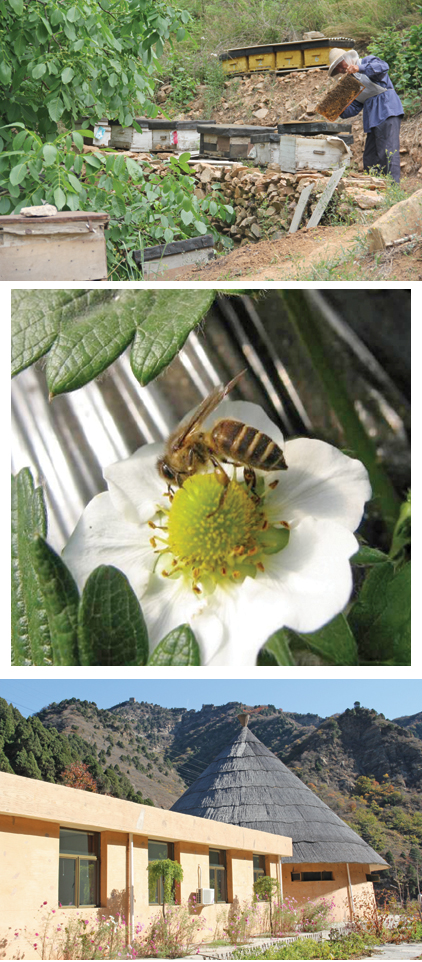
From top: Chen Jinheng, a beekeeper in Miyun county, works on one of his movable-frame hives. A Chinese honeybee pollinates a strawberry flower. The single story office building based on the design of a walnut tree hive is a landmark at a Chinese beekeeping demonstration garden in Miyun county. Photos Provided to China Daily Cheng Anqi / China Daily |
Related readingsa:
Demise of bees disrupts pollination
China's indigenous honeybee is fighting for survival, following the introduction of the productive Italian honeybee and increasing environmental degradation. Stories by Cheng Anqi.
Huangyukou village in Miyun county, northeast Beijing, is famous for Chinese chaste trees (Vitex negundo) that provide most of the nectar for North China's indigenous honeybees - which are mysteriously vanishing.
Chen Jinheng's first colony of honeybees was taken from trees in his backyard when he was 11 years old.
With 10 other beekeepers in the village, Chen started to learn about beekeeping from apiculture books and eventually formed seven colonies (each colony has less than 30,000 honey bees) at the end of the 1960s.
"Western bees are generally kept in movable-frame hives, while Chinese honeybees love living in original hives cut out of walnut tree trunks," says the 76-year-old, pointing out dozens of walnut-tree cylinders nestled on the mountain.
In the late 1970s, the first bunch of Italian beekeepers (and their Italian bees) from Zhejiang province came to Miyun to collect chaste honey. The exotic species, however, transmitted sacbrood virus that often fatally infected the pupae of indigenous bees.
"On several early mornings, a large, dense mass of bees flew away from the farm and I believe they fled to the mountains to take refuge," Shen says.
More than 20 colonies of bees flew away or died, which cost Shen dearly. Each colony was worth 80 yuan ($13) and could feed five people for a month at that time.
After the infection, the number of beekeepers reduced from 10 to three. Since then, Italian bees have become popular nationwide because they produce more royal jelly and are more fertile.
But Shen has a special fondness for China's indigenous honeybee and says the nectar source in Miyun of 6,300 hectares of chaste trees - plus linden and apple trees - produce the best honey.
"Chinese honeybees have a 30 percent higher pollination rate for apple trees compared with Italian bees," Shen says. "Even at low temperatures, the dutiful Chinese bees start work two hours earlier than their counterparts, and they are very good at collecting scattered nectar sources, which puts their Italian adversaries in the shade."
Zhang Jinshuo, a professor at the Institute of Zoology, Chinese Academy of Sciences, says when the temperature is below 14 C, Chinese bees collect on average three times the nectar that Italian bees do, therefore making their honey more nutritious.
This is why Shen introduced another two hives of bees from neighboring Xinglong county of Hebei province, in the 1970s, and there were 10 colonies by the late 1980s, when reform and opening-up led to the rapid expansion of China's apiculture. Even so, most apiarists concentrated on breeding Italian colonies to establish commercial apiaries.
Miyun had only seven colonies of Italian bees in 1980, but four years later there were more than 300 that produced 15 tons of honey every year, posing a threat to the continued existence of indigenous bees.
"Due to heavy rains in 1989 there were floods that washed away swarms of Italian bees in low-lying areas, so Chinese bees were sustainable," Shen recalls.
Later, however, the introduction of pesticides and herbicides used for organic farming killed off more than 200 colonies of bees in Huangyukou.
Li Zhanming, who started beekeeping in 1992 and owns about 30 colonies, says: "Herbicides killed off nearly half of my bees."
At the end of 2009, Rao Shizhong set up a beekeeping cooperative and a 12,600-hectare Chinese beekeeping demonstration garden in order to protect Chinese bees.
Each year, the village's 26 Chinese honeybee keepers produce 5,000 kg of honey, bringing in more than 300,000 yuan ($47,634).
The honey is deep in color and tastes fragrant, and the wholesale price is 13 yuan per kg, three times more than the honey of Italian bees.
Even so, associate professor of Huazhong Agricultural University Zhang Xinjun, from Hubei province, says he is extremely concerned about the future of Chinese bees.
"It is inevitable the Italian bees kill Chinese queen bees," Zhang explains. "They cannot coexist."
A productive Chinese queen bee can lay about 1,500 eggs in 24 hours and has an average lifespan of between three to five years, though they can live up to nine years.
Since the introduction of Italian bees in 1896, the Chinese honeybee's territory has been reduced by more than 75 percent. Only small populations are found in Beijing, Hubei province and Sichuan province's Aba Tibetan and Qiang autonomous prefecture.
Zhang says records from 10 years ago suggest nearly 70 percent of farmers in Shennongjia forest district kept Chinese bees. "But now it has dropped to about 10 percent," he says.
"Over the past century, Italian bees have basically seized the plains areas of China, so that Chinese bees have gradually retreated to the mountains," Zhang says.
In recent years, Chinese bees have died off or fled in huge numbers, but the cause for this is unknown.
"Due to deforestation, land reclamation, excessive use of pesticides, environmental pollution and other factors, the living environment of Chinese bees has been impacted," Zhang says.
Now, apiaries of Chinese bees on both sides of mountain roads, that used to be common, have almost disappeared. Flowers and plants evolve with bees, so they need each other to survive. Without bees or other inset pollinators, you won't get any fruits and vegetables, the professor says.