Han treasures rise from the grave and visit London
London 2012 Olympics Games spectators can sneak a peek into ancient Chinese arts.
The largest-ever exhibition of treasures from Western Han Dynasty (206 BC-AD 24) tombs opened on May 5 at the Fitzwilliam Museum of Cambridge University and will run until Nov 11.
Search for Immortality: Tomb Treasures of Western Han China presents more than 300 ancient tomb treasures from the collections of the Xuzhou Museum in Jiangsu province and the Museum of the Mausoleum of the Nanyue King of the Western Han Dynasty in Guangdong province.
The artifacts belonged to two ancient rulers. The first is Liu Wu, the third king of the Chu Kingdom in what's now Xuzhou. The second is Zhao Mo, the second king of the Nanyue Kingdom in what is now Guangdong's provincial capital Guangzhou.
Exhibition highlights include the rulers' jade burial outfits, painstakingly crafted with thousands of plaques of jade and sewn together with gold or silk. There are also jade burial furnishings and daily items, such as a jade cup used to catch morning dew, to serve the kings' afterlives.
Experts believe jade was widely used in Han tombs to ward off demons and ensure rulers' immortalities.
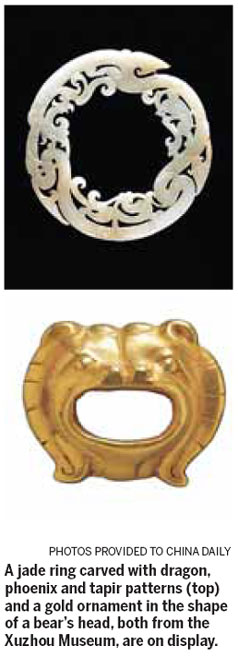
There's also a lacquered wooden coffin decorated with 2,095 jade pieces from "Xiyu", or the Western Regions, in what's now the Xinjiang Uygur autonomous region.
Exquisite gold works include imperial seals with Chinese dragons, a silver jewelry case with Persian patterns and motifs, and clay figurines of guardians, musicians and servants.
Less typical items include a toilet with stepping stones and an armrest, and a ginger grater.
The four-part exhibition replicates the funerary goods' layout in the tombs. This gives patrons a sense of what it would have been like to be the first to rediscover the burial chambers.
Viewers are greeted by guard statues, walk into the main chambers filled with clay statues of servants, musical instruments and other treasures, and then enter the inner sanctum, where the kings are buried.
"We've put together the two museums' best to show the Han period's importance, because it is, in many ways, a defining age in China's history and in the splendor of ancient China's arts, crafts and culture," China Cultural Heritage Exchange Center deputy director Zhou Ming says.
Zhou says the dynasty marked the genesis of contemporary Chinese civilization.
During the Roman Empire time, Han emperors unified vast swaths of what's now known as China under an empire that ruled virtually unchallenged for 400 years.
The Han Dynasty gave the Chinese language its name - Chinese is called "hanyu" in Chinese - as it did to the written script - "hanzi" - and the largest ethnicity - "hanzu".
It also fostered mainstream cultural values, ideologies and institutions that remained central to dynastic China. These include Confucianism and the keju system, which used imperial examinations to select civil servants according to merit rather than hereditary.
The exhibition's opening coincides with the London Games, the 60th anniversary of the queen's coronation and the 40th anniversary of Sino-UK diplomatic relations' establishment.
The show is co-organized by the China Cultural Heritage Exchange Center and the museum.
"I believe the exhibition will play a crucial role in promoting Chinese culture among British viewers," curator James Lin says.
Wu Lingyun, director of the Museum of the Mausoleum of the Nanyue King of Western Han Dynasty, says: "Western viewers may also discover connections among ancient cultures from different parts of the world."
Excavations of the Nanyue King's tomb in the 1980s yielded more than 1,000 sets of ancient treasures, many of which bear foreign influences in their designs, patterns, motifs, craftsmanship and techniques, Wu says.
"Archaeological findings from the King of the State of Chu also reveal certain foreign influences over ancient craftsmanship," Xuzhou Museum director Li Yinde says.
"That means active intercultural exchanges and world trade began as early as the Han Dynasty."