Scent of success
 |
|
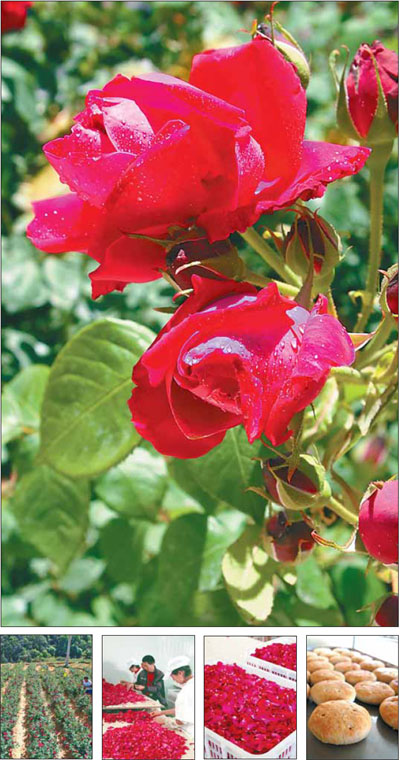
Counter-clockwise from top: This native species of rose in Bajie is intensely aromatic. Rose rows in local farms. The floral harvest keeps the sorting line busy in summer. Freshly baked rose pastries are popular souvenirs from Bajie. Photos by Cang Lide / China Daily |
Journey outside Kunming to visit Bajie, a sleepy little rural enclave in the county of Anning where the flowers are edible, and heady fields of scented roses signal a blooming industry. Pauline D. Loh and Cang Lide get a close sniff at the changes afoot.
We could smell the roses before we saw any, the perfume rising above the dust our multi-purpose vehicle stirred up as it sped along the Anning countryside. We were on our way to visit the rose plantations at Bajie, home of the fresh flower pastries that are fast becoming a tourist must-buy from Yunnan. Bajie is a township in Anning, in the western suburbs of Kunming, the capital of Yunnan province in Southwest China. In recent decades, Bajie had developed into a thriving greenhouse for high quality vegetables that are exported all over the country and to Southeast Asian countries such as Singapore.
The famous cabbage hearts or wa-wa cai is a signature product, as are mushrooms of all sorts, including black truffles in the right season.
Planting roses is a recent industry by comparison. About 30 years ago, families working and staying at the Kunming Steel Plant in Bajie decided to plant roses to beautify the stark environment.
They discovered that the native species they had planted were intensely aromatic and had thick petals that were ideal for eating.
They started experimenting, and soon, petals were picked before the Mid-Autumn Festival to be used as filling for traditional moon cakes. That was just the start.
A Taiwan chef started experimenting with the roses and made them into a filling for a flaky pastry.
Paired with some smart marketing moves, the little fragrant pies soon became popular as souvenirs from Kunming, which is, after all, known as the City of Spring, and known for its flower exports.
The roses soon became a lucrative cash crop as local farmers found a growing demand from the food processing industry. Now, the annual harvest comes from nearly 2,400 mu or about 1,600 hectares.
Other factors helped the rise of rose cultivation. One was the growing numbers of young people leaving the farms for the bright city lights.
With the loss of the able-bodied, older farmers left on the land had to choose less labor-intensive crops. Roses were ideal in that sense.
Once the rose cuttings are properly rooted and planted, they basically need very little care except an occasional eye on serious pest infestations and weekly watering if the weather got too dry.
Harvesting could be done half the year, given the clement weather in the Kunming-Anning hinterland.
That is why many farmers are now turning to a floral harvest, compared to traditional crops such as tobacco, grains or vegetables that need much more daily attention.
Profitability is another push. While a harvest of tobacco leaves may fetch about 2,000 yuan for every mu, roses can bring in as much as 10,000 yuan in a good year.
Yet another reason is the dedicated support from local government agencies here. At Bajie, there are three cooperatives helping the farmers.
At the Xinrun Flower Professionals Cooperative of Anning, the co-op provides farmers with technical support such as research and development and the proper use of pesticides, especially since the petals are used as food.
According to general manager Li Zhenghai, the co-ops play an important role in quality control, and food safety.
They also ensure the rose farmers are protected against volatile market fluctuations, to the extent of buying the harvest at a guaranteed price.
Li says his co-op, set up in 2010, helps rose farmers with over 230 mu of planted land.
Harvesting goes on from April to October each year, with each mu yielding about 600 kilogram of petals.
On an average, each year may yield a total harvest of 200 metric tons of fresh petals, most of which are processed immediately into rose jam. This is then sent to food producers in Kunming.
Many visitors make the excursion to Bajie to visit the rose plantations when the blooms are at their best.
In spring and summer, the air is refreshingly perfumed, and the eyes are rested by the sight of rows of roses, each studded with little gems of deep, dark red.
They can also stop by the pastry factories, where the petals are carefully washed, dried and preserved in sugar to make rose jam, or processed into rose syrup and many other products including rose water, moisturizers and bath salts.
However, the most popular souvenir from Bajie must be the freshly baked rose pastries, the famous fresh flower puffs that are now sold as a Kunming souvenir.
At a little factory that is yet meticulously clean, we saw how the petals were made into jam, weighed in and then covered in flaky pastry.
These little pies were then baked, cooled and packed into individual bags.
Our first bite produced appreciative sighs. The pastry was incredibly light and the filling of rose jam was just sweet enough without being too cloying. Bottles of rose syrup are also available for sale, and they make refreshing drinks.
As China's rural demographics evolve, many more changes will happen. Perhaps the rest of the country can learn from the Bajie farmers' willingness to innovate, and also from the way the local authorities come out in support. They turned what was a losing proposition into a winner, and that's the true scent of success.
What's next? We are going back to sample the black truffles soon, at the invitation of Li and his team. You can bet they are already hatching more plans for another new industry.