Thinking tours
 |
|
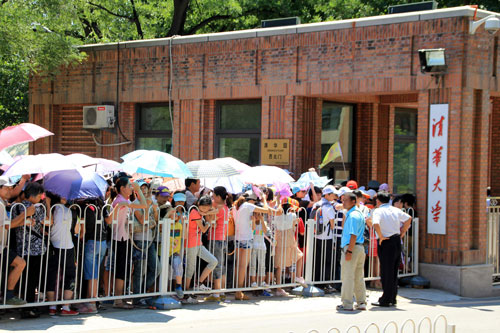
Tourists wait in a line in front of Tsinghua University's gate to visit the campus grounds during the summer vacation. Shi Yan / China Photo Press |
Campus visits have become an in thing in the last few years. Liu Zhihua and Xu Lin find out their unique selling proposition and the downside of these tours.
It is Li Suqun's turn, at last. After waiting in the sweltering heat for half an hour, she reaches the gate of Tsinghua University, to visit the top-ranking campus. Behind her, the waiting line stretches more than 50 meters.
Li, from Nanning, Guangxi Zhuang autonomous region, is on a five-day package tour to Beijing with her husband and son.
The trip includes a free and easy day, and the family chose to visit Tsinghua University and Peking University, just like the rest of the 100 people in her group.
"Reading about them (the universities) in the books is not enough," Li says. "We want our son to have a feel of the prestigious universities himself."
For many Chinese, famous universities across China are not only top seats of learning but also veritable tourist destinations.
Many visitors bring their children not only to admire the sceneries of the campuses. They hope such visits, which present awe-inspiring achievements of the universities and give a sense of the conducive learning environment, will inspire their kids to strive for a place in such ivory towers.
Others visit these institutes of higher learning to realize their unfulfilled dream - they failed to secure a place in the universities, so the least they could do now is to take a walk in the college grounds.
Most of these old and prestigious universities are rich with artworks, memorials and museums, and are in themselves architectural showcases with historical value.
But there are downsides to being a tourist attraction. High tourist traffic also means more litter, thefts and vandalism. Visitors also encroach on the daily lives of students when they throng the canteens and classrooms.
"The tourists are noisy, and some throw trash everywhere. I cannot bear seeing them taking photos everywhere on campus," says Jiang Yuan from the School of Communication and Journalism, Xiamen University, which is a hot tourist spot in the coastal city of Xiamen in Fujian province.
"Once, when we were self-studying in a classroom, a couple asked us to leave so that they could take wedding photos. It's very annoying," says Sun Jiameng from the university.
Wuhan University in Hubei province attracts more than 1 million tourists every year because of its well-known cherry blossoms, as well as its academic achievements and magnificent architecture of the 1930s.
From mid- to late March every year, the season when its 1,000 cherry trees bloom, droves of tourists flood the campus, despite having to pay a 10-yuan ($6.36) entrance fee.
During peak season, the campus receives some 200,000 a day, resulting in traffic chaos, according to the university's official website.
"College campuses should be open to the public, but the amount of visitors should be limited to an appropriate level," says Jiang Yuan, from Xiamen University.
"Too many tourists will harm the students' learning environment. At the same time, they will strain the university's facilities, such as canteens."
Peking University has opened its doors to visitors during holidays since 2007. But it requires organized tour groups to book in advance, and there is a maximum number of daily visitors. Individuals need to register with identifications to enter.
Since 2010, Tsinghua University has adopted similar practices and organized student volunteers to guide visitors.
During the cherry blossom season, Wuhan University organizes more than 2,000 student volunteers to provide free guided tours. The move has proven successful in preventing vandalism and stopping visitors from climbing trees and breaking branches.
In March, the university offered free portable toilets and set up service areas, where tourists can buy water, meals and souvenirs. They also mobilized more cleaners and placed more dustbins on campus.
To control the flow of traffic within the campus and its surroundings, traffic policemen were at hand. Groups were also directed to different entry points to avoid overcrowding.
Qian Jianguo, director of Wuhan University president's office, said in an interview with CCTV in April that the university is open-minded, and they are happy to open up the university's grounds so that members of the public can appreciate its cherry blossoms.
"I understand the practice of those universities that limit and guide visitors," says Xu Qiong, 29, a Beijing resident who has made umpteen trips to Peking and Tsinghua universities. He brings his visiting friends and relatives there.
"After all, universities are places for learning, not for tours. Their top priority is to ensure a good environment for their students."
Contact the writers through liuzhihua@chinadaily.com.cn.