Toll-free roads policy results in traffic jams across China
Expressways clogged as motorists hit the highways and head home
Heavy traffic on main expressways has ignited criticism about the government's decision to abandon the use of tolls on China's roads during the eight-day "Golden Week" holiday for the Mid-Autumn Festival and National Day.
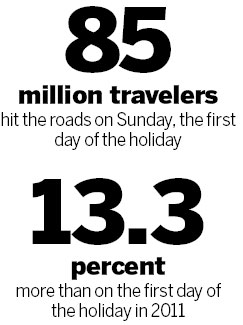
On Sunday, the first day of the holiday, more than 85 million travelers took to the roads, 13.3 percent more than on the first day of the holiday in 2011, according to the Ministry of Transport.
Heavy congestion was reported at various sections of 24 expressways across 16 provinces, caused by accidents and the heavy volume of traffic, said He Jianzhong, a ministry spokesman.
Li Daokui, a renowned professor of economics at Tsinghua University, criticized the toll-free policy in a micro blog post, calling it the most foolish in the world.
He said the move had caused massive traffic jams, and that raising the tolls by 50 percent would have benefited people more.
The extra revenue raised could help to pay for education for poor children in rural areas, suggested Li in his post on Sunday.
The post was forwarded more than 8,300 times, attracting huge attention and sparking debate among China's Internet users.
And while some agreed with Li, others were dismissive of his claims.
One online commentator, writing under the name Xiedaoliu, said on his micro blog that Li's criticism was absurd.
"It's like a family servant suddenly being offered a large feast and getting indigestion after eating too much. It's absurd that he blamed the feast," said the post.
According to Xinhua News Agency, the tolls on China's expressways are among the highest in the world. On average, the toll works out at 1 yuan (16 US cents) for every two kilometers traveled.
If the government abandoned the tolls altogether, travel times would be more flexible because travelers wouldn't have to wait for a specific date to begin their journeys, and would reduce heavy traffic volumes, according to a micro blog comment posted by Renxinxiagu.
A migrant worker in Shanghai, surnamed Chen, said he was devastated to have missed the last chance to see his father, who died on Sunday morning, according to a report on the news portal longhoo.net.
Chen delayed his trip home until Sunday to save the toll of 275 yuan between Shanghai and East China's Anhui province, it said.
"If I had set out immediately when my mother called on Saturday, I could have avoided the traffic and seen my father for the last time," he told longhoo.net.
Many travelers caught in the traffic turned to micro blogs to kill time.
"I won't dare to enjoy the 'free lunch' (the toll-free policy) ever again, after moving just a few kilometers in an hour on the highway," said a post by Liuyufei.
As the traffic jams lengthened, some motorists were seen playing badminton and even walking their dogs on the expressways, according to media reports.
He, the Ministry of Transport spokesman, said that since Sunday China's major expressways have seen heavy volumes of traffic building up as early as 5 am.
The average speed was less than 80 kilometers per hour on major expressways as the number of vehicles rose by between 20 and 50 percent from an average day, he said.
On some sections, accidents further slowed traffic to speeds of less than 20 km/h, he added.
Xiao Ju, an associate professor at Shenzhen University, said that, although the gesture of goodwill would be appreciated, the government should have been better prepared to handle the heavy traffic flow, which had been predicted.
He suggested that the toll-free policy should be extended to public transport to allow more middle or low earners to benefit.
If that were to happen, the average price of a ticket for long-haul buses would be reduced by 10 to 15 yuan, encouraging more people to travel by bus, said Zhang Yongbin, director of the Shanghai Long Distance Bus Station.
Yang Chuantang, the Minister of Transport, told Xinhua that the ministry would try its best to maintain good conditions for travelers.
According to the ministry, about 740 million trips will be made during the holiday, with 660 million of those being made by road and water. That's an average of 82.5 million trips per day, an increase of 8.8 percent year-on-year.
The heaviest traffic flow is expected to occur on the last few days of the holiday.
That prompted the traffic authority in Guangdong province to issue a notice asking travelers to consider using other modes of transport for their return journeys.
The authority also issued tips to those determined to hit the road: Carry sufficient food and water and pack a first-aid kit.
Also motorists should ensure that their car battery is fully charged, along with those of cell phones and other electronic devices, and listen to travel bulletins to avoid becoming caught in heavy traffic.
shanjuan@chinadaily.com.cn