A poacher turned ranger hunts the hunters
 |
|
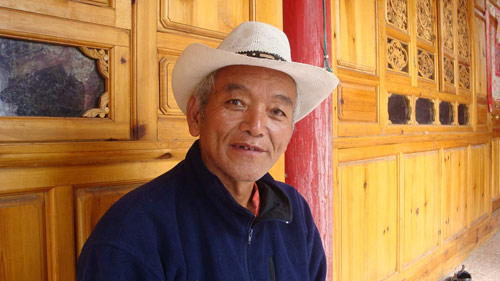
Sinaduji, 66, who used to be a poacher himself, is now the leader of an anti-poaching team in his village at the foot of Kawagarbo, Meili Snow Mountain's highest peak, in Yunnan province's Deqen county. Xiao Xiangyi / China Daily |
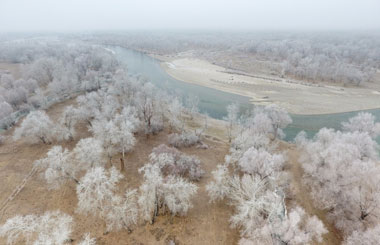
Tibetans in Yunnan province's Deqen county have been relieved to see more gazelles, black bears and dwarf blue sheep running on the Meili Snow Mountain, their altar of pilgrimage, in recent years.
The animals that had almost vanished started to reappear because one person changed his mind.
Sinaduji is the leader of a local anti-poaching team. His name is said to strike fear into local poachers' hearts.
But the wildlife ranger used to be a poacher himself, and is an expert marksman with pinpoint accuracy.
The 66-year-old Tibetan lives in Bucun village at the foot of Kawagarbo, Meili Snow Mountain's highest peak.
At 19, he became the only guard of the credit union for 16 villages and was equipped with a gun. He loved trekking the paths that few had traveled with his gun.
"I can shoot an egg 100 meters away and a cigarette 50 meters away," he says.
"I know exactly how to shoot a red deer running or standing still, up or down the slopes, without shooting twice."
Sinaduji says he had killed about 500 wild animals until one day in 1986 when he encountered a black bear.
He shot the creature eight times, but it just wouldn't die, he says.
"The strangest thing happened," he recalls.
"The bear shrank to nothing."
He claims that, from that point on, any animal he shot turned into an image of him or a puff of smoke.
He became seriously ill.
"The illness of all the animals I'd killed attacked me with hallucinations," he says.
"I was so scared that I sweated day and night. I knew I'd angered the god of Kawagarbo. I knelt and kowtowed for a long time, confessed what I'd done and vowed to stop hunting."
He handed in his gun and shut his hunting dog in the yard.
Sinaduji has been telling this story to villagers to persuade local Tibetans to respect nature as the sacred snow mountain's guardians.
Since he gave up his gun, Sinaduji has supported his family by farming. But they barely scrape out an existence without the supplementary meat from hunting.
In 2001, his daughter Zhuige planted grapevines at the local government's encouragement and sells homemade wine to tourists who visit the remote mountain settlement.
Last month, Sinaduji and 12 fellow anti-poaching teammates finished their third patrol of the year.
The rangers make four five-day rounds a year. "I've got 20 years of hunting experience, so I know exactly where to find poachers. They go where other people don't. I teach my teammates their methods," he explains, showing a map he drew of Meili Mountain's 13 peaks.
The team has dismantled more than 1,200 traps since it was formed in 2005, Sinaduji says.
Deqen county's biodiversity office director Litsinggerong says more than 30 percent of local Tibetan families hunted in the 1990s, but fewer than 3 percent still do.
"Sinaduji and his team have created a much safer living space for endangered animals like snow leopards and river deer," Litsinggerong says.
Sinaduji's team has also saved the forests.
"Last June, a team member found a cigarette left by a woodcutter and prevented a massive fire that could have caused immeasurable losses," Sinaduji recalls.
The team members are volunteers aging 22-66. The Yunnan Green Environment Development Foundation provides a 60-yuan subsidy to every member per day on patrol.
"But we still need support and sponsorship from society," Sinaduji says.
"The equipment we bought ourselves, such as sleeping bags, water filters and walking sticks, are old and worn down. Our efforts are too limited. The snow mountain's glaciers are melting to create vaster migration ranges. I hope more volunteers will sign up, even after I'm dead."
The Tibetan ranger believes the protection of cultural diversity is linked to that of biodiversity.
Sinaduji spends much time poring over historical documents and researching Tibetan classics and folklore.
"I've found people today have many misunderstandings about local culture and folklore," he says.
"As other cultures' impacts grow stronger, I fear our descendents will never know their authentic culture and history."
Sinaduji is working on his first book, Secrets of Kawagarbo, which will be published early next year. It contains Tibetan documents about Kawagarbo from past dynasties and depicts little-known folklores about the Tibetan pilgrimage.
xiaoxiangyi@chinadaily.com.cn