Unseemly behavior
Chinese are said to be the world's second worst tourists, after Americans. Tiffany Tan and Liu Xiangrui find there is some truth to the accusation, but the situation is improving as more Chinese travel abroad.
In September, a flight carrying 200 people from Zurich to Beijing had to turn around four hours into its journey after two Chinese passengers got into a scuffle. According to reports, the trouble started when an intoxicated 57-year-old man slapped a younger man on the head for refusing to put his seat upright while a meal was being served.
"The next thing we noticed, they were both on the floor fighting," Valerie Sprenger, a tourist guide on the flight, told a Swiss news outlet.
A crew member and another passenger restrained the older man, binding his hands and placing him at the back of the plane, where he shouted for an hour, said Sprenger. Upon landing in Zurich, police took both Chinese men into custody, and a local prosecutor fined the aggressor for "undermining the safety of public transport".
The incident, which made headlines around the world, is another blow against Chinese travelers, coming on the heels of a survey on the "world's worst tourists".
The March poll, conducted by the US-based e-commerce site Living Social, found the Chinese to be the second-worst tourists in the world - next only to the American respondents themselves.
The Chinese may not agree about being ranked so high on the list, but they do have an idea of the sentiments that landed them there.
In a micro blog post that has gone viral, one Chinese television executive bemoaned his compatriots' unseemly behavior while getting on a ferry from Singapore to the nearby Indonesian resort island of Bintan.
"The moment the gates opened, everyone scrambled onto the deck," he wrote in an Oct 6 post. "I heard the voices of two foreigners trapped in the crowd. One asked, 'Won't this boat wait for all of us?' The other asked, 'Doesn't everyone have assigned seats?'
"While being pushed forward by the passengers behind me, I pondered these two questions with a bit of bitterness. With tickets already clutched in our hands, what are we so afraid of?"
Efforts to instill better behavior among Chinese tourists have been going on for years. In October 2006, spurred by unflattering media reports on mainlanders visiting the newly opened Hong Kong Disneyland, the Ministry of Tourism issued manuals for foreign and domestic travelers.
The international version, titled Manual on Proper Behavior for Chinese Citizens Traveling Abroad, also sought to address complaints made online.
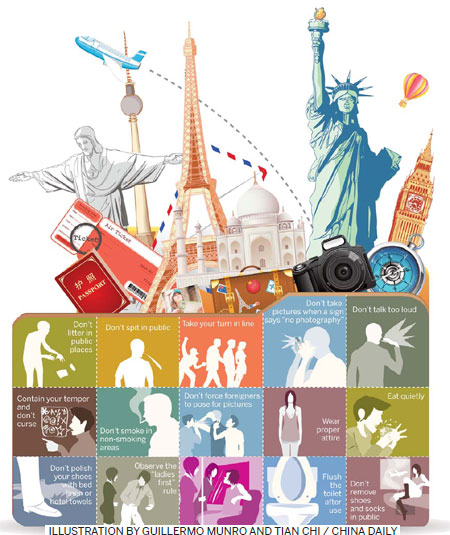
Among its directives are: Maintain personal hygiene (or don't take off your socks or shoes in public). Don't talk too loud. Treat people with courtesy and humility. Wait for your turn in line. Eat quietly. Give way to ladies, the elderly and children. Protect the environment (don't litter, spit on the ground or smoke in non-smoking areas).
The manuals were disseminated to Chinese travel agencies, tour guides, as well as airline ticketing offices.
Now, half a decade later, the Chinese have become some of the most sought-after tourists for their eagerness to see the world - and to shop.
This year, they are expected to take 80 million overseas trips, spending $80 billion in the process, according to the China Tourism Academy. This means one Chinese for every 13 international travelers in 2012.
Their purchasing power has prompted modifications in hospitality and retail industry practices worldwide. Western hotels have begun to supply rooms with a kettle, instant noodles and chopsticks. Some have created Chinese-language websites, added a Chinese menu and provided Chinese newspapers.
Tour operators have incorporated visits to outlet stores into their itineraries, while luxury-goods stores in Europe and the United States have hired Chinese-speaking sales personnel.
But how about your typical middle-class Chinese tourists, how much has their behavior changed in the last several years?
Not much, if you ask Yang Bo, a 37-year-old tour operator from Beihai, Guangxi Zhuang autonomous region, who has been accompanying groups overseas since 2000.
"The thing is, we get so used to certain behaviors that we barely notice them as improper." But Yang says he has also seen how education and travel experience have contributed to better public conduct.
Money can also mean more sophistication and better manners, but sometimes it translates into posturing, like wanting to buy items that are only for display, Yang says.
Liu Jie, 29, a foreign tour leader for four years, is satisfied with Chinese travelers' attitudes toward hotel employees and salespeople, but says they need to show more respect for other cultures.
"Chinese tourists usually show disdain and arrogance for the customs of another country, making me feel ashamed to be their tour leader," the Beijing native says. "My strongest impressions come from their attitude toward public order."
People who have lived in China know that public order is not the mainlanders' greatest strength. Jaywalking is the rule, rather than the exception. Drivers are prone to speeding and swerving. Cars park in bike lanes, leaving cyclists to pedal alongside cars, buses and tricycles.
During rush hour, commuters jostle their way onto buses or subway carriages. Screaming matches between bus drivers and passengers are common. Orderly, single-file lines are a rarity.
Foreigners who have lived in the country long enough have found themselves learning more than just the language, local arts or eating habits. Just ask 25-year-old Ana Ropot, a native of Moldova who is on her seventh year in China.
The graduate student and part-time model and actress experienced the most embarrassing moment of her life during a trip to Sydney this summer.
She was busy texting on her cellphone when she was startled by cars honking and drivers shouting at her. It was only then that Ropot realized she was in the middle of a road, in a no-crossing zone.
"I have never been so embarrassed in my life. And the worst part was that I didn't even bother looking at the traffic light," she says. "I guess I've really been here (China) too long."
Pu Zhengzhang's problem is, he had been away too long. The Beijing child psychiatrist, who lived in the US and Hong Kong for 17 years, says he experienced "culture shock" when he moved back to the mainland in 2009. Besides having difficulty readjusting to local work practices, the lack of consideration among people also bothered him.
The 48-year-old from Nanjing's pet peeves include talking loudly in public, removing one's shoes during a flight and sneezing without covering one's nose. To avoid getting into uncomfortable situations, Pu says he avoids going to places that are "too local".
But he still tries to be considerate in public, like holding doors open, even if people don't appreciate such gestures.
"Even if they don't say 'thank you', I'll just keep on doing that. I don't want to blame this culture. I want to show a good example."
Ultimately, the person we are at home is the person we bring to foreign lands. And in 2006, when the tourist manuals were issued, experts did say it may take several generations to nurture the correct behavior and create a positive image of Chinese tourists.
Contact the writers at tiffany@chinadaily.com.cn and liuxiangrui@chinadaily.com.cn.