Ancient history abounds at virtually every turn in Xi'an
 |
|
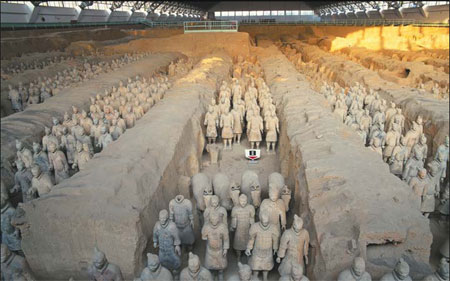
The Terracotta Warriors were discovered by farmers as they dug a well in 1974. Photos Provided to China Daily |
 |
|
The Giant Wild Goose Pagoda Kiran Kumar Pandy / The Kathmandu Post |
With a history of some 6,000 years, Xi'an is the right place for a treasure hunter - along every single step there could be historic relics under your feet, said local residents.
In 1970, construction workers found in the south of the city a large hoard of gold and silverware produced in the Tang Dynasty (618-907). More than 1,000 other relics were excavated later.
Just four years later, local farmers near the city made an even more stunning discovery - the world-famous Terracotta Warriors - when they were digging a well in their field.
Today one of the best-known tourist attractions nationwide and a must-see in the city, the site of the giant underground "army" was actually buried only 5 meters beneath the earth.
Emperor Qinshihuang (259-210 BC), the first emperor of the Qin Dynasty (221-206 BC), believed that he would enter another world after death, so he gave orders to build an army of sculptures, warriors that would protect him in the afterlife.
All of the figures were handmade in the actual size of real people, wagons and horses. With delicate facial expressions, hair and other details, no two are exactly the same.
Archaeologists have so far discovered three vaults with altogether 8,000 terracotta warriors, 130 wagons and 520 horses, but they are just a small part of the entire army. More remain still buried.
 |
|
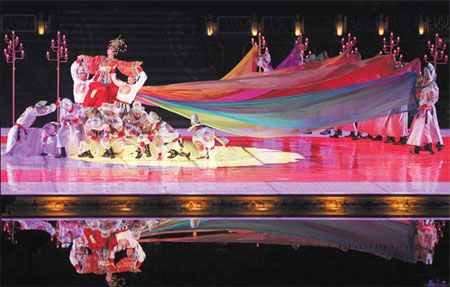
The Song of Everlasting Sorrow is a historical dance drama performed at Huaqing Spring, the site of a pool built by Emperor Li Longji for his favorite concubine Yang Yuhuan. Seah Kwang Peng / The Straits Times |
Ancient metropolis
Located at the very center of the map of China, Xi'an is one of the great ancient capitals, standing alongside Rome, Athens and Cairo in size and significance. It was also the eastern gateway of the Silk Road.
In the seventh century, Xi'an was the world's largest city with a population of more than 1 million. It also had one of the most efficient urban management systems of its time.
Thirteen dynasties across long sweep of the nation's history chose Xi'an as their capital, including the Qin and Han (206 BC-AD 220) empires and the prosperous Tang.
Even today the city has the same layout as the past, a network of roads that stretch strictly from south to north or from east to west like on a chessboard. It is the style typical of capital cities of ancient dynasties including Beijing.
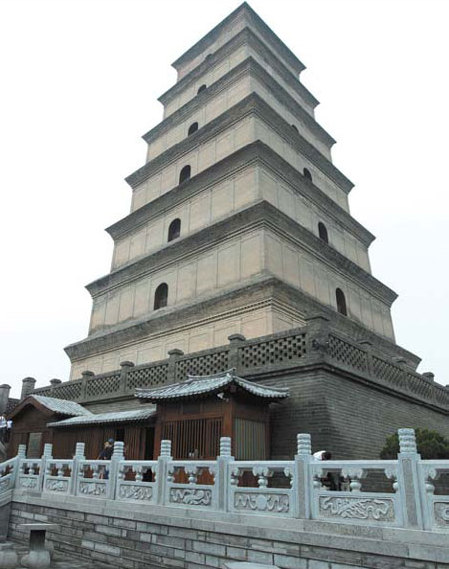
The most famous ancient building in the city is Dayan - Giant Wild Goose - Pagoda, which dates back more than 1,300 years to a time when Buddhism was flourishing in China. The seven-story pagoda is 64.5 meters high built of rammed earth.
One of the pagoda's many functions was to store the sutras and figurines of the Buddha brought to China from India by the Buddhist translator and traveler Xuanzang (AD 602-664).
Surrounding the city center is a 14-kilometer-long, 15-meter-wide wall built in the Ming Dynasty (1368-1644).
It is the best-preserved ancient city wall in China, and one of the largest ancient military defensive systems in the world.
Today the wall serves as a tourist attraction. On a sunny day, travelers often rent bicycles and enjoy riding on top of the wall that separates the city center from the outside.
Local snacks
As famous as the cultural heritage are the city's characteristic local snacks.
With thousands of years of history growing wheat, Xi'an is home to many kinds of flour-based food. Even the simple noodle has different shapes and tastes.
One of them is called biangbiang mian. It is famous not only for its distinctive taste, but also for the name itself - its Chinese name cannot by typed out on a computer. Even the local people need a pithy formula to remember how to write the characters consisting of dozens of strokes.
Another iconic local snack is roujiamo, which looks like a Chinese version of a hamburger. The simple fast food is believed to have been prepared that way for some 2,400 years.
In an authentic roujiamo, the pork inside is stewed for hours in a soup containing more than 20 kinds of spices and seasonings, then minced into fine shreds.
The meat is then stuffed in a mo, a type of flatbread made of wheat flour, and baked in a clay or mud oven.
 |
 |