Behind these walls
Home sweet home
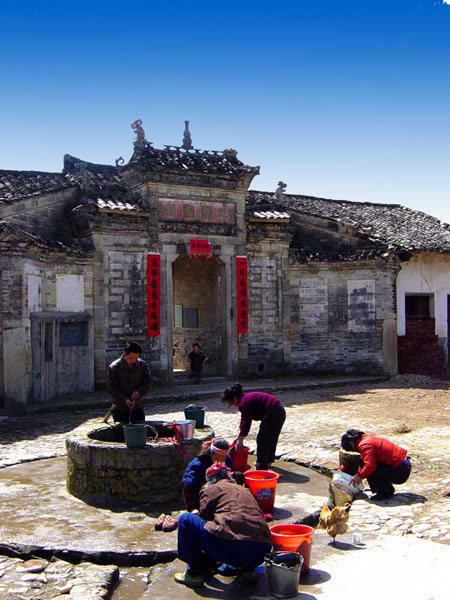
Around 20 households still live within these walls. It is not uncommon to see a resident making the local Hakka snack tang pi, a kind of cracker made with milled rice and Chinese chives.
Li Manyu, 95, sits in the yard and enjoys the sunshine. She has been living in this enclosed house since 1949, after marrying into the Xu family.
Li says the house was not big enough for the whole family so her children moved out. But she refused.
 |
|
Residents are busy around a well in the Wushi Enclosed House in Longnan.[Photo/Provided to China Daily] |
"I have gotten used to the comfort of living here," says the elderly woman. "Although it rains a lot in Guanxi, the house never floods."
"The enclosed houses in the Qing Dynasty were well designed before construction," says Lai Jianqing, a local Hakka culture expert. "But in earlier periods there were houses first, then the fence wall."
The Liyuan Enclosed House in Liren township constructed during the Ming Dynasty is the biggest in Longnan county - six times bigger than the Guanxi enclosed house.
The unusual shape of its outer wall indicates that it was added after the houses were built. It was constructed for defense purposes, Lai says.
The three front doors indicate the house belonged to an official's family. The central door was only used by the landlord and honored guests.
Behind the doors and main rooms is a maze-like area composed of 64 alleys, which was also built for security.
"This enclosed house reflects traditional Chinese culture in the form of architecture," Lai says.
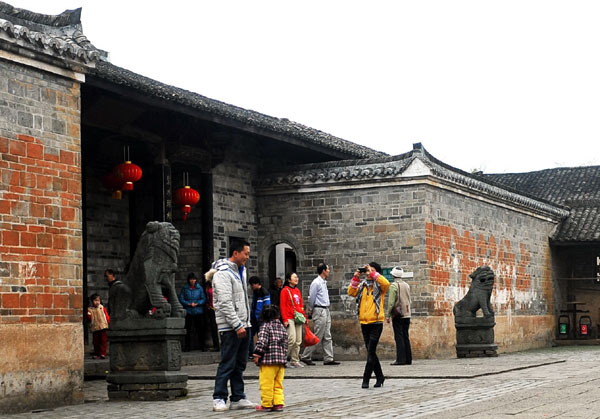
In 2008, the Hakka tulou (earthen buildings) of Fujian province, was declared a World Cultural Heritage by UNESCO. Their international fame has overshadowed enclosed houses, leading many to believe they are all the same.
"The enclosed houses and tulou are both representative dwellings of the Hakka people, but they are different," Lai says, who has been studying Hakka culture and enclosed houses for more than 20 years.
Although both were constructed from the mid-Ming Dynasty, Lai says, the enclosed houses stopped being built during the period of the Republic of China (1912-1949), while tulou continued being constructed until the 1980s. That explains why there are tens of thousands of tulou, but only about 600 enclosed houses, each with a history of more than a century.
Secondly, tulou is built by rammed earth, while enclosed houses are built from masonry.
Thirdly, tulou is usually co-constructed and shared by several families, but every enclosed house is one man's work. Hence, many enclosed houses were named after the builders' surname.
The Xie Family's Enclosed House in Lintang township is the only circular house among all the enclosed houses in Longnan county.
Xie Liangnan, 47, is a third-generation descendant of the man who originally built the house. He has been living in the building since he was born.
"There has never been outsiders living here, only my family members," Xie says.
"Tulou are for commoners and enclosed houses are for the rich," Lai says.
The enclosed houses also have more distinguished military defense capability, Lai says.
They have fewer doors than tulou, and each one has three-layers of wooden doors wrapped in iron sheets.
Most importantly, there are four high fire turrets at each corner of the rectangular wall. Hence "there is no military dead angle".
"No matter if used as a home, a place of ancestor worship or a fortress, the enclosed houses function much better than tulou," Lai says.
|
|
|