Martyrs remembered
 |
|
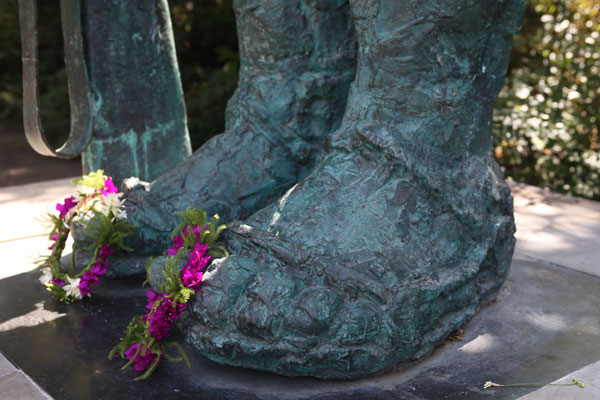
The National Martyr Cemetery has a special meaning to the half a million people living in Tengchong, a county bordering Myanmar in Southwest China's Yunnan province that was the first county in China liberated from occupation by the Japanese army in World War II. |
The cemetery was damaged by the Red Guards during the "cultural revolution" (1966-76) and used as a Party school until the mid-1980s, when it was refurbished and turned into the only cemetery marking the Kuomintang's sacrifice in the frontline battlefield against the Japanese invasion of the Chinese mainland.
"Local people had never stopped visiting the cemetery stealthily - including me - despite the special political environment," says Lu Caiwen, 88, a veteran of the 20th Group Army and a graduate of the Whampoa Military Academy in 1942.
|
|
|
|
"Some of my comrades-inarms are buried there. Sitting near their tombstones, I feel I am with them again. They never get old in my eyes and always remain young just as if it were yesterday."
Most of the famous generals that were victorious in the War of Resistance against Japanese Aggression (1937-45) in Tengchong and Myanmar surrendered to the army of the Communist Party of China during the Chinese civil war from 1945 to 1949.
Their military achievements in Tengchong were largely uncelebrated by the Kuomintang as well as the Communists.
It is a custom for local residents to visit the cemetery not only on important memorial days, but also when they feel they need to attain a kind of inner peace. "Visiting the cemetery for local people is like going to church for Westerners," says Duan Shengkui, a famous local collector of relics from the war. Duan has collected about 87,000 military articles of the Kuomintang, US and Japanese armies from the old battlefields since 1986.
He lives beside the cemetery and has operated a private museum there since 2005.
The county government built a large museum for him beside the cemetery, which opened on Aug 15, 2013, the anniversary of the Japanese surrender to China.
"I am honored to have the museum built near the cemetery and I hope my collection can supplement the visitors' understanding of the Expedition Army that has been long ignored," Duan says.
"I found paper cranes, a symbol of peace, made by primary school students and coins donated by the kids in a rusting helmet with bullet holes, which I exhibited in my private exhibition. I was touched by the children's wish for peace and made up my mind that I should make my collections accessible to more people. Thanks to the government's help, my dream came true."
Both Duan and Lu hope the National Martyr Cemetery can serve as a public reminder to the long forgotten war in Tengchong.
The Japanese army developed a weaponized plague during the war, and the ancient disease was spread among Chinese civilians in Tengchong by infected white mice. It still lingers to this day.
Just like the virus, the trauma of the war is still evident and is felt in the hearts of the local people, says Huang Minghui, a local villager visiting the cemetery on the weekend.
"Learning from history is the best way for both China and Japan to strive for a better future," Lu says. "As cross-Straits ties thaw, the cemetery will win complete recognition from Chinese people and that piece of history."
If you go:
Tengchong is accessible by air from most major cities in China. The cemetery and the new museum are free to visit.
The new museum features more than 22,000 items, including military articles, Willis jeeps, uniforms, conventional weapons, flags, helmets, bayonets, Japanese mustard gas bombs, scalpels, condoms and bacteriological weapons as well as the skulls of two female Kuomintang soldiers who were killed in tropical forests in Myanmar.