Where Shanghai began
 |
|
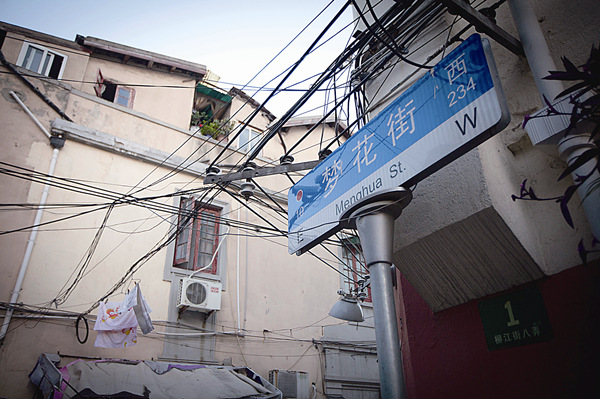
The street has retained much of its original charm.[Photo by Gao Erqiang/Shanghai Star] |
Foreign influence
Longmencun, or Dragon Gate Village, was very famous in Shanghai early last century.
This neighborhood on Shangwen Road with 4-meter-wide alleys is obviously different from the surrounding stone-arched shikumen lane houses, the typical Shanghai-style residential buildings constructed mainly in the early part of the last century. Its fame came from the 76 houses of various foreign styles.
"The garden villas on Xinhua Road and Shaoxing Road are appreciated, but Longmencun is unique. It's the only neighborhood that embraces the architecture of different Western styles in Shanghai," says Chen Weimin, 66, who has lived in the neighborhood, a city-level immovable cultural relic, for more than 30 years.
The gate of the community is an archway stating "Longmencun 1935", which marks the year construction was completed.
It was where Longmen Academy, the former Shanghai High School, was located. In 1932, the school was moved elsewhere and the lane was used to build residential houses.
Capitalists poured in to purchase the land and invited architects to design and build their garden villas.
"The architect first made a plastic model of the house and showed the capitalist by removing the roof to see if he was satisfied. The person who paid decided everything, including where the toilet was placed," says Liu Kun, a 62-year-old resident.
That's how the 76 houses came into being. They include styles from Scotland and Spain and some combining Chinese and Western elements.
"Almost all of the houses have fireplaces, which showed they were the homes of very well-to-do people 80 years ago, and one big family lived in a house. But now there are 13 households living in the three-storey building and we have to share the kitchen,” says Chen, who moved in after the "cultural revolution" (1966-76) when the houses were all confiscated by the government and civilians moved in.
Address: Lane 133 Shangwen Road, Huangpu district